Japanese Story Cubes: Roll, Tell, and Learn New Words in Five Sentences
Story cubes turn language learning into an imaginative adventure. Each six-sided die bears a simple illustration—いぬ (inu, dog), きしゃ (kisha, train), はな (hana, flower)—and when children roll nine cubes, they weave a five-sentence story in Japanese. This playful challenge builds sentence skills, new words, and the thrill of creation.
What Are Story Cubes?
Story cubes are sets of illustrated dice designed to spark storytelling. Players roll the cubes, arrange them in any order, and describe each image with a simple Japanese sentence. For example:
- ねこ が うみ を みる。 (Neko ga umi o miru. The cat sees the ocean.)
- うみ の そば に いぬ が はしる。 (Umi no soba ni inu ga hashiru. A dog runs by the shore.)
This format encourages spontaneous language use and reinforces vocabulary in context.
How to Play
- Roll & Arrange: Shake nine story cubes and place them face-up in a grid.
- Name & Frame: Point to the first image, say the Japanese word and a one-clause sentence—「きしゃ が くる。」 (Kisha ga kuru. The train comes.).
- Connect & Continue: Repeat for each cube, linking ideas: 「きしゃ は とり を のせる。」 (Kisha wa tori o noseru. The train carries a bird.).
- Review Together: Read the full five-sentence story aloud, noticing new words and grammar patterns.
Activities
1. Story Chain Relay
Split into teams. Team A rolls and tells the first two sentences in Japanese. Team B picks up the next two cubes and continues with sentences three and four. Finally, Team A rolls one cube to finish the fifth sentence. This cooperative game builds listening and speaking skills.
2. Emoji Prompt Remix
Add a deck of emoji cards to the cubes. After rolling, draw one emoji—😊 or ⚡—and challenge children to include the feeling or action in their story, e.g., 「びっくりした。」 (Bikkuri shita. They were surprised.)
Practice Corner
Create a “Cube of the Day” station. Each morning, let a child roll three cubes and write—or dictate—a three-sentence mini-story in a notebook, illustrating each line. Display completed pages on a “Story Wall” to revisit new vocabulary.
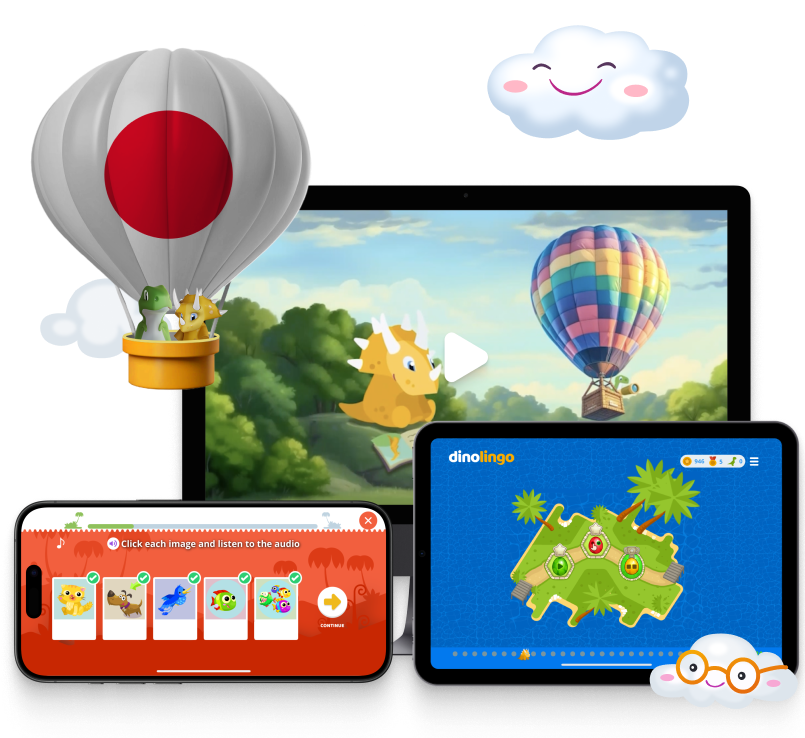
After your dice adventures, open Dinolingo for a vocabulary quiz on the day’s words. One family subscription unlocks 50+ languages and 40 000+ activities—animated story modules, flashcard drills, and surprise badge rewards—organized by age: Pre-readers (2–5), Elementary (6–10), and Tween/Teen (11–14). Parents monitor progress on an ad-free dashboard while kids cement each new term through playful follow-ups.
Final Thoughts
Rolling, narrating, and linking images into a short tale makes Japanese words come alive. Picture-driven stories engage both creativity and speech practice. Pair these dice games with Dinolingo’s interactive follow-ups, and watch your child craft—and confidently speak—their own Japanese adventures.
Sources
- Rory’s Story Cubes – Rory’s Story Cubes
- Tofugu – Review: Japanese Stories for Language Learners
- JALT Publications – Storytelling Activities for ELD in Japanese Preschool
Start Learning a New Language Today!
Best Language App for Kids.
7-day free trial. Then only $19/month. Cancel anytime.