The Finnish Alphabet for Kids: What Makes It So Unique?
Finnish is a fascinating language that sounds as playful as it looks. Although its grammar may be complex, Finnish pronunciation follows clear rules, and the alphabet has some exciting surprises. The Finnish alphabet might look familiar at first glance, but it hides some special twists, and with only a handful of unique sounds it is one of the most organized alphabets for kids to learn. For families raising bilingual children or introducing them to new cultures, learning about the Finnish alphabet can be a fun and educational journey.
The Finnish Alphabet: What Makes It Special?
The Finnish alphabet is based on the Latin script and is very similar to the Swedish alphabet. In fact, Swedish is the second official language of Finland. The standard Finnish alphabet includes 28 letters:
A, B, C, D, E, F, G, H, I, J, K, L, M, N, O, P, Q, R, S, T, U, V, X, Y, Z, Å, Ä, Ö
The letter W is also used in modern Finnish, usually right after V. So you can think of it as the same 26 letters used in English, plus the three extra ones that make Finnish stand out.
What really makes the Finnish alphabet special are the three extra letters at the end: Å, Ä, and Ö. These are sometimes playfully called “ääkköset”, a nickname that tweaks the Finnish word for alphabet, aakkoset. Here is what they do:
- Ä sounds like the “a” in “cat” and is used in many everyday Finnish words.
- Ö sounds like the “i” in “bird” (but rounder), and like Ä it appears in a lot of common words while sounding quite different from plain A and O.
- Å, on the other hand, is used mostly in Swedish and rarely in native Finnish words.
Some letters like Q, W, X, and Z are not traditionally used in Finnish, except in borrowed words, and even B, F, and G usually show up only in loanwords. For example:
- banaani (banana)
- bussi (bus)
Finns love to make words their own by adding an “i” at the end. So do not be surprised if you hear “hotelli” for hotel!
How Finnish Sounds Work
One reason Finnish is fun to learn is that every letter has a consistent sound, and you pronounce every letter. That means once you learn the letters, reading Finnish out loud becomes much easier.
A few key points for kids and parents:
- Short and long letters matter: A single letter makes a short sound (e.g., tuli means “fire”), while a double letter makes a long sound (tuuli means “wind”; tulli means “customs”).
- The main stress is always on the first syllable, though it may sound soft to new learners.
- The famous letters Ä and Ö can be tricky but fun to practice with phrases like:
- Hyvää yötä! (Good night!)
- Hyvää päivää! (Good day!)
Encourage your child to repeat these words out loud and listen carefully for the difference between short and long vowels.
Alphabet Activities for Kids
Once your child knows that each letter has its own steady sound, simple games turn that knowledge into real practice. Here are two easy activities you can try at home:
Letter Match-Up
Print out Finnish letters and pictures of matching items (like aurinko for A, which means “sun”). Let your child match the sound to the image, saying each letter out loud as they go.
Make Your Name in Finnish
Write your child’s name using Finnish letters and teach how each one sounds. Even a familiar name can feel new and exciting when you sound it out the Finnish way.
Easy and Useful Finnish Phrases for Kids
Here are a few simple Finnish words and phrases children can learn:
- Hei! – Hello
- Kiitos! – Thank you
- Moi moi! – Bye-bye
- Kissa – Cat
- Koira – Dog
- Vesi – Water
- Hyvää huomenta! – Good morning
- Anteeksi – Sorry / Excuse me
Children love saying short, rhythmic words, and Finnish offers many of those. You can also label household items or draw flashcards to help reinforce new vocabulary.
Learning Finnish with Dinolingo
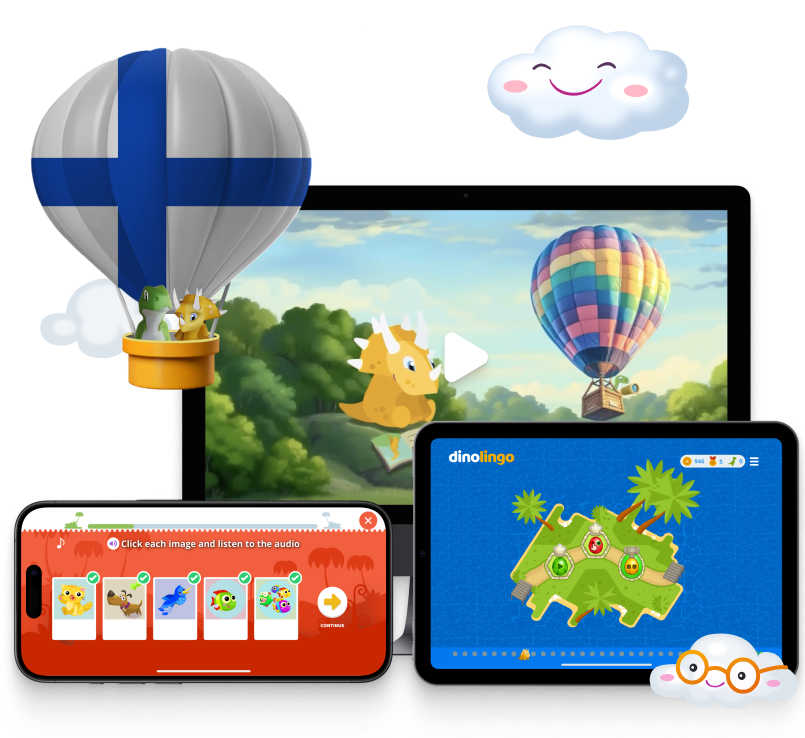
Learning Finnish does not have to be hard or boring. With Dinolingo, kids can explore the Finnish language through interactive stories, songs, games, animated videos, and printable worksheets. Children hear each letter in context and start connecting letters to real-life words. Dinolingo supports children aged 2 to 14 and is available on the web, iOS, and Android. The platform also includes offline flashcards, drawing activities, a fun reward system, and a parent dashboard so you can follow your child’s progress, making learning fun, easy, and screen-free when you need it to be.
Source: