Where in the World Do People Speak Creole?
Creole languages are spoken far beyond Haiti! From islands to continents, millions of people speak different versions of Creole every day. Kids learning Haitian Creole might be surprised to find how many countries share this special language family. In this guide we will travel the globe to meet the many Creoles, discover how they were born, learn why Haitian Creole sounds like a song, pick up easy spelling tricks, celebrate Creole festivals, and find playful ways to teach children Creole at home.
Creole Around the Globe
There isn’t just one Creole. Creole languages exist all over the world, from the Caribbean to Africa to Southeast Asia. They all started in similar ways, but each one is unique. For kids, it’s like unlocking a treasure chest of languages that share a family tree. Here are some of the places where Creole languages are spoken every day:
- Haiti – Haitian Creole is the most widely spoken, used by nearly all Haitians.
- Louisiana, USA – Louisiana Creole is part of local culture.
- Mauritius – Mauritian Creole is the main spoken language.
- Seychelles – Seychellois Creole is spoken across the islands.
- Cape Verde – Cape Verdean Creole is common on every island.
Each version of Creole sounds a little different, but they all grew from the same idea: people creating a shared language to connect with one another. Every version tells a story of how people came together and built something new.
From One to Many: The Amazing Journey of Creole Languages
Hundreds of years ago, people from many different cultures were brought together, often through colonization and trade. They needed ways to talk to one another, so they created simple, shared languages from bits of others. Over time, these “contact languages” developed into full languages called Creoles.
Each Creole has its own grammar, pronunciation, and local flavor. Some are based on French, others on English, Portuguese, or Spanish. Haitian Creole, for example, has French roots with African and Caribbean influences. By learning Haitian Creole, kids are joining a global story, one filled with courage, culture, and creativity.
Creole Isn’t Broken French: Here’s Why It’s Special
Many people assume Haitian Creole is just a version of French, but it’s actually a full, living language with its own sounds, grammar, and spirit. For kids learning Creole, it’s important to know: this language is all its own!
What Makes Creole Different from French?
While Haitian Creole developed from French roots during colonial times, it grew into something unique. Creole has simpler grammar, a different sound system, and lots of influences from African languages, Spanish, and Taino words. For example:
- Li ale – He/She goes (Creole)
- Il va – He goes (French)
Both mean the same thing, but they sound and look different! Haitian Creole reflects identity, pride, and joy, and it’s easy for kids to speak clearly and confidently. It’s how families talk at home, sing songs, and tell stories. Creole is not a shortcut to French, it’s a full and special language that celebrates culture, creativity, and connection.
Why Creole Sounds Like a Song
Ever notice how some languages seem to dance when they’re spoken? Haitian Creole is one of them! Its rhythm, tone, and expressions make it sound like music, and that’s one of the reasons kids love learning it. Creole isn’t just about words, it’s about flow. Sentences often rise and fall like a melody, because Creole is full of:
- Repetition
- Expressive vowel sounds
- Natural, smooth phrasing
Even simple phrases like “Kijan ou ye?” (How are you?) have a musical quality when spoken aloud. Kids love to sing, chant, and play with sounds, and Haitian Creole gives them a way to do that while learning. Its natural rhythm helps kids remember phrases and boosts their confidence. Try these melodic words and phrases:
- Bonjou – Good morning
- Mwen renmen ou – I love you
- Map boule – I’m doing great (literally: I’m burning!)
Creole Spelling Is Easy (If You Know These Tricks!)
At first glance, Haitian Creole may look unfamiliar, but once kids understand the simple spelling rules, reading and writing becomes a breeze! In fact, Creole spelling is often more consistent than English. Unlike English, where the same letters can sound different in every word, Haitian Creole is phonetic. That means words are mostly spelled the way they sound. If you can say it, you can write it! Here are a few tips that help:
- The letter “j” is pronounced like the “s” in measure
- The letters “ou” sound like oo in “food”
- The letters “ch” sound like sh in “shoe”
Try sounding out these sample words:
- jou – day
- chen – dog
- zanmi – friend
Creole Festivals Full of Music and Color
Haitian Creole is a language full of life, and there’s no better way to see it in action than during festivals! From music and costumes to dancing in the streets, Creole celebrations are joyful, loud, and unforgettable. Carnival in Haiti is the country’s biggest festival, a time when the whole country sings, dances, and celebrates. Kids wear colorful costumes, musicians play drums and horns, and everyone takes part in parades. During Carnival, you’ll hear lots of Creole phrases like:
- Ann danse! – Let’s dance!
- Mwen kontan! – I’m happy!
- Bel bagay! – Beautiful things!
Other fun holidays where Creole comes alive include:
- Fet Gede – A lively festival honoring ancestors
- Independence Day (Jan 1st) – Celebrated with traditional food and proud Creole phrases
These are perfect chances for kids to connect language with rhythm, food, and joy.
Best Methods to Teach Children Creole
Helping your child learn Creole can be a joyful, bonding experience filled with games, stories, songs, and cultural exploration. Here are practical, age-appropriate methods for weaving Creole into everyday life, perfect for children ages 2 to 14.
Begin with Books and Storytelling
Read fairy tales and storybooks in Creole together. Choose titles with vivid illustrations and ask questions like “What do you think is happening?” or “What might this word mean?” Encourage your child to act out their favorite parts, change endings, or create their own versions using their imagination. A children’s picture dictionary or a basic alphabet book in Creole is ideal for building vocabulary and understanding the written form of the language.
Use Puppets, Plush Toys, and Talking Posters
Create simple puppets or use your child’s favorite plush toy as a Creole-speaking character. Puppet shows help with fine motor skills and allow children to express themselves while hearing and speaking new vocabulary. Decorate your child’s room with colorful learning posters, and try toys that speak or sing in Creole to build vocabulary in context.
Turn Everyday Outings into Vocabulary Practice
Before a zoo trip, explore animal books in Creole. During the visit, name animals aloud and add adjectives and colors. Afterward, draw animals and talk about them using Creole phrases. You can make any moment playful: count in Creole during hide and seek, starting with 1 to 10, then counting backward to repeat vocabulary without it feeling like repetition.
Play Games, Songs, and Cartoons
Use games like Snakes and Ladders or memory games with Creole vocabulary. Flashcards are great for matching sounds, pictures, or actions: lay cards out and take turns being the caller. Listen to children’s songs and catchy pop tunes in Creole, adding hand motions or dance moves to help with memory, and hold a fun “song night” for the family. Find Creole-language cartoons on YouTube or build playlists with songs and craft tutorials, then let your child guide the selection during family learning time.
Track Progress and Offer Rewards
Set clear language goals and celebrate each milestone. Use sticker charts and offer praise for every word or phrase your child masters. Break bigger goals into smaller monthly steps with a simple checklist, and follow a simple syllabus so children know what’s next and feel secure. Celebrate progress with certificates, congratulatory messages in Creole, or a mini celebration.
Add Worksheets, Crafts, and Movement
Many websites offer Creole worksheets and printable flashcards. Kids enjoy coloring, tracing letters, or playing matching games. Encourage movement-based learning through crafts, dancing, dress-up games, or drawing, using Creole words to describe colors, actions, and feelings. Let your child create a personalized learning notebook for drawings, new words, and stickers to share with family or display at home.
Encourage Real-Life Use and Cultural Immersion
Arrange playdates with other Creole-speaking children, and let your child video chat with relatives or friends who speak Creole. Involve grandparents or part-time caregivers who can converse in the language. Cook Creole dishes together and describe each step in Creole, visit Creole supermarkets and restaurants, and explore the Creole Ministry of Culture’s website, local libraries, and cultural centers to discover food, holidays, music, and traditions together. Choose a “word of the day” and use it throughout your routine, from driving to mealtime to bedtime stories.
Join Communities and Classes
Connect with other families learning Creole through forums, Facebook groups, or blogs, where sharing tips helps everyone stay motivated. Incorporate digital tools like Spotify playlists, online radio, or reading pens to reinforce listening and speaking in a passive, engaging way. For more structure, consider short online lessons, tutoring, or local and virtual language camps that mix learning with fun and culture.
Why It Matters for Kids
Learning Haitian Creole helps kids see that they’re part of a global community. Whether someone is in the Caribbean, Africa, or the U.S., they might be using Creole to tell stories, sing songs, or greet a friend. By learning Haitian Creole, kids not only gain a language, they connect to a world of voices and cultures.
Fun Learning Ideas to Try at Home
Here are a few hands-on activities that bring everything together, from geography to spelling to celebration:
- Creole Country Flags: Print out the flags of different Creole-speaking countries and learn how to say “hello” in the Creole version spoken there.
- Creole Connections Map: Use a world map to draw lines between Haiti and other Creole-speaking places, and talk about what makes each one unique. Mark each spot with pictures or stickers.
- Language Family Tree: Draw a tree and write different Creole names on the branches, connecting them back to the roots (French, English, Portuguese, and more).
- French vs. Creole Match-Up: Write simple phrases in French and Creole on separate cards, then mix and match them to see the differences.
- Creole Storytime: Have kids listen to or create a short story using Creole words they know, like “zanmi” (friend) or “lakay” (home).
- Build-a-Word Cards: Create letter cards and have your child spell out Creole words. Say the word together first, then build it.
- Sound It Out Game: Say a Creole word and let your child guess the letters that go with each sound, starting with words like “manje” (eat) or “solèy” (sun).
- Creole Song Time: Find a simple Creole song or rhyme, clap along to the beat, and sing the words together. Then play the “Say It Like a Song” game, repeating short phrases in your own song voice.
- Creole Costume Parade and Rara Band: Make simple costume pieces and homemade instruments like cans and shakers, then parade and play to the beat while shouting Creole phrases.
Learn Haitian Creole with Dinolingo
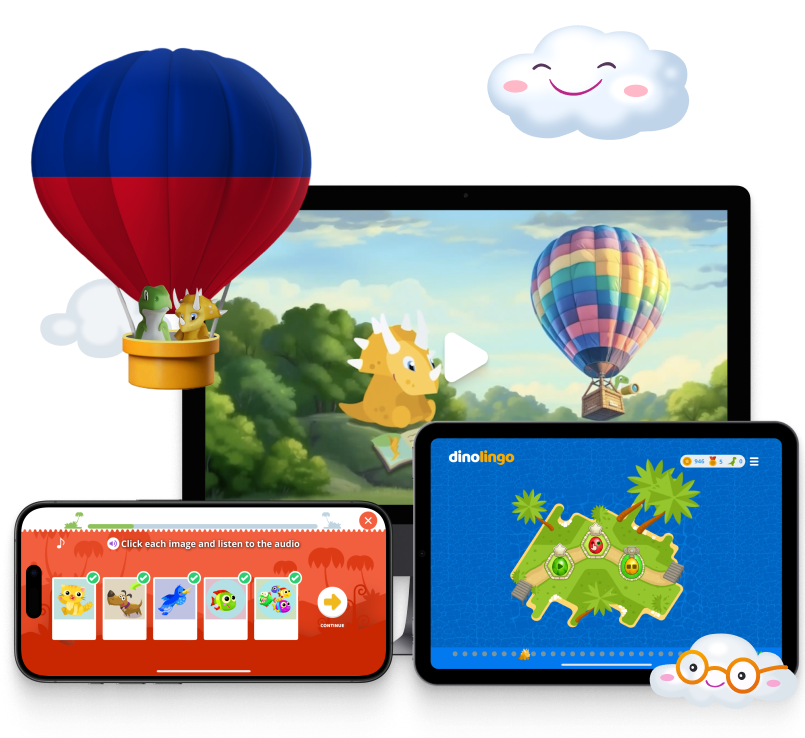
Dinolingo’s Haitian Creole program helps kids ages 2 to 14 start their journey with fun, hands-on tools. With songs, games, storybooks, worksheets, flashcards, and interactive videos, learning feels like play. Young learners can hear native Creole speakers, sing along with upbeat songs, practice real-life pronunciation, and pick up vocabulary and spelling naturally and without stress.
The platform works on iOS, Android, and web browsers and supports both online and offline learning with printable materials. It also includes a parent dashboard, gamified rewards, and support for up to six users on one subscription. By learning Haitian Creole, kids not only gain a language, they connect to a world of voices and cultures. With playful methods and consistent exposure, your child can grow confident in speaking and understanding Creole while having fun along the way!
Sources