Popular Romanian Names for Kids: What’s in a Name?
Have you ever wondered what names children in Romania usually have? Romanian names are full of meaning, history, and tradition, and they are fun to explore! Names are just the beginning, though. Behind every Romanian name is a whole world of history, language, folktales, costumes, places, and games waiting to be discovered. This guide takes you on a tour through all of it, with plenty of words to learn and fun activities for kids ages 2 to 14 along the way.
What Romanian Names Tell Us
One Child, Two Names?
Romanian kids often have more than one first name, but they usually only use one of them in daily life. For example, if a girl’s name is Maria Ioana, her family and friends will most likely just call her Maria. They don’t shorten names into nicknames like “MJ” or “MI” as you might in English.
Girl Names Usually End in “A”
Want to guess if a Romanian name belongs to a girl? Most girl names end in “a.” Names like Maria, Elena, Ana, and Ioana are very common, and very beautiful!
Where Do These Names Come From?
Many names in Romania come from Romanian Orthodox saints, since religion plays an important role in naming traditions. For boys, names like:
- Ioan (John)
- Andrei (Andrew)
- Alexandru (Alexander)
- Vasile (Basil)
- Gheorghe (George)
are very popular. For girls, names like:
- Maria
- Elena
- Ana
- Ioana
are commonly used.
Names from History and Mythology
Some names go way back in time! Boys may have names like Traian or Octavian, which are Roman in origin. Girls may be named Andrada or Meda, names that come from Dacian roots, a culture that lived in Romania thousands of years ago. Romanian names tell stories about family, faith, and history. It is like carrying a little piece of the past with you, and that past is exactly where our journey begins.
From Dacia to Dracula: The Story of Romania
Ever wondered how Romania became the beautiful country it is today? Let us go on a historical adventure, one filled with brave warriors, clever leaders, and exciting battles!
Long Ago: The Land of Dacia
Our story begins in ancient times when the land we now call Romania was known as Dacia. It was home to strong tribes, ruled by a leader named Decebal. But they had a powerful neighbor: the Roman Empire.
The Romans wanted to conquer Dacia, and after two big battles, they took control of part of it. Many Romans moved there, built cities, and stayed for years. This is when the Romanian language and people began to form, mixing local traditions with Roman culture.
Barbarians, Battles, and Brave Rulers
After a while, barbarian tribes came to take the land. The Romans left Dacia, and the land got split up. Over time, it became three separate regions, called principalities:
- Wallachia
- Moldavia
- Transylvania
Then came a famous ruler: Vlad Dracul. He ruled Wallachia and fought against the powerful Ottoman Empire, protecting his land from invasion.
Michael the Brave and the First Union
Later, a leader named Mihai Viteazul (Michael the Brave) dreamed of uniting the three principalities. And guess what? He did it! But only for a short time. After he died, the regions separated again. Still, the dream to unite Romania never faded.
A Step Closer: Alexandru Ioan Cuza
Many years later, another hero appeared: Alexandru Ioan Cuza. He managed to unite Wallachia and Moldavia into one country. It was a big step toward building modern-day Romania.
The Final Union After World War I
After World War I, something amazing happened. The third principality, Transylvania, joined the others. A prince named Carol I, from the Hohenzollern royal family, became the first king of a united Romania. Finally, all Romanians were together!
Romania Today
Today, Romania is no longer a kingdom. It is a republic with a president, just like the United States. But its rich history is still remembered with pride. And what does history teach us? That unity and peace help people live better. When there is peace, children can learn, play, and grow, and history becomes just another fascinating story to explore.
The Romanian Language: Letters, Latin, and Special Sounds
That Roman past lives on most clearly in the language itself. Romanian might sound mysterious at first, but it actually has a lot in common with French, Italian, and Spanish. That is because Romanian comes from Latin, the ancient language spoken by the Romans, and that Latin connection makes many words easier to recognize and remember.
Latin Is Hiding in Everyday Words
Even if a child has never studied Latin, they may already know similar words from English or other Romance languages. For example:
- mamă (mother) comes from Latin mamma
- lup (wolf) comes from lupus
- lumină (light) comes from lumen
These connections make Romanian feel familiar even for beginners. It is like unlocking a secret code! When kids learn that one root word can connect to many languages, they feel more confident. It builds their vocabulary and helps them guess new words based on patterns. You can even draw a language family tree showing Romanian, Spanish, French, and Italian as branches from Latin, then add example words on each branch to compare. For a quick game, give kids Romanian words with Latin roots and let them guess the English meaning, or the other way around.
Why Romanian Letters Look So Unique
If you have seen Romanian written out, you might have noticed some unusual letters like ă, ş, and ţ. These special characters give Romanian its unique sound and identity. Romanian uses the Latin alphabet, just like English, but with a few important extras:
- Ă ă sounds like “uh” (as in sofa)
- Ş ş makes the “sh” sound (like in shoe)
- Ţ ţ makes the “ts” sound (like in pizza)
- Â â and Î î both sound like a deep “uh,” used in different parts of words
These letters help make Romanian pronunciation clear and consistent. Once kids get the hang of them, reading becomes much easier! Children can learn these characters through games, songs, and visual repetition. Younger learners can start by matching letters to sounds, while older kids can practice reading and writing them in simple words. Try a Letter Sound Hop: make flashcards with the special letters, say a sound, and have kids hop to the right card. Or try Alphabet Art, where kids turn letters like ş or ţ into fun creatures and say the sound each time they draw.
Cultural Words, Idioms, and Folk Costumes
Beyond the alphabet, Romanian is rich with words that carry whole stories inside them. Language is more than just words: it is a way to connect with the past. Many everyday Romanian words come from traditional village life, nature, and cultural customs, offering children a colorful window into the country’s heritage.
Old Ways, New Words: Cultural Vocabulary
Some Romanian vocabulary is inspired by the natural world and traditional ways of living. Here are a few great examples:
- plai – grassy hillside (often used in poetry or songs)
- cămin – home or hearth
- poveste – story or tale
- horă – a circle dance performed at festivals
- gospodar – someone who takes good care of the household or farm
These words are not only beautiful, they come with feelings, images, and stories that make learning more meaningful. When children learn words that reflect real life, it helps them build a stronger emotional connection to the language. Cultural vocabulary also teaches values like family, community, and respect for nature. Try a Word and Story Time activity: introduce one cultural word each day and tell a short story around it, then let kids draw or retell the story. Or set up a Tradition Treasure Hunt, showing pictures of traditional objects and customs for kids to match with the right Romanian word.
Old Sayings, New Meanings: Romanian Idioms
Like many cultures, Romania has a treasure chest of wise, funny, and sometimes confusing sayings. These old phrases, called idioms, are still used today, and kids love how strange and silly they sound! Here are a few kid-friendly examples:
- A călca pe bec – “To step on the lightbulb” (meaning: to make a mistake)
- Are un morcov – “He has a carrot” (meaning: he is nervous)
- Se uită ca mâța-n calendar – “She is looking at the calendar like a cat” (meaning: totally confused!)
These expressions are full of character. They often come from village life, nature, or funny observations. Idioms help kids feel like insiders in a new language. They go beyond basic words and into how people really talk, plus they are fun to act out or guess the meaning of. Play Guess the Meaning by saying a silly idiom and letting kids draw or guess what it means, then reveal the real meaning. Or play Sayings Charades, acting out an idiom like “stepping on a lightbulb” to see if others can guess the Romanian phrase.
Folk Costumes and Colorful Words
Romania is full of color, and nowhere is that more clear than in its traditional folk costumes! Worn during festivals and dances, these beautiful outfits tell stories about Romania’s villages, history, and values. Each region in Romania has its own patterns and styles. For example, the ie (pronounced “ee-eh”) is a traditional embroidered blouse worn by women. It often features bright red or blue thread and patterns that represent nature, family, or protection. Children might also see items like:
- cojoc – a sheepskin vest
- opinci – leather sandals with ties
- brâu – a woven belt tied at the waist
These words are fun to say and even more fun to act out with costumes or crafts! Folk costumes help children learn colors, materials, and body-related vocabulary such as sleeves or buttons, connecting language to real-life images and emotions. Cultural visuals are especially helpful for younger learners ages 2 to 10 who are still building word associations. For a hands-on activity, give kids a drawing of a blank shirt and let them design their own “ie” embroidery patterns while you teach the names of colors and shapes in Romanian. Or set up Dress-Up Dialogues, using cutouts or doll clothes to build traditional outfits while kids role-play simple greetings or songs.
Romanian Myths and Folktales
Romania has a rich tradition of storytelling, filled with dragons, talking animals, and clever heroes. These tales are not just entertaining, they are also a wonderful way for kids to learn Romanian naturally through magical words, simple sentences, and vivid imagery.
Dragons, Princes, and Magic Words
When kids listen to Romanian fairy tales, they are hearing everyday vocabulary in action, plus fun new words like zmeu (dragon), prinț (prince), or fermecat (enchanted). These words stick because they come with action, emotion, and visual meaning. Many Romanian folktales are also repetitive, which helps kids remember the structure of the language. They hear how sentences flow and how characters talk, all while enjoying the adventure. Young learners love listening and repeating short phrases, while older kids can follow along with subtitles or retell the story in their own words. After reading a tale, kids can make a Folktale Puppet Show, creating puppets for the characters and acting out favorite scenes. Or try a Magic Word Hunt: write down fun Romanian words from a story, then have kids shout “found it!” when they hear one during reading time.
From Miorița to Strigoi
Romanian stories are not just about princes and castles, they are also full of mystery, magic, and meaningful lessons. Miorița is one of Romania’s most famous ballads. It tells the story of a shepherd, his loyal sheep, and a quiet reflection on life and destiny. While poetic, it also teaches important values like peace, courage, and trust. The Strigoi are spooky creatures from Romanian folklore, restless spirits that return from the grave. These legends may sound scary, but many are told with humor and curiosity, making them great for older kids who love mysterious tales.
Myths are rich in symbolic language and repetition, which makes them easier for kids to remember. They also spark the imagination, helping learners connect words to strong images and emotions. After learning about Strigoi or forest spirits, kids can do Myth Mask Making, creating their own masks and describing their creature in Romanian. Inspired by Miorița, kids can also write or draw a Sheep’s Secret Message using simple Romanian words and symbols.
Let Us Play: The Game of TOMANAP
Looking for a fun and smart way to help your child learn Romanian vocabulary and geography at the same time? The traditional game TOMANAP is a great way to practice language skills while having fun with friends or family. TOMANAP is a classic Romanian game played by 3 to 6 children. The name comes from the first letters of each category players need to fill in:
- T – Țară (Country)
- O – Oraş (City)
- M – Munte (Mountain)
- A – Apă (Water source like river, lake, sea)
- N – Nume (Name of a person)
- A – Animal (Animal)
- P – Plantă (Plant)
To play, pick a letter of the alphabet, for example the letter “F.” Each player writes down one word in each category starting with that letter, such as Țară (Country): France, Oraş (City): Frankfurt, Munte (Mountain): Făgăraş, Apă (Water): Fiji River, Nume (Name): Felix, Animal: Fox, and Plantă: Fern. When one player finishes, they yell “STOP!” and everyone must stop writing. Then players compare answers and give points: 10 points for a correct and unique answer, 5 points if two players write the same answer, and 0 points for a blank space or wrong answer.
Kids love TOMANAP because it is fast and exciting, great for vocabulary building, encourages thinking and writing in Romanian, boosts geography knowledge, and is perfect for car rides, classrooms, or game nights. You can even create your own categories like “Fruit,” “Color,” or “Famous Person” for extra fun!
Famous Romanian Places to See
Romania is filled with amazing places to visit! From mysterious castles to mountain roads full of twists and turns, there is so much to explore. Whether you are learning about Romania at home or planning a visit someday, these famous locations are fun and exciting for kids to learn about. Romania really has it all: majestic mountains, peaceful valleys, sandy beaches, and rich cultural history.
The Carpathian Mountains: The Heart of Romania
The Carpathian Mountains are even longer than the Alps and cover much of Romania! They are divided into four parts: Western, Forests, Eastern, and Southern Carpathians. People call them “the heart of Romania” because they are full of forests, rivers, wild animals, and amazing views. Families can enjoy hiking trails in summer or skiing down snowy slopes in winter. You can even spot rock formations shaped like animals or faces, including the mysterious Sphinx and “Babele” (which means “old ladies” in Romanian), perfect for sparking a child’s imagination. Along the way, you will find peaceful lakes, waterfalls, and even bubbling mud volcanoes that spit out muddy water!
The Danube Delta and the Black Sea
The Danube Delta is one of the biggest river deltas in Europe! It has lakes, marshes, and more than 300 species of birds. You can also find 45 different types of fish here, plus swans, pelicans, raccoon dogs, and more. It is one of the best places in Europe to see rare birds and animals in their natural habitat, and a great place to learn about wildlife and water ecosystems. Just south, Romania’s Black Sea coast offers 12 fun-filled beach resorts with warm sand and gentle waves.
Bran Castle: The Legendary Home of Dracula
Have you heard of Dracula? Bran Castle is believed to be his home! It is located 30 kilometers from Braşov and is one of the most visited places in Romania, especially around Halloween. Tourists from around the world come to explore its mysterious halls, towers, and hidden staircases. Although the real Vlad Dracul may not have lived there, the castle captures the imagination of children and adults alike.
Peleş Castle: A Royal Treasure
Peleş Castle is one of the most beautiful castles in Europe. Built between 1875 and 1883, it was the dream of King Carol I. The castle has over 170 rooms, but only 10 are open to the public. Inside, you will find treasures like paintings, jewelry, statues, gold and silver dishes, and so much more!
The Transfăgărăşan Highway: Romania’s Most Twisty Road
The Transfăgărăşan is a mountain road that climbs the Făgăraş Mountains, home to Moldoveanu Peak (2,544 meters), the highest point in Romania! The road is famous for its tunnels, viaducts, sharp turns, and views of Bâlea Lake, a beautiful glacial lake. Because of the curves, cars drive slowly, but the views are worth it!
Bucovina: The Land of Painted Monasteries
Bucovina, in northern Romania, is famous for its beautiful monasteries with colorful painted walls. Some of the most famous are Suceвița, Moldovița, Voroneț, and Humor. Families can stay in cozy hotels, guesthouses, or even traditional farmhouses. From peaceful countryside to legendary castles, Romania is not just a place to visit. It is a place to explore, imagine, and learn.
Fun and Engaging Ways to Teach Romanian to Kids
With all these names, words, stories, and places to explore, how do you bring it together at home? Helping your child learn Romanian can be a joyful and enriching experience! With interactive activities and consistent exposure, you can foster a love for the Romanian language in fun and creative ways. Here is a set of ideas to support children aged 2 to 14 in learning Romanian naturally and enjoyably.
- Read together in Romanian. Find fairy tales and storybooks online or at your local library, look at the pictures together and talk about them, use different voices for different characters, and encourage your child to retell or change the story.
- Use puppets and toys. Turn plush toys into Romanian-speaking characters, act out favorite stories or sing songs, and build a puppet theatre from a cardboard box.
- Visit the zoo and speak in Romanian. Learn animal names before the trip, point and say them aloud, add colors and adjectives, then draw and describe the animals at home.
- Play games in Romanian. Try hide and seek with Romanian numbers, board games like Snakes and Ladders for counting, and flashcard games such as Memory or Go Fish.
- Use flashcards and progress charts. Teach vocabulary through images and repetition, match sounds to words, and track progress with sticker charts and praise words in Romanian.
- Enjoy songs and cartoons. Listen to children’s songs at home or in the car, use actions to help memory, and watch age-appropriate Romanian cartoons, letting your child pick favorites.
- Try online resources and tools. Build a Romanian playlist on YouTube, explore interactive games, set up video calls with native speakers, and join online language support groups.
- Set clear learning goals. Make monthly or annual checklists, set mini-goals for vocabulary, grammar, or comprehension, and celebrate achievements with rewards.
- Explore Romanian culture. Visit cultural centers and festivals, go to Romanian supermarkets or restaurants and talk about the food, and browse the Romanian Ministry of Culture website together.
- Get crafty and creative. Do traditional Romanian crafts, draw or paint while discussing the process in Romanian, and decorate learning areas with the alphabet, numbers, or flag.
- Use worksheets, books, and DVDs. Try beginner worksheets, Romanian-language kids’ DVDs, and children’s picture dictionaries and alphabet books.
- Build daily routines in Romanian. Speak Romanian during cooking or getting dressed, start a “word of the day,” and keep a notebook for words and drawings.
- Create social opportunities. Arrange playdates with Romanian-speaking children, video call family and friends, and encourage grandparents or caregivers to speak Romanian.
- Try camps and professional support. Enroll in a Romanian summer camp, consider a Romanian-speaking babysitter or tutor, and connect with families raising bilingual kids.
The key to teaching Romanian is to make learning part of your child’s everyday life. Whether you are singing a song, reading a bedtime story, or cooking a meal together, each activity can turn into a language moment. Keep the experience fun, encouraging, and consistent, and enjoy the journey of learning Romanian together!
Learn More with Dinolingo
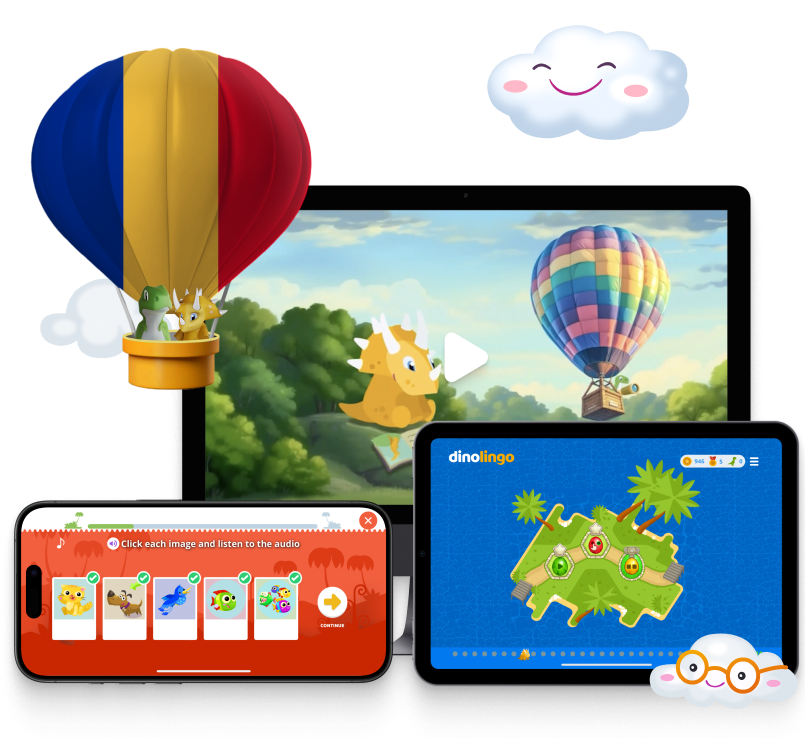
Want to explore more Romanian names, words, and traditions? With Dinolingo, kids can:
- Watch fun Romanian videos
- Sing along with traditional songs
- Practice new words with flashcards and games
- Discover culture through stories and activities
- Use the program on any device: web, iOS, or Android
- Share one subscription with up to 6 users
Whether your name is Maria, Andrei, or something totally different, learning Romanian with Dinolingo makes every child feel at home!