Say Hello to Your Hebrew Family: Words for Relatives Made Easy
Family words are among the first that kids use in any language. Learning how to say mom, dad, sister, and more in Hebrew helps kids talk about people they love and makes learning feel personal and familiar. This guide starts with the people closest to your child, then grows outward into greetings, feelings, favorites, food, colors, weather, holidays, and the sounds and dots that make Hebrew its own beautiful language. Use it as one big map for early Hebrew, and pick the section that fits the moment.
Common Hebrew Words for Family Members
Start with the words your child already says all day long in English. These ten family titles are the warm, familiar heart of early Hebrew.
- אמא (Ima) – Mom
- אבא (Abba) – Dad
- אח (Ach) – Brother
- אחות (Achot) – Sister
- סבתא (Savta) – Grandma
- סבא (Saba) – Grandpa
- בן (Ben) – Son
- בת (Bat) – Daughter
- דוד (Dod) – Uncle
- דודה (Doda) – Aunt
Activities to Practice Family Words in Hebrew
Family Tree Craft. Draw or print a tree and add labeled photos or drawings of family members with their Hebrew titles.
Who’s Who? Game. Show pictures and ask “מי זה?” (Mi zeh?) which means Who is this? Answer with Hebrew family names.
Story Time Swap. Read a story about a family and swap English names for Hebrew ones while reading aloud.
My Family Poster. Have kids create a poster with drawings of their family, labeling each member in Hebrew.
Saying Your Name and Meeting New Friends
Once kids can name the people they love, the next step is introducing themselves to new ones. Saying your name and greeting others is one of the first and most useful skills in any language. With a few friendly Hebrew phrases, kids can start conversations, make friends, and feel more confident speaking Hebrew every day.
- שלום! (Shalom!) – Hello!
- איך קוראים לך? (Eich kor’im lecha?) – What’s your name? (to a boy)
- איך קוראים לך? (Eich kor’im lach?) – What’s your name? (to a girl)
- קוראים לי… (Kor’im li…) – My name is…
- נעים להכיר! (Na’im lehakir!) – Nice to meet you!
- אתה רוצה לשחק? (Ata rotzeh l’sachek?) – Do you want to play? (to a boy)
- את רוצה לשחק? (At rotzah l’sachek?) – Do you want to play? (to a girl)
- כן, בוא נשחק! (Ken, bo n’sachek!) – Yes, let’s play!
- בן כמה אתה? (Ben kama atah?) – How old are you? (to a boy)
- בת כמה את? (Bat kama at?) – How old are you? (to a girl)
Fun Ways to Practice Hebrew Introductions
Greeting Circle. Sit in a circle and have each child greet the next with “Shalom! Kor’im li ___.” Practice replying with “Na’im lehakir!”
Name Tag Craft. Create name tags with Hebrew text. Practice asking and answering: “Eich kor’im lecha/lach?”
Puppet Conversation. Use puppets to act out meeting someone new: “Kor’im li Dani. Na’im lehakir!”
Pair and Share. In pairs, kids take turns asking questions like “Ben kama atah?” and answering.
Being Polite in Hebrew
Good first impressions need good manners. Polite words help children show respect, make friends, and feel confident in conversations. In Hebrew, manners are expressed with clear, simple phrases, making them perfect for young learners to practice kindness every day.
- תודה (Todah) – Thank you
- בבקשה (Bevakasha) – Please / You’re welcome
- סליחה (Slicha) – Excuse me / Sorry
- כן (Ken) – Yes
- לא (Lo) – No
- אפשר…? (Efshar…?) – May I…?
- אני מצטער / מצטערת (Ani mitzta’er / mitzta’eret) – I’m sorry (boy / girl)
- תסלח לי / תסלחי לי (Tislach li / Tislechi li) – Excuse me (to a boy / girl)
- תודה רבה! (Todah rabah!) – Thank you very much!
- אני מעריך את זה (Ani ma’arich et zeh) – I appreciate it (boy)
Activities for Practicing Polite Hebrew
Thank You Chain. Pass a small object and say “Todah!” before handing it on. Add new words like “Bevakasha” in reply.
Role-Play Scenarios. Act out common polite situations: asking for a toy, bumping into someone, or saying goodbye.
Manners Matching Game. Match Hebrew phrases to picture cards showing polite actions.
Politeness Puppet Show. Create a mini scene with puppets saying “Slicha,” “Ken,” or “Efshar…” as they interact.
Sharing Feelings in Hebrew
Kids feel a lot, and being able to express emotions in Hebrew helps them connect, self-regulate, and communicate clearly. From excitement to nervousness, learning emotion-related phrases encourages natural language use and emotional awareness.
- אני מתרגש! (Ani mitragesh!) – I’m excited! (boy)
- אני מתרגשת! (Ani mitrageshet!) – I’m excited! (girl)
- אני שמח / שמחה. (Ani sameach / smecha.) – I’m happy. (boy / girl)
- אני עצוב / עצובה. (Ani atzuv / atzuva.) – I’m sad. (boy / girl)
- אני כועס / כועסת. (Ani ko’es / ko’eset.) – I’m angry. (boy / girl)
- אני עייף / עייפה. (Ani ayef / ayefa.) – I’m tired. (boy / girl)
- אני מפחד / מפחדת. (Ani mefached / mefacheddet.) – I’m scared. (boy / girl)
- אני נבוך / נבוכה. (Ani navoch / nevucha.) – I’m embarrassed. (boy / girl)
- אני מתוח / מתוחה. (Ani matuach / metucha.) – I’m nervous. (boy / girl)
- אני גאה. (Ani ge’eh / ge’ah.) – I’m proud. (boy / girl)
Fun Ways to Practice Emotions in Hebrew
Emotion Wheel Game. Create a wheel with different Hebrew emotion phrases. Spin it and act out the feeling using the matching phrase.
Mirror and Match. Look in the mirror while saying and acting each emotion phrase in Hebrew: “Ani sameach!” or “Ani ko’eset!”
Story and Feelings. Read a short story and ask: “איך הוא מרגיש?” (Eich hu margish?) which means How does he feel?
Daily Feeling Chart. Each morning, ask “איך אתה מרגיש היום?” (Eich atah margish hayom?) and answer with a Hebrew phrase.
Agreeing, Disagreeing, and Being Unsure
Feelings often lead straight into opinions, and being able to express them respectfully is a vital part of language development. In Hebrew, kids can learn clear and simple ways to say yes, no, and I don’t know, helping them engage in everyday conversation with confidence.
- כן (Ken) – Yes
- לא (Lo) – No
- אולי (Ulay) – Maybe
- אני לא יודע / יודעת. (Ani lo yodea / yodat.) – I don’t know. (boy / girl)
- נכון. (Nachon.) – That’s right.
- לא נכון. (Lo nachon.) – That’s not right.
- אני חושב / חושבת שכן. (Ani choshev / choshevet sheken.) – I think so. (boy / girl)
- אני לא בטוח / בטוחה. (Ani lo batuach / batu’cha.) – I’m not sure. (boy / girl)
- אני מסכים / מסכימה. (Ani maskim / maskimah.) – I agree. (boy / girl)
- אני לא מסכים / מסכימה. (Ani lo maskim / maskimah.) – I disagree. (boy / girl)
Fun Activities to Practice Agreeing and Disagreeing
Yes-No-Maybe Game. Say a sentence in Hebrew and let kids respond with “Ken,” “Lo,” or “Ulay.” Make it a fast-paced challenge!
Opinion Cards. Hold up statements with fun topics like “Ice cream is the best!” and have children use “Ani maskim” or “Ani lo maskim.”
Uncertainty Skits. Act out a scene where someone doesn’t know the answer and uses phrases like “Ani lo yodea.”
Partner Discussion Practice. In pairs, give kids questions to answer with opinions: “Do you like to run?” Respond with agreeing or unsure phrases in Hebrew.
Talking About Favorites
Sharing favorites is one of the most joyful parts of speaking a new language. Whether it’s pizza, pets, or playgrounds, learning how to say I love or I like in Hebrew helps kids express themselves and connect with others.
- אני אוהב / אוהבת… (Ani ohev / ohevet…) – I love… (boy / girl)
- אני מאוד אוהב / אוהבת… (Ani me’od ohev / ohevet…) – I really love…
- אני לא אוהב / אוהבת… (Ani lo ohev / ohevet…) – I don’t like…
- האהוב עליי הוא… (Ha’ahuv alai hu…) – My favorite is…
- הכי אני אוהב / אוהבת… (Hachi ani ohev / ohevet…) – What I love most is…
- אני אוהב לשחק ב… (Ani ohev lesachek b’…) – I love to play…
- הצבע האהוב עליי הוא… (Hatzeva ha’ahuv alai hu…) – My favorite color is…
- האוכל שאני הכי אוהב הוא… (Ha’ochel she’ani hachi ohev hu…) – The food I love most is…
- אני אוהב חיות, במיוחד… (Ani ohev chayot, bimyuched…) – I love animals, especially…
- אני אוהב את זה מאוד! (Ani ohev et ze me’od!) – I love this a lot!
Activities to Practice Favorites in Hebrew
Favorites Show and Tell. Bring or draw a favorite object and say in Hebrew: “Ani ohevet et ze!”
Favorites Sorting Game. Sort pictures into “ohev/ohevet” and “lo ohev/ohevet” categories. Say why in Hebrew!
Color and Food Match. Match Hebrew phrases like “Hatzeva ha’ahuv alai hu…” with crayons or food cards.
Who Loves What? Game. Ask in Hebrew: “Mi ohev glidah?” (Who loves ice cream?) and guess together.
Everyday Hebrew Vocabulary: Food, Colors, Animals, and Weather
Favorites get a lot more fun when kids have the words to fill in the blanks. The next four themes give them the everyday nouns they will reach for most: food on the table, colors in their crayon box, animals at the zoo, and weather right outside the window.
Food Words Kids Will Love
Food words are among the easiest and most relatable for kids to learn. Whether they’re naming fruits, asking for snacks, or playing pretend kitchen, Hebrew vocabulary for food brings language to the table, literally.
- לחם (Lechem) – Bread
- חלב (Chalav) – Milk
- מים (Mayim) – Water
- תפוח (Tapuach) – Apple
- בננה (Banana) – Banana
- עוגה (Ugah) – Cake
- גבינה (Gvinah) – Cheese
- ביצה (Beitzah) – Egg
- מיץ (Mitz) – Juice
- שוקולד (Shokolad) – Chocolate
Try these food activities: set up a Pretend Restaurant and use Hebrew food words when taking orders and serving; play Grocery Bag Match by packing toy foods or drawings into bags labeled with Hebrew names; Color Your Plate by drawing a plate, filling it with foods, and labeling each one in Hebrew; and do a Snack Time Shout-Out where kids say what they’re eating in Hebrew.
Colors for Little Learners
Colors are part of every child’s world, from crayons to toys to clothing. Learning the names of colors in Hebrew gives kids the chance to practice daily vocabulary through objects they already know and love.
- אדום (Adom) – Red
- כחול (Kachol) – Blue
- ירוק (Yarok) – Green
- צהוב (Tzahov) – Yellow
- כתום (Katom) – Orange
- ורוד (Varod) – Pink
- סגול (Sagol) – Purple
- חום (Chum) – Brown
- שחור (Shachor) – Black
- לבן (Lavan) – White
Practice with a Crayon Color Match using crayon wrappers or swatches, a Color Hunt Game where you call out a Hebrew color and kids find something that matches around the room, a Rainbow Art Poster with each color labeled in Hebrew, and a Say and Color session where kids color each object while saying the Hebrew word.
Animal Words for Every Creature
Animals are one of the most exciting topics for young learners. Whether it’s pets at home, farm animals, or wild creatures, kids love talking about animals, and learning their Hebrew names makes it even more fun.
- כלב (Kelev) – Dog
- חתול (Chatul) – Cat
- פרה (Parah) – Cow
- תרנגול (Tarnegol) – Rooster
- סוס (Sus) – Horse
- כבשה (Kivsa) – Sheep
- דג (Dag) – Fish
- ברווז (Barvaz) – Duck
- פיל (Pil) – Elephant
- אריה (Ariyeh) – Lion
Bring the animals to life with an Animal Sounds Match that pairs sounds to Hebrew names, Stuffed Animal Talk using toy animals in pretend play, a Zoo Poster in Hebrew with every animal labeled, and a Guess the Animal Game where you give clues in simple Hebrew and kids guess.
Weather Words That Match What You See Outside
Weather is all around us, and it changes every day! That makes it a perfect subject for practicing Hebrew. Kids can look outside, feel the air, and say what they see using simple, useful words.
- שמש (Shemesh) – Sun / Sunny
- גשם (Geshem) – Rain
- שלג (Sheleg) – Snow
- רוח (Ruach) – Wind
- עננים (Ananim) – Clouds
- חם (Cham) – Hot
- קר (Kar) – Cold
- סוער (So’er) – Stormy
- מעונן (Me’unan) – Cloudy
- בהיר (Bahir) – Clear / Bright
Once kids know the words, they can put them into short weather phrases:
- היום חם. (Hayom cham.) – Today is hot.
- יורד גשם. (Yored geshem.) – It’s raining.
- אני רואה שלג. (Ani ro’eh sheleg.) – I see snow.
- יש הרבה עננים. (Yesh harbeh ananim.) – There are many clouds.
- השמש זורחת. (Ha’shemesh zorachat.) – The sun is shining.
Make weather part of the daily routine with a Weather Chart kids update each morning, a Dress for the Weather game using paper dolls, a Weather Walk describing what you see in Hebrew, and a Weather Song Time using the words שמש, גשם, קר, and חם.
Celebrating Shabbat in Hebrew
Family, food, and warm words all come together once a week at Shabbat, a weekly celebration of rest, family, and reflection. It’s also a great opportunity for kids to hear and use Hebrew in a calm, joyful setting. Learning a few simple words and phrases helps children participate in rituals and understand the beauty of this tradition.
- שבת (Shabbat) – Sabbath / Saturday
- שלום (Shalom) – Peace / Hello / Goodbye
- חלה (Challah) – Braided bread
- יין (Yayin) – Wine or grape juice
- נרות (Nerot) – Candles
- שולחן (Shulchan) – Table
- משפחה (Mishpachah) – Family
- ברכה (Berachah) – Blessing
- זמיר (Zamir) – Song
- מנוחה (Menuchah) – Rest
A few simple phrases let kids join right in:
- שבת שלום! (Shabbat shalom!) – Have a peaceful Shabbat!
- אני אוהב חלה. (Ani ohev challah.) – I love challah.
- יש לי נר. (Yesh li ner.) – I have a candle.
- אני עם המשפחה שלי. (Ani im hamishpachah sheli.) – I’m with my family.
Bring the celebration to life with a Shabbat Table Craft using paper candles, challah, and labeled Hebrew words; a Blessing Match Game pairing Hebrew blessings to the objects they go with; Candle Lighting Practice using the words נרות and ברכה; and Peaceful Word Coloring of calming illustrations labeled with שלום and מנוחה.
Building Simple Hebrew Sentences
Learning single words is a start, but full sentences help kids really express themselves. Simple sentence building boosts vocabulary, grammar, and confidence by turning words into meaning. Hebrew word order is often Subject plus Verb plus Object.
- אני רץ. (Ani ratz.) – I run.
- היא שותה מים. (Hi shotah mayim.) – She drinks water.
- הילד קורא ספר. (Hayeled kore sefer.) – The boy reads a book.
- אנחנו משחקים. (Anachnu mesachakim.) – We are playing.
These simple sentence starters give kids the subjects to begin almost any sentence:
- אני (Ani) – I
- אתה / את (Atah / At) – You (m/f)
- הוא / היא (Hu / Hi) – He / She
- אנחנו (Anachnu) – We
Practice with Mix and Match Cards using subjects, verbs, and objects; Action and Say, performing simple actions and saying the matching sentence such as “אני קופץ!” (I jump!); Picture Talk, describing what’s happening in an image with short sentences; and a Sentence Relay Game where each child adds a word to build a sentence together.
Sounds and Letters: Pronouncing Hebrew Clearly
Sentences sound their best when the letters behind them are clear. Hebrew has a few sounds and reading marks that are new to English speakers, and a little playful practice makes them feel natural.
Saying the Hebrew “R” Right
The Hebrew letter ר (resh) is pronounced differently than the English “R.” It’s more of a soft, back-of-the-throat sound, similar to the French or German “R.” Kids may find it strange at first, but with playful practice, they can learn to say it clearly and confidently. What makes it special: it’s pronounced at the back of the throat (a uvular sound), it’s softer and shorter than the English R, and it can sound like a light gargle or a soft growl.
- רגל (regel) – Leg
- ראש (rosh) – Head
- רוצה (rotzeh / rotzah) – Want (boy / girl)
- רעש (ra’ash) – Noise
- רופא (rofeh) – Doctor
Try Gargle and Go, where kids gently gargle water to feel where the sound comes from, then say “resh” with a giggle; an R Sound Parade of toy animals or objects with resh in their names; Mirror Practice comparing tongue and mouth position to English R sounds; and Silly Sentences packed with resh words said with dramatic flair.
What Are Those Dots? Hebrew Vowels Made Easy
Unlike English, Hebrew doesn’t use separate letters for vowels. Instead, it uses a system called Nikud, a set of small dots and dashes placed under, above, or inside letters. These marks help children know how to pronounce each word, especially when they’re just starting to read. Here are the most common vowel symbols and the sounds they make:
- קָמַץ (Kamatz) sounds like “ah” as in father. Example: אָב (Av – father).
- פַּתַח (Patach) is also “ah” but slightly shorter. Example: בַּיִת (Bayit – house).
- צֵירֵי (Tzere) sounds like “ey” as in they. Example: בֵּן (Ben – son).
- סֶגוֹל (Segol) sounds like “eh” as in bed. Example: מֶלֶךְ (Melech – king).
- חִירִיק (Chirik) sounds like “ee” as in see. Example: שִׁיר (Shir – song).
- חוֹלָם (Cholam) sounds like “oh” as in go. Example: קוֹל (Kol – voice).
- שׁוּרוּק / קִבּוּץ (Shuruk / Kubutz) sounds like “oo” as in boot. Example: סוּס (Sus – horse).
Make the dots stick with Vowel Bingo boards where you call out sounds and kids cover the matching symbol; Nikud Drawing Time, adding vowel dots to giant Hebrew letters with markers; Match and Sound, matching words to vowel symbols and saying each aloud; and Song the Sounds, silly songs using one vowel over and over, like “Ah ah ah, like Abba and Bayit!”
Hebrew Tongue Twisters You’ll Love
Once the resh and the vowels feel familiar, tongue twisters put them to a fun test. Tongue twisters are playful and powerful tools for practicing pronunciation. In Hebrew, they help kids repeat tricky sounds, improve rhythm, and gain fluency, all while laughing and having fun.
- שרה שרה שיר שמח (Sarah sharah shir sameach) – Sarah sang a happy song.
- רינה רצה רצה רינה (Rina ratzah ratzah Rina) – Rina ran, Rina ran.
- שלמה שלח שלושה שליחים (Shlomo shalach shlosha shlichim) – Shlomo sent three messengers.
- חתול קטן חצה חצר חומה (Chatul katan chatza chatzer chomah) – A small cat crossed a walled yard.
- קובי קפץ קפיצה קטנה (Kobi kafatz kefitzah ktanah) – Kobi made a little jump.
Play Repeat and Race, timing how fast kids can say a twister three times without mistakes; an Echo Game, where one child says a line and others echo it back; Act It Out, turning a twister into a mini skit; and Twister Art, drawing the scene a twister describes and reciting it together.
Two Ways to Speak Hebrew: Ashkenazi and Sephardic
Hebrew is spoken around the world, but not always in the exact same way. Two main traditions, Ashkenazi and Sephardic, pronounce words a little differently. Learning both helps kids understand where these differences come from and how to recognize them.
Pronunciation of Tav (ת). Ashkenazi uses an “s” sound (for example, Shabbos), while Sephardic uses a “t” sound (for example, Shabbat).
Vowels: Kamatz and Cholam. Kamatz is often pronounced “aw” in Ashkenazi but “ah” in Sephardic. Cholam is more like “oy” in Ashkenazi versus “oh” in Sephardic.
Stress and Melody. Ashkenazi Hebrew often has a sing-song or chanting rhythm, while Sephardic is more flat and modern-sounding.
Everyday Examples. In Ashkenazi you might hear Baruch ataw Hashem Eloykaynu, while in Sephardic the same words become Baruch atah Hashem Eloheinu.
It helps to know both because kids may hear each one at school, synagogue, or home. Some Jewish traditions use Ashkenazi Hebrew for prayer and Sephardic for modern speech, and recognizing both builds listening skills and cultural awareness. Practice with a Word Swap Game saying a word like Shabbat in both styles, Accent Matching with audio samples, a Family Sound Chart asking relatives how they pronounce Hebrew, and a Double Reading Challenge reading the same sentence twice, once with each accent.
How Dinolingo Brings It All Together
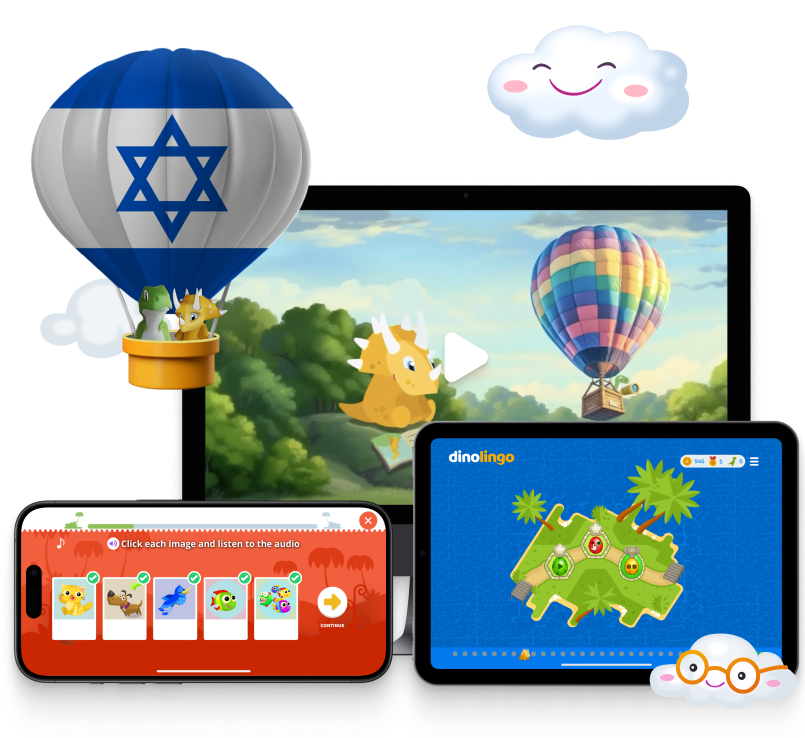
Across every theme in this guide, Dinolingo introduces real vocabulary through interactive lessons, animated stories, songs, and games. Kids meet family words, greetings, feelings, favorites, food, colors, animals, weather, and Shabbat vocabulary in context, with visuals and repetition that connect names to meaning. Hebrew audio with native speakers helps children hear sounds like the resh and the vowel marks (Nikud) the way they are really spoken. Dinolingo provides modern Sephardic-style pronunciation by default while building strong listening skills, so kids grow flexible ears for different sounds and rhythms.
Away from the screen, printable worksheets, flashcards, dialogue cards, picture activities, coloring pages, and pronunciation aids make it easy and fun to keep practicing offline too.
Final Thoughts
When kids learn to say words for their loved ones in Hebrew, the language becomes more meaningful, and that closeness carries into every other topic. From family titles to greetings, feelings, favorites, food, and the sounds and dots that shape every word, each piece builds on the last. With tools like Dinolingo and fun home-based activities, Hebrew learning starts close to the heart and grows from there.
Sources: