Learn French Through Play: 5 Engaging Games Your Kids Will Love
Play is children’s natural classroom. When vocabulary meets laughter and friendly competition, new words stick without the struggle. This guide brings together five playful games, ten screen-free family activities, a starter shelf of beloved French books, and the memory science that makes it all last, so you can build a vibrant French-learning home from a single page.
5 Engaging Games Your Kids Will Love
Start with games that turn vocabulary into movement, suspense, and storytelling. Each one needs little more than household objects and a few minutes.
1. Scavenger Hunt – “Chasse au trésor”
Hide household objects labelled in French (la chaise, le livre). Give clues like C’est sous la table ! Kids dash, find, and shout the word to claim a point.
2. Memory Match Cards
Create pairs: one card shows chat with a picture, the other shows the word. Flip, match, and keep the pair only after pronouncing correctly.
3. Dice Dialogue
Number a list of phrases. Roll the dice; whatever number appears, say the matching French sentence to move a game‑piece forward.
4. Hopscotch Numbers
Draw a 1‑10 grid; hop and shout un, deux, trois… Add the 70‑90 twist: land on 7, say soixante‑dix.
5. Story Cube Theatre
Roll picture cubes (sun, cat, house) and build a three‑sentence mini‑story in French. Great for creative tweens.
10 Screen-Free French Practice Ideas Every Family Will Love
When you want to keep the energy going away from devices, screen-free activities reinforce French learning by engaging the whole family in tactile, social, and creative play. Here are ten hands-on ideas to make every moment language-rich, no screens required.
1. French Story Stones
Paint smooth stones with simple pictures (chat, pomme, livre). Store them in a bag and let each family member draw one and tell a short sentence in French. Rotate stones daily to review vocabulary.
2. Kitchen Conversation Cards
Write common kitchen words (couteau, cuillère, assiette) on index cards. During meals, draw a card and say the word aloud before using the item. Use Dinolingo’s printable kit for extra card templates by downloading them from Dinolingo’s French course.
3. Treasure Hunt with Clues
Hide small toys or treats with French clue cards guiding to the next location: “Va à la chaise”. Each clue reinforces imperative verbs and prepositions.
4. Label Everything
Attach colorful sticky notes to household objects (le frigo, la porte). Challenge kids to remove a label only after saying the item in French three times.
5. Cooking Relay
Turn recipe instructions into a team game. One child reads a step in French, the next performs it. Practice phrases like “Mélange la pâte” until the batter is ready.
6. Family French Journal
Keep a simple paper journal where each member writes one sentence per day in French about a shared activity. Read entries aloud once a week for listening and speaking practice.
7. Board Game Makeover
Transform classic board games by adding French prompts. In Monopoly, name the property in French before purchasing; in Candy Land, say the color as you move.
8. Puppet Show Dialogues
Create sock puppets and write mini-dialogue scripts in French. Perform a short show together, focusing on greetings, questions, and simple descriptions.
9. Nature Walk Vocabulary List
During outdoor walks, collect leaves or rocks and ask children to label each in French (feuille, pierre). At home, glue them to a poster and add their names.
10. Badge Rewards for Milestones
Celebrate screen-free success with badge certificates from Dinolingo awards & rewards. Print and display each achievement to motivate continued practice.
Build Your Home French Library: 10 Kids’ Books Parents Love
Games and crafts pair beautifully with reading. Building a home library of French books accelerates language skills and fosters cultural curiosity. Below are ten must-have titles, from charming picture books for toddlers to engaging chapter books for older kids, plus ideas to integrate each read with interactive tools.
“Le Petit Prince” by Antoine de Saint-Exupéry (Age 6+)
A timeless allegory of friendship and imagination. Read aloud in short excerpts to practise pronunciation and discuss themes in French.
“T’choupi” series by Thierry Courtin (Age 2–5)
Simple sentences and relatable scenarios (playground, bath time) help pre-readers pick up everyday vocabulary. Turn each page into a Dinolingo story lesson by echoing T’choupi’s phrases.
“Le loup qui voulait changer de couleur” by Orianne Lallemand (Age 3–7)
Follow Loup’s color-changing adventures to learn colors and emotions. Use the family plans from Dinolingo to extend activities with printable coloring sheets.
“Monsieur Lapin” by François Rollin (Age 4–8)
A humorous tale with wordplay that introduces puns and simple dialogue. Pause to play “freeze-frame” and ask kids to recount scenes in their own French words.
“Les p’tites poules” by Christian Jolibois (Age 5–9)
Fun rhymes and farmyard antics build farm and animal vocabulary. After reading, challenge kids to role-play new words with puppet animals.
“Max et Lili” series by Dominique de Saint-Mars (Age 7–10)
Real-life stories addressing friendship, school issues, and self-esteem. Read one story per week and discuss key sentences, using Dinolingo’s Vocab Tracker for a weekly word list review.
“Petit Ours Brun” series by Marie Aubinais (Age 2–5)
Beloved bear stories featuring daily routines. Create scene cards and ask children to sequence them in French after each read.
“La cabane magique” series by Mary Pope Osborne (translated) (Age 8–12)
Time-travel adventures that introduce historical and cultural vocabulary. Pair chapters with short Dinolingo podcasts for shadowing practice.
“L’école des loisirs” picture books (Age 3–7)
A publisher collection with diverse themes and art styles. Rotate one title per month and ask kids to draw their favorite page, then label it in French.
“Les Sisters” by William and Christophe Cazenove (Age 9–12)
Comic-style sibling stories that engage reluctant readers. Encourage silent reading sessions followed by quick oral summaries in French.
Tips for a Rich Family Reading Corner
- Display books at child height; add a cozy reading nook with cushions.
- Keep a Dinolingo-enabled tablet stand nearby for quick story-module tie-ins.
- Track each book finished on a fridge chart; award a Dinolingo badge for every three titles.
Storytime in French: Memory Hacks That Make Words Stick
Reading aloud and listening together are powerful, and a little memory science makes the words last. Smart memory tricks turn chat, chien, cheval into lifelong vocabulary instead of tomorrow’s forget‑me‑nots. Try these five evidence‑based hacks at home.
1. Spaced Repetition Levels
Review new words on day 1, 3, 7, 14, then monthly. The “staircase” schedule refreshes neural pathways just before they fade.
2. Visual Mnemonics
Pair every word with a vivid image: la pomme → a giant apple wearing sunglasses. Drawing it yourself doubles recall.
3. Story Chains
Link ten new words into one silly tale: “Le chien chevauche un cheval violet qui mange une pomme.” The brain stores stories more efficiently than lists.
4. Physical Anchors
Act out a motion while saying the word, jump for saute, clap for heureux. Muscle memory boosts lexical memory.
5. Teach‑Back Moments
Have your child “teach” today’s set to a sibling or teddy bear; people remember 90 % of what they explain.
Level‑Up With Dinolingo
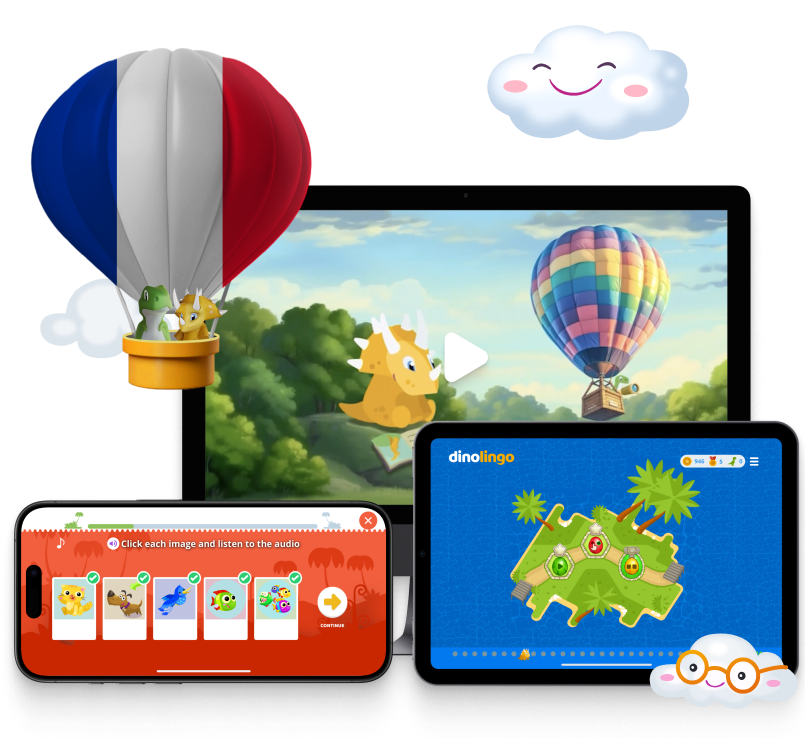
A five‑minute lesson on Dinolingo turns vocab into interactive tap‑to‑win games, while the Dinolingo dashboard awards surprise badges for streaks and high scores. A short session also schedules automatic spaced‑review games with native audio, and the course roadmap shows exactly when each word set will reappear.
- 40 000+ game modules, race the clock or challenge a sibling.
- AR flashcards drop 3‑D animals onto the table for real‑world play.
- Pronunciation meter with instant redo for tricky sounds.
- Surprise badges every time a spaced‑review streak hits 7 days.
- Printable board‑game and memory‑card templates in the offline kit keep screen time balanced and travel-friendly.
Quick 15‑Minute Play Plan
- Warm‑up: play one Dinolingo mini‑game (5 min).
- Physical game: hopscotch or scavenger hunt (7 min).
- Cool‑down: memory match review (3 min).
Quick 10‑Minute Memory Routine
- Review yesterday’s flashcards (2 min).
- Watch one Dinolingo mini‑lesson (3 min).
- Draw a crazy mnemonic for each new word (3 min).
- Teach the list to a plush toy (2 min).
Daily joy beats weekend cram every time.
Final Thoughts
Turn “study time” into game time and watch French explode with giggles. Mix these DIY ideas, screen-free crafts, beloved books, and memory hacks with Dinolingo’s gamified lessons, and vocabulary growth will feel like winning, because it is. Consistency plus creativity is the secret sauce: by reading together, playing daily, and integrating multimedia follow-ups, you turn each page and each game into a bilingual adventure your family will treasure.