
Beautiful Hebrew Names and Their Meanings for Kids

Names are very meaningful in Jewish culture. Many Hebrew names come from the Bible and have been used for generations. They often carry strong meanings and are chosen with care. This guide starts with beloved Hebrew names and the traditions behind them, then opens out into a wider journey through Israeli culture, music, holidays, and simple, joyful ways for children to learn the Hebrew language itself.

Popular Hebrew Names for Boys and Girls

Popular Boys’ Names

Here are some of the most popular Hebrew boys’ names:

  • Aaron (Aharon)
  • Adam
  • Benjamin
  • Daniel
  • David
  • Jonathan (Y’honatan)
  • Joseph
  • Joshua (Y’hoshua)
  • Michael
  • Samuel (Sh’mu’el)

These names are still commonly used by Jewish families around the world.

Popular Girls’ Names

Here are popular Hebrew girls’ names:

  • Deborah
  • Elizabeth (Elisheva)
  • Judith (Y’hudit)
  • Mary (Miriam)
  • Rachel
  • Rebecca (Rivka)
  • Ruth
  • Sarah
  • Susan (Shoshanah)

These names often appear in stories from the Torah and are admired for their historical and spiritual significance.

How Jewish Children Are Named

Jewish children are traditionally named after a loved one who has passed away. This is a way to honor the person and carry their memory into the future. At naming ceremonies, families often explain why they chose the name and what values or qualities they hope the child will carry forward.

  • Boys are named during a bris, which is a circumcision ceremony held on the 8th day after birth.
  • Girls are often named during a special ceremony in the synagogue, where their Hebrew name is shared with the community.

Most Jewish children also have a Hebrew name, used for religious events and prayers, in addition to their everyday name.

Jewish Surnames

There are a few last names that are especially common in Jewish families:

  • Cohen – means “priest,” from a family of temple priests
  • Levy – from the biblical tribe of Levi
  • Israel – used by people from the broader community of Israel

These names come from ancient tribal connections and are still used today.

Discovering Israel: The Land Behind the Names

Hebrew names and traditions are rooted in the land of Israel, so it helps children to picture the country itself. Israel is one of the most exciting and diverse countries in the world. Despite its small size, it offers everything from mountains and deserts to forests, rivers, and a beautiful coastline along the Mediterranean Sea. One of its most unique features is the Dead Sea, the lowest point on the Earth’s surface. Most of Israel’s population lives near the Mediterranean coast, and many visitors fall in love with the region’s natural beauty.

Population and Cities

Israel has a population of around 7.5 million people. A large portion of the population lives in coastal cities near the Mediterranean Sea.

The capital city is Jerusalem, one of the oldest and most sacred cities in the world, especially important in Judaism, Christianity, and Islam. It is known for its limestone buildings and ancient Old City, which holds religious and historical sites like the Church of the Holy Sepulchre and the Dome of the Rock. Another major city is Tel Aviv, known for its modern life, innovation, and cultural attractions.

The Israeli Flag

The flag of Israel is simple yet meaningful. It features a white background with two blue stripes near the top and bottom. In the center is the Star of David, a symbol of Judaism and named after King David.

Currency

The currency of Israel is the New Israeli Shekel (NIS). It has been used since 1986, replacing the old shekel.

Languages Spoken

The two main languages spoken in Israel are Hebrew and Arabic. Hebrew is one of the world’s oldest languages, spoken by around 10 million people. Arabic is spoken by over 280 million people worldwide and is also widely used in Israel.

Fun Facts About Israel

Israel is a small country that can be crossed in about 10 hours. The climate varies greatly, from the snowy Mount Hermon in the north to the warm Red Sea in the south. The Dead Sea, one of the most famous places, is so salty that you can float without trying.

A Colorful Journey Through Jewish Food, Traditions, and Daily Life

Food

Israeli cuisine is a mix of cultures, reflecting the country’s diverse history, and many dishes are colorful, flavorful, and shared with family and friends. Some Jewish holidays in Israel are traditionally celebrated with special meals that bring families together to share ancient stories. During Passover, for example, families eat matza, a flat, crispy bread, to remember the hurried escape from slavery in Egypt. On Saturday nights, challah is served, a sweet, braided white bread topped with sesame seeds. Ethiopian Jews make injera, a spongy sourdough bread, while lafa is a large flatbread often filled with meat and salads.

Families from different backgrounds cook dishes inspired by their heritage. Gefilte fish comes from Eastern Europe, while Jews from North Africa prepare spicy dishes using a mix of turmeric, cumin, coriander, and black pepper. These meals are often slow-cooked with garlic, onion, and vegetables. Popular sauces include hilbeh and schug, which add extra flavor to the food.

Some meals are sweet, like tzimmes, a stew made with carrots, beans, potatoes, and dried fruit. Another favorite is ptitim, Israeli pasta shaped like pearls or stars. Shavuot is a holiday where only dairy foods are eaten, including cheese pies, veggie quiches, and pastries. Pita sandwiches are very popular too. Vendors fill them with hummus, falafel, schnitzel, shakshuka, or shawarma, and top them with salad, fries, and sauces like mashed eggplant or pickles.

Clothing

Israel is a modern country where people enjoy fashionable clothing. However, religious traditions still influence how some dress. Orthodox Jewish boys wear a kippah, a small round cap, and girls wear modest clothing with covered shoulders and skirts. Men wear a tallit during prayers, which is a scarf with special knots. Some traditional garments are long, colorful robes, often decorated with beads. Israeli youth are also often seen in olive green army uniforms, as military service is common for both boys and girls.

Festivals and Holidays

The people of Israel use a lunar calendar, so their New Year, Rosh Hashanah, can fall in different months each year. For this holiday, apples dipped in honey are eaten to wish for a sweet year. Sukkot celebrates the harvest and the journey through the desert by building small shelters decorated with lights and paper crafts. Hanukkah is a winter holiday that celebrates light and includes delicious jelly-filled doughnuts called sufganiyot. Purim is a carnival-like holiday where people wear costumes, use noisemakers, and give sweet treats to others.

Famous Stories and Epics

Many children in Israel grow up learning stories from the Old Testament and other traditional texts. One well-known story is the Book of Esther, where Queen Esther saves her people from harm. Another is the story of Masada, an ancient fortress where Jewish rebels made a final stand against the Roman Empire.

Children’s Games

Israeli children love to play with marbles, a game called gulot. They draw a circle and try to knock each other’s marbles out of it. Each marble has a name, like drakonit for a striped one, bombila for a big one, and gazozit for one with bubbles.

Communication and Values

Israeli people are often very friendly and open. They speak casually, often calling each other “brother” or “sister.” It is common to speak with hand gestures. One common gesture is holding your fingers together and shaking your hand to say “wait a second.” Religious traditions are respected across the country. Boys and girls celebrate a special coming-of-age ceremony called Bar or Bat Mitzvah at age 12 or 13. Military service begins at age 18, and young people can serve in many roles, such as teaching, programming, or performing in the military entertainment unit.

Jewish and Israeli Musical Traditions

Music has always played a meaningful role in Jewish life, from ancient religious ceremonies to modern celebrations. Over the centuries, both religious and secular music evolved, reflecting the deep cultural and historical identity of the Jewish people. Israel has a rich musical heritage. Traditional songs known as the “Songs of the Land of Israel” are still sung today. Israelis also enjoy Greek, Middle Eastern, jazz, and pop music, and the country is home to world-famous orchestras and modern music festivals.

Ancient Sounds: Temple and Synagogue Music

In Biblical times, music was part of religious ceremonies in the Jewish Temple and synagogues. There were 12 singers and an orchestra of 12 instruments used during services. One of the most popular instruments from that time was the uggav, an early wind instrument.

Many ancient Jewish poems called piyyuts are still chanted or sung in synagogues today, especially during holidays and Shabbat. Families also sing special Jewish hymns called zemiros at the dinner table during Jewish holidays. These songs help pass down traditions and bring generations together.

Another unique style of singing is called nigun. These are wordless melodies, often sung in groups, where the focus is on feeling and spirituality rather than lyrics. In some traditions, people also sing Baqashot, a collection of prayers and songs sung every Shabbat morning from midnight until dawn.

Music and the Founding of Israel

As the modern state of Israel was being formed, music played a major role in uniting people. The youth, labor, and kibbutz movements helped spread Hebrew songs in everyday life. Sing-alongs, known as shira betzibur, became a popular social activity and remain a beloved tradition in Israel today. Early immigrants to Israel brought with them melodies from their home countries, including Germany, Russia, and other parts of Europe, and wrote new lyrics in Hebrew. These became the first Hebrew folk songs, often shared at public gatherings and community events.

Songs of Hope and Remembrance

During Israel’s many wars, soldiers and civilians expressed their feelings through patriotic folk songs. These songs spoke about friendship, bravery, and the sadness of loss. Today, many of these melodies are played during memorial days and national holidays, helping to remember and honor the past.

Hebrew Songs for Children

Music plays a powerful role in language learning, especially for children. In Hebrew-speaking cultures, songs are not just about melodies, they are rich with history, emotion, and tradition. Hebrew children’s songs often center around themes of animals, seasons, holidays, and the beauty of nature, making them both educational and enjoyable for young learners. From lullabies to lively group songs, these tunes help children develop vocabulary, pronunciation, and cultural understanding. Many of the most beloved songs are sung in schools, family gatherings, and Jewish celebrations around the world.

Here are some popular Hebrew children’s songs:

  • Kol Eileh
  • Ba Shana Ha Ba-a
  • Chevlei Mashiach
  • Lu Y’hi
  • Yerushalayim Shel Zahav
  • Sisu Et Yerushalayim
  • Yihiye Tov
  • Amar Adon Kohelet
  • Eifo Hem Kol Avoteinu
  • Nevel Mi Zahav
  • Shneeraleh, Peraleh
  • Tirza
  • Utsu Eytsa
  • Y’varech’cha Hashem Mi Tzion
  • Lach Yerushalayim
  • Sachki Sachki (Laugh, Oh Laugh)

These songs are a great tool for introducing children to Hebrew in a way that feels natural and enjoyable.

Easy Songs Beginners Can Sing

Singing simple Hebrew songs boosts memory, teaches pronunciation, and helps kids absorb new vocabulary without even trying. These five tunes are perfect first songs:

  1. Shalom Chaverim – a song about greeting and parting with friends.
  2. Bim Bam – a catchy rhythm for learning syllables and sounds.
  3. Eretz Yisrael Sheli – a gentle tune about the land of Israel.
  4. Ani Purim – a festive song sung during the Purim holiday.
  5. Yesh Li Yadayim – teaches body parts through movement and song.

What makes Hebrew songs a great learning tool:

  • Repetition helps words and phrases stick.
  • Tunes add emotion and energy to learning.
  • Movements paired with lyrics improve comprehension.
  • Simple lyrics introduce real-life vocabulary.

Try these song activities: Sing along with gestures by using hand motions or dance steps to act out the words. Have kids draw pictures of what is happening in each verse. Pause a familiar song and ask kids to fill in the line or word. Collect favorite Hebrew songs into a mini illustrated songbook for sing-alongs.

Easy Methods to Make Hebrew Learning Fun

Learning a new language like Hebrew can be a rewarding experience for children, especially when it’s presented in a playful, motivating, and engaging way. Whether you’re teaching Hebrew at home or supplementing classroom lessons, here are practical strategies you can use to make Hebrew learning both fun and effective.

Spark Motivation Through Fun and Surprise

Motivation is the key to language learning success, and boosting motivation in children is easier than it seems. Offer simple rewards such as a favorite snack, stickers, or a visit to a Jewish bakery or museum when your child learns new Hebrew words. Use surprises for younger children, like a Hebrew song popping up during playtime or a peekaboo game using Hebrew words. Make it fun with classic games like hide and seek, counting in Hebrew, or a board game adapted with Hebrew vocabulary. The goal is to associate Hebrew with play, not work.

Keep Lessons Short and Enjoyable

Children, especially those under age 10, can lose interest quickly if the content feels overwhelming. Break learning down into small chunks:

  • Introduce only a few Hebrew words at a time
  • Use repetition through different formats (games, songs, visuals)
  • Focus on confidence-building rather than memorization

Create Opportunities for Practice

Hebrew learning sticks best when children get to use it regularly. Daily mini-quizzes: if you speak Hebrew, ask your child questions in Hebrew during the day, or show an object and ask “Do you know what this is in Hebrew?” Drawing and labeling: ask children to draw objects and label them with Hebrew names. Native speaker interaction: help your child interact with native speakers at Hebrew schools, Jewish cultural centers, or synagogues. Even simple greetings can build confidence.

Use Visual and Audio Tools

Flashcards strengthen visual associations. Dinolingo offers Hebrew flashcards designed for children, making review time feel like playtime. Songs and cartoons are especially effective: play them in the background at home or in the car and children will pick up rhythm, pronunciation, and new words without even realizing it. Storytime fun: mix Hebrew words into your storytime, then introduce short Hebrew storybooks and fairy tales as kids improve.

Bring Language to Life

Cultural visits: go on mini field trips to Hebrew-speaking spaces like a Jewish grocery store or a Hebrew school. Hebrew toys and posters: decorate your child’s space with Hebrew alphabet posters, fun puzzles, or educational toys featuring Hebrew letters. Peer learning: arrange playdates or group sessions with other children learning Hebrew so practice feels like a social adventure.

Make Hebrew Learning a Daily Habit

One of the easiest ways to ensure steady progress is to integrate Hebrew into your child’s routine:

  • Watch Dinolingo Hebrew videos regularly
  • Play online Hebrew games from Dinolingo
  • Listen to Hebrew songs during meals or car rides
  • Use flashcards and posters for 5–10 minutes daily

The key to helping your child succeed in Hebrew is consistency, positivity, and play. Learning Hebrew doesn’t have to feel like schoolwork, it can be part of your everyday fun together.

Reading and Writing Hebrew: First Steps

Start on the Right Side: Hebrew Reading Tricks for Beginners

Unlike English, Hebrew is read from right to left. This may feel strange at first, but with the right tools and a little practice, kids can quickly get used to it and start reading with confidence.

Reading basics for Hebrew beginners:

  1. Hebrew reads right to left. Start every line from the right-hand margin.
  2. Letters look different at the end of a word. These are called final letters (sofit).
  3. Vowels are dots and dashes under or near the letters. They help kids sound out each word.
  4. No capital or lowercase letters in Hebrew. Every letter looks the same size.

Helpful beginner Hebrew words to practice:

  1. שלום (Shalom) – Hello
  2. אבא (Abba) – Dad
  3. אמא (Ima) – Mom
  4. מים (Mayim) – Water
  5. כיף (Kef) – Fun

Fun tricks to master reading direction: Use stickers or draw arrows pointing right-to-left to guide the eyes (Follow the Arrow). Turn reading into a race to find the starting point on the right fastest. Use a pencil, finger, or reading wand to trace each word from right to left out loud. Or cut a short Hebrew sentence into separate word cards, mix them up, and let kids reorder them correctly from right to left.

Letter by Letter: Easy Hebrew Handwriting Practice

Learning to write Hebrew letters gives kids a hands-on way to connect with the language. Tracing and writing one letter at a time helps develop memory, fine motor skills, and confidence, all while introducing the basics of Hebrew reading and spelling.

Key features of Hebrew writing:

  1. Hebrew is written from right to left. Letters start on the right side of the page.
  2. The Aleph-Bet has 22 letters. Each with a unique shape and sound.
  3. Some letters have final forms. Five letters look different at the end of a word.
  4. No uppercase or lowercase. All Hebrew letters are one size.

Steps for easy handwriting practice: Start with large print letters using thick lines and wide spaces to trace. Practice one letter per day, focusing on its shape, name, and sound. Use dotted-line worksheets to guide correct direction and structure. Say each letter out loud, because repeating the sound helps connect writing to speech.

Fun handwriting activities: Make a Daily Letter Book with one page per letter to trace, color, and write. Try Rainbow Tracing by tracing each letter in multiple colors. Use Dry Erase Practice on laminated worksheets or whiteboards. Or play Letter Hunt, searching for a practiced letter in books or signs and circling it.

Your First Hebrew Storybook: Easy Tales for Early Readers

Reading short stories in Hebrew is one of the most effective ways for kids to practice vocabulary, sentence structure, and comprehension. Simple tales introduce key words in context and make learning feel like play, not work. A great first storybook has short sentences that are easy to follow and repeat, simple vocabulary kids already know or are learning, repetition that reinforces sentence patterns, and bright illustrations that support understanding without needing translation.

Common Hebrew phrases in beginner stories:

  1. יש לי כלב. (Yesh li kelev.) – I have a dog.
  2. החתול שלי ישן. (Hachatul sheli yashen.) – My cat is sleeping.
  3. שלום, קוראים לי נועה. (Shalom, kor’im li Noa.) – Hello, my name is Noa.
  4. זה הבית שלי. (Zeh habayit sheli.) – This is my house.
  5. אני אוהב לשחק. (Ani ohev lesachek.) – I love to play.

Reading activities to try: Read a sentence aloud and have the child repeat it like an echo (Storytime Echo). Let kids draw what happened to recall vocabulary. Pick one Hebrew word, like כלב (dog), and find it each time it appears (Word Finder). Or write the story out of order and ask kids to rearrange the scenes (Story Mix-Up).

Everyday Hebrew Phrases and Vocabulary Kids Will Love

From “Shalom” to “Sababa”: Real Hebrew Expressions

In Israel, Hebrew is full of playful and expressive words that make speech feel warm and fun. Teaching kids these phrases gives them tools to sound friendly and confident, from saying hello to showing excitement.

  1. שלום (Shalom) – Hello / Peace / Goodbye
  2. מה נשמע? (Ma nishma?) – What’s up? / How’s it going?
  3. סבבה! (Sababa!) – Cool! / Great!
  4. יופי! (Yofi!) – Nice! / Good job!
  5. בכיף! (B’kef!) – With pleasure! / Sure!
  6. יאללה! (Yalla!) – Let’s go! / Come on!
  7. כיף חיים! (Kef chayim!) – So much fun!
  8. אין בעיה (Ein beaya) – No problem
  9. מה קורה? (Ma kore?) – What’s happening?
  10. להתראות! (Lehitraot!) – See you later!

Fun practice ideas: Play Phrase Charades by acting out phrases like “Yalla!” or “Yofi!” and letting others guess. Try Greeting Mix and Match, pairing “Ma nishma?” with “Sababa!” or “Shalom” with “Lehitraot.” Pick an Expression of the Day to use as often as possible. Or place sticky notes with expressions like “Ein beaya” around the room and say them when used.

Question Time in Hebrew: Easy Phrases for Curious Kids

Kids love asking questions, and it’s one of the best ways to learn a language. Hebrew question words help children express curiosity and start conversations:

  1. ?מה (Mah?) – What?
  2. ?מי (Mi?) – Who?
  3. ?מתי (Matay?) – When?
  4. ?איפה (Eifo?) – Where?
  5. ?למה (Lama?) – Why?
  6. ?איך (Eich?) – How?
  7. ?איזה / איזו (Eizeh / Eizo?) – Which? (masculine / feminine)

Simple questions kids can use:

  • מה זה? (Mah zeh?) – What is this?
  • מי זה? (Mi zeh?) – Who is that?
  • איפה אמא? (Eifo ima?) – Where is Mom?
  • למה אתה צוחק? (Lama atah tzochek?) – Why are you laughing? (to a boy)
  • איך עושים את זה? (Eich osim et zeh?) – How do you do that?
  • מתי הולכים הביתה? (Matay holchim habaytah?) – When are we going home?

Practice questions through play: Try a Question Ball Toss where the catcher answers or asks a new question in Hebrew. Use a puppet to model asking and answering in a silly voice. Post a Question of the Day, or pull from a stack of colorful Curiosity Cards to spark play-based discussions.

Let’s Play in Hebrew: Easy Phrases Kids Use Outdoors

Playing outside is one of the best ways for kids to learn a new language. It’s active, social, and full of real situations where simple Hebrew phrases come in handy. Whether they’re running, climbing, or riding a bike, children can use Hebrew naturally while having fun:

  1. בוא נשחק! (Bo n’sachek!) – Let’s play!
  2. תורך! (Torcha / Torach!) – Your turn! (girl / boy)
  3. אני הבא / הבאה! (Ani haba / haba’ah!) – I’m next! (boy / girl)
  4. רוצה להצטרף? (Rotzeh / Rotzah l’histaref?) – Want to join? (to a boy / girl)
  5. איזה כיף! (Eizeh kef!) – So fun!
  6. אני מוכן / מוכנה! (Ani muchan / muchanah!) – I’m ready! (boy / girl)
  7. בוא נרוץ! (Bo narutz!) – Let’s run!
  8. עצור! (Atzor!) – Stop!
  9. זה היה מדהים! (Zeh haya madhim!) – That was amazing!

Outdoor activities: Play Follow the Leader using commands like “Bo narutz” or “Atzor.” Try Jump and Say, where each child says one Hebrew phrase aloud as they jump or run. Use “Torcha!” or “Torach!” while taking turns for a slide or swing. Or set up a Hebrew obstacle course and call out instructions: run, stop, jump, go!

Speaking Games That Build Confidence

Games take the pressure off and turn speaking Hebrew into something exciting. Through play, kids practice real conversation, repeat key words, and use full sentences without even realizing they’re learning. Useful game phrases include:

  1. אני מוכן / מוכנה! (Ani muchan / muchanah!) – I’m ready! (boy / girl)
  2. התור שלך! (Hator shelcha / shelach!) – Your turn! (to a boy / girl)
  3. התחלנו! (Hitchalnu!) – Let’s begin!
  4. ניצחתי! (Nitzachti!) – I won!
  5. שיחקנו יפה! (Sichaknu yafeh!) – We played nicely!

Games that unlock speaking confidence: Play Hebrew Charades by acting out words and phrases while others guess. Try Memory Match by flipping cards to pair Hebrew words and pictures, then saying the word aloud. Play Who Am I? (מי אני?), asking and answering questions to guess a character or animal. Or roll a Hebrew Dice Game to pick a category (colors, animals, foods) and say a word in Hebrew.

Talk Trees in Hebrew: Tu B’Shvat Vocabulary

Tu B’Shvat, the “New Year of the Trees,” is a great opportunity to introduce kids to Hebrew words about nature, fruits, and environmental care. It’s a holiday filled with planting, tasting, and celebrating growth, making it perfect for vocabulary building:

  1. עץ (Etz) – Tree
  2. פרי (Pri) – Fruit
  3. פרח (Perach) – Flower
  4. טבע (Teva) – Nature
  5. אדמה (Adamah) – Earth / Soil
  6. לשתול (Lishtol) – To plant
  7. שורש (Shoresh) – Root
  8. גזע (Geza) – Trunk
  9. עלים (Alaim) – Leaves
  10. מים (Mayim) – Water

Simple Tu B’Shvat phrases kids can use:

  • אני שותל עץ. (Ani shoteil etz.) – I’m planting a tree.
  • אני אוהב פירות. (Ani ohev peirot.) – I love fruits.
  • יש לי פרחים. (Yesh li perachim.) – I have flowers.
  • האדמה רטובה. (Ha’adamah retuvah.) – The soil is wet.

Tu B’Shvat activities: Make a paper tree and label each part in Hebrew (עץ, עלים, שורש). Taste fruits and write their Hebrew names on a chart. Take a nature walk and look for things that match Hebrew words. Or plant a seed and say each step in Hebrew: לשתול, מים, אדמה.

Play, Swipe, Speak: Fun Hebrew Apps Kids Will Love

For busy families and curious kids, Hebrew learning apps bring vocabulary, pronunciation, and listening practice to life right from a tablet or phone. With touch-based games, native audio, and colorful visuals, kids stay engaged while picking up language skills. Common words kids learn through apps include:

  1. שלום (Shalom) – Hello
  2. חתול (Chatul) – Cat
  3. כדור (Kadur) – Ball
  4. תודה (Todah) – Thank you
  5. ספר (Sefer) – Book
  6. מים (Mayim) – Water
  7. בית (Bayit) – House
  8. מה זה? (Mah zeh?) – What is this?
  9. אני רואה… (Ani ro’eh / ro’ah…) – I see… (m/f)
  10. אני רוצה… (Ani rotzeh / rotzah…) – I want… (m/f)

Favorite Hebrew apps: Dinolingo offers interactive lessons, games, and videos in Hebrew, perfect for kids ages 2 to 14 and available on iOS, Android, and the web, with vocabulary, storytelling, songs, and a reward system to keep motivation high. FunEasyLearn Hebrew features illustrated word lists, audio, and quizzes for beginners with themed categories. Mango Languages offers simple, conversational Hebrew with audio from native speakers. Hebrew for Kids with Stories by Gus on the Go is an animated story-based app for young learners who love a story-driven approach.

Tips for using apps effectively: Use headphones to hear pronunciation clearly, set short daily goals (10 to 15 minutes works well), and combine apps with offline play, such as flashcards that use the same words.

Children can learn more about Hebrew names, culture, and language through Dinolingo’s Hebrew lessons for kids. With fun videos, songs, games, and printable flashcards, learning Hebrew becomes easy and enjoyable for kids everywhere. Designed for children aged 2 to 14 and available on web, iOS, and Android, Dinolingo supports language development at every stage.
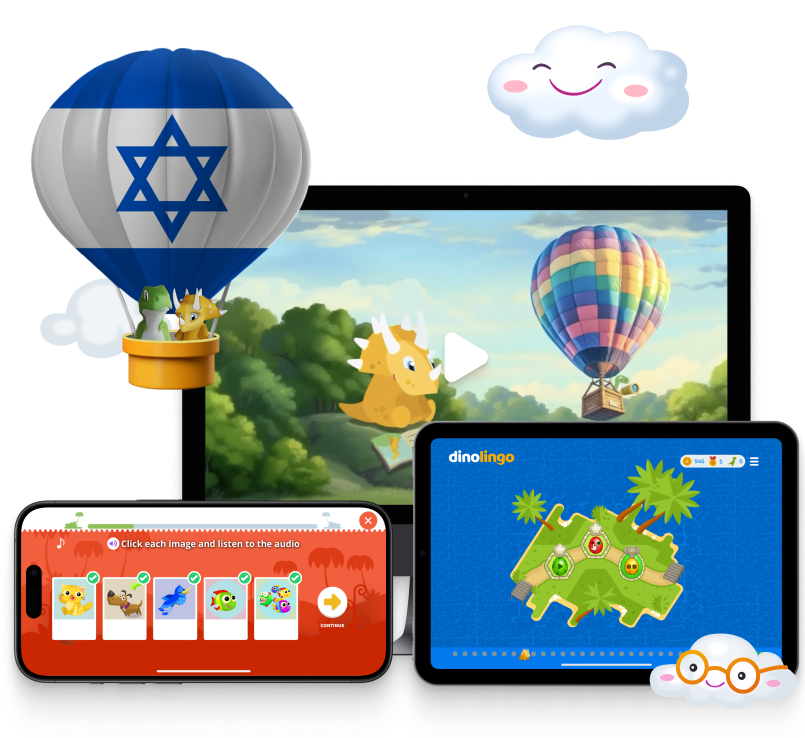
Learn Hebrew for Kids – Best Hebrew App & Website

Dinolingo – #1 Language Learning App for Kids Ages 2-14

$19/month · Cancel Anytime
4.4/5 - (21 votes)

Leave a Comment

Your email address will not be published. Required fields are marked *

Scroll to Top