Great Minds of Italy—Historical Figures Who Changed the World
Italy’s rich history is shaped by a vibrant tapestry of artists, thinkers, rulers, and explorers whose contributions have reached far beyond their homeland. From the heights of the Renaissance to the intrigue of ancient Rome, these famous Italians left their mark on art, science, politics, and culture. This guide takes you on a journey through the people who shaped Italy, the cities and landmarks where their stories unfolded, the virtual ways your family can explore it all from home, and even the regional words that bring the language to life. Here’s a look at some of the most influential figures, and how their legacies continue to inspire generations today.
The People Who Shaped Italy
Some of the most celebrated names in art, science, and politics were born on Italian soil. Each of these figures opened a new chapter in human history.
Donatello
Born in Florence in 1386, Donato di Niccolò di Betto Bardi, known as Donatello, was one of the pioneering sculptors of the Early Renaissance. He broke away from traditional medieval styles, creating lifelike statues such as David and Gattamelata, which still impress visitors with their realism and emotion.
Christopher Columbus (Cristoforo Colombo)
An explorer from Genoa, Columbus was born in 1451 and famously sailed westward across the Atlantic in 1492. Although he thought he had found a new route to Asia, he had instead reached the Americas, setting off an era of exploration and global change. You can still visit the port in Genoa where he set sail.
Michelangelo
A true Renaissance genius, Michelangelo was born in 1475 and excelled in sculpture, painting, architecture, and poetry. His masterpieces include the Sistine Chapel ceiling, the Pietà, and the monumental statue of David. He also designed the magnificent dome of St. Peter’s Basilica in Rome.
Galileo Galilei
One of the most important scientific minds of all time, Galileo was born in 1564. He improved the telescope, discovered moons of Jupiter, and laid the groundwork for modern physics. His support for the heliocentric model of the universe sparked conflict with the Catholic Church, symbolizing the ongoing struggle between science and belief.
Gianni Versace
A modern icon of Italian style, Gianni Versace launched his fashion empire in 1978. Known for bold designs and elegance, Versace’s brand has become one of the most famous in the world. Today, the company is led by Donatella Versace and continues to shape global fashion.
The Roman Centurion
More than just a soldier, a centurion in ancient Rome was a symbol of leadership and bravery. These commanders were chosen for their intelligence and strength, often leading from the front lines and playing a crucial role in Rome’s military power.
Niccolò Machiavelli
A sharp political thinker of the Renaissance, Machiavelli worked in the Florentine government and wrote about the realities of power. His book Il Principe (The Prince) is still discussed today for its bold advice to rulers and has made his name synonymous with cunning strategy.
Emperor Nero
One of Rome’s most notorious emperors, Nero ruled from 54 to 68 C.E. His reign is remembered for extravagance, cruelty, and scandal. He was accused of letting the Great Fire of Rome burn, and ultimately died by suicide after losing control of the empire. A colossal statue of Nero once stood near the Colosseum and even gave the arena its name.
Pope Alexander VI
A powerful yet controversial figure, Alexander VI was part of the infamous Borgia family. His papacy (1492 to 1503) was marked by political maneuvering, nepotism, and a desire to expand the Vatican’s influence across Italy.
Cesare Borgia
The ambitious son of Pope Alexander VI, Cesare Borgia was admired by Machiavelli for his ruthless leadership. He became the model for The Prince, a symbol of political power and strategy during the Renaissance.
Where History Comes Alive: The Landmarks of Rome
Many of these great figures lived, ruled, or built in Rome, the capital of the ancient world and of modern Italy alike. Rome is full of history everywhere you look, with ancient monuments, medieval churches, beautiful fountains, museums, and Renaissance palaces. The Vatican and St. Peter’s are also found here. A few must-see landmarks bring the stories of emperors and architects to life.
The Pantheon
The Pantheon is one of Rome’s most iconic landmarks, a temple originally constructed between 27 and 25 BC during the third consulship of Marcus Vipsanius Agrippa. His name remains inscribed on the building’s portico, reading: M·AGRIPPA·L·F·COS·TERTIUM·FECIT (“Marcus Agrippa, son of Lucius, consul for the third time, built this.”)
The building’s structure is remarkable: a circular rotunda connected to a rectangular entrance by a portico of granite Corinthian columns. The highlight is the immense concrete dome, featuring a central oculus (also known as the “Great Eye”) that remains open to the sky. This oculus, nearly 30 feet wide, serves as the sole source of natural light and an engineering marvel of the ancient world.
Originally, the portico displayed statues of Caesar, Augustus, and Agrippa. Though the gold-plated bronze doors remain today, the gold has long vanished. Clues of a decorative bronze sculpture showing the Battle of the Titans can still be seen through the clamp holes in the pediment. Visitors are drawn not only by the architecture but also by the temple’s interior artwork and serene garden.
The Roman Colosseum
The Roman Colosseum, one of the world’s most recognized arenas, gets its name from a colossal statue of Emperor Nero that once stood nearby. Later emperors altered the statue to resemble the sun god Sol, replacing Nero’s head with their own. Eventually, the bronze statue disappeared, possibly melted down in the Middle Ages.
The Colosseum is massive: 48 meters high, 188 meters long, and 156 meters wide, with 80 arches on each of its first three levels. Over 100,000 cubic meters of travertine stone were used in its construction. Inside, a wooden arena floor measuring 86 by 54 meters once held gladiatorial battles and dramatic performances. Its elliptical shape was designed to keep performers in action and to bring spectators closer to the event. This was the great arena where the Roman plays and gladiator fights took place, and it can be seen from miles away because of its height and width.
The Temple of Venus and Rome
Located near the Colosseum at the eastern edge of the Roman Forum, the Temple of Venus and Rome is the largest known temple in ancient Rome. Emperor Hadrian designed the structure, with construction beginning in 121 AD. While Hadrian inaugurated it in 135, it was completed by Antoninus Pius in 141.
Measuring 110 meters in length and 53 meters in width, the temple stood atop a platform 145 by 100 meters. It featured two main chambers or cellae, each housing a statue: Venus Felix, the goddess of love and good fortune, and Roma Aeterna, the personification of eternal Rome. These chambers were positioned back-to-back: Venus’s facing east toward the Colosseum, and Roma’s facing west toward the Forum. This harmonious symmetry and the temple’s grandeur made it a powerful representation of Rome’s imperial identity and divine favor.
Family-Friendly Cities Across Italy
Italy is a country full of magic, with ancient ruins, stunning cathedrals, charming canals, and delicious food awaiting in every corner. Exploring Italian cities can be a wonderful way for children to connect with the culture behind the language they’re learning. Beyond Rome, here is a quick tour of some of Italy’s most iconic cities and what makes each one special for young learners.
- Rome is the capital of modern Italy and home to the Pantheon, the Colosseum, the Temple of Venus and Rome, the Vatican, and St. Peter’s. Modern Rome is a bustling and lively city with many restaurants to sample all sorts of Italian foods.
- Venice is a unique city built on water in the middle of a lagoon, one of Italy’s most beautiful and romantic cities and one of the most popular for visitors. The heart of Venice is Piazza San Marco with its magnificent church. There are many museums, palaces, and churches to visit, and wandering along Venice’s canals is a delight. Venice is in the northeast of Italy and historically was a bridge between East and West.
- Florence is one of the most important Renaissance architectural and art centers, the birthplace of Donatello and the home of Machiavelli’s political career. Its Duomo and Baptistery are magnificent, and it has several museums with famous paintings and sculptures, along with Medici palaces and gardens.
- Milan, one of Europe’s richest cities, is known for stylish shops, galleries, and restaurants, with a faster pace of life than most Italian cities. Its Duomo, with its beautiful marble facade, is a popular site, and La Scala is one of the world’s most famous opera houses.
- Naples is one of Italy’s most vibrant cities, lying on the coast south of Rome. An important city in southern Italy, it retains much of its old character and holds many historical and artistic treasures.
- Verona is known for the story of Romeo and Juliet and for its Roman Arena, the third largest in Italy and the gathering place for a yearly opera festival. Verona has a medieval center, Roman remains, and an interesting castle complex to explore.
- Turin, host of the 2006 Winter Olympics, is a major cultural hub with several museums, elegant shops, and a variety of restaurants. It has many examples of baroque architecture, historic palaces, historic cafes, artisan workshops, and archways. The city sits in the northwest of Italy between the Po River and the foothills of the Alps.
- Bologna is known for its beauty, wealth, and food. Its streets are lined with beautiful archways, making it a good place to walk even in the rain. It has one of Europe’s oldest universities and a medieval center, with several squares lined by buildings with porticoes. Bologna is the capital of the Emilia-Romagna region in northern Italy.
- Perugia is a very cosmopolitan city and home to two universities. It hosts a world-famous jazz festival in the summer. A walled city on a hilltop with great views over the valley, its rich history goes back to the ninth century B.C. Perugia is in the center of Italy and is the capital of the region of Umbria.
- Genoa, on the northwest coast, is Italy’s principal seaport and a 2004 European Culture Capital. It has a fascinating aquarium, an interesting port area where Christopher Columbus sailed from, and a historic center said to be the largest medieval quarter in Europe, with a wealth of churches, palaces, and museums.
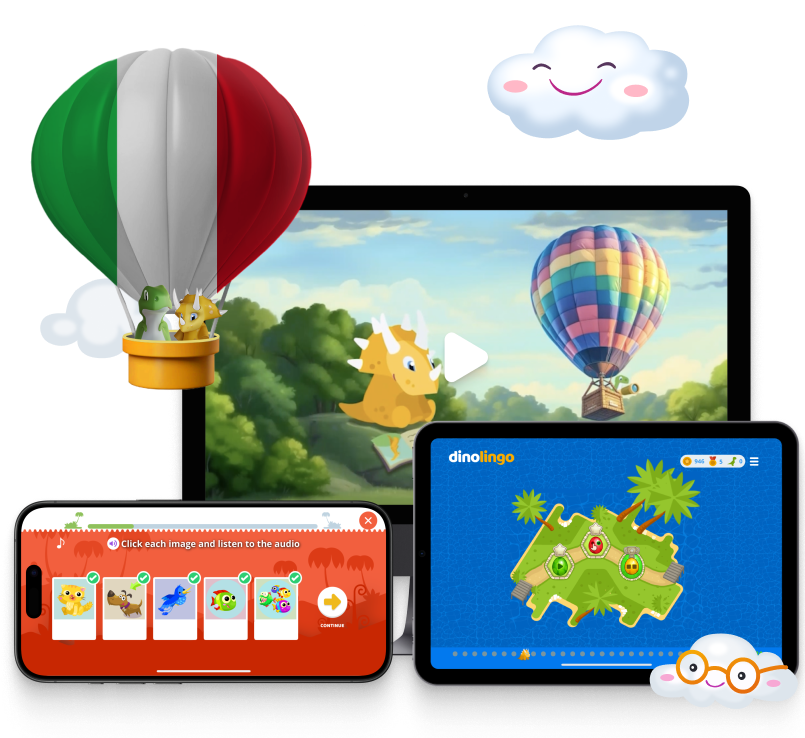
With Dinolingo’s online Italian lessons for kids, children don’t just memorize words, they go on a cultural adventure. Through engaging videos, games, and stories, they can “travel” to cities like Rome, Venice, and Florence while picking up Italian vocabulary naturally.
Explore Italy from Home: Virtual Field Trips
You don’t need a plane ticket to walk these streets with your children. Virtual tours transport kids to iconic Italian landmarks, museums, and cultural hotspots without leaving the living room, sparking curiosity, vocabulary growth, and cultural understanding. Pair each stop with a few Italian words to turn screen time into a language lesson.
- Colosseum and Ancient Rome: Take a 360° tour of the Colosseum’s underground and learn terms like l’arena (arena) and il gladiatore (gladiator). Pause to ask: “Dove combattevano i gladiatori?”
- The Canals of Venice: Glide down virtual gondolas while spotting la gondola and il canal Grande. Kids practice phrases: “Guarda il ponte!” and narrate scenes in Italian.
- Uffizi Gallery in Florence: Stroll through Renaissance masterpieces. Teach il dipinto (painting), il artista (artist), and discuss colors in Italian: “Questo è un quadro blu.”
- Pompeii Ruins: Walk ancient streets frozen in time. Introduce la casa, il foro, and practice past-tense phrases: “Gli antichi Romani vivevano qui.”
- Leaning Tower of Pisa: Explore the tilt and mechanics. Kids say: “La torre è inclinata” and measure angles using simple Italian prompts: “Quanti gradi?”
- Italian Cooking Demo: Join live or recorded cooking sessions and learn il pomodoro, la pasta, mescolare (to stir). Narrate each step: “Ora aggiungi l’olio.”
- Dolomites Virtual Hike: Discover mountain vocabulary: la montagna, il sentiero, la neve. Encourage descriptive sentences: “Vedo la neve bianca.”
- Sicilian Puppet Show: Watch a traditional Opera dei Pupi performance. Teach il burattino (puppet), la storia (story), and have kids retell the plot in Italian.
- Vatican Museums: Virtually explore St. Peter’s Basilica; learn la cupola, il mosaico, and practice respectful phrases: “Che bello!”
- Italian Festivals and Traditions: Experience Carnevale in Venice or the Palio di Siena. Discuss la maschera (mask), la corsa (race), and craft mini masks at home while narrating in Italian.
After each tour, launch a themed micro-lesson in the Dinolingo Italian course to reinforce key vocabulary and earn a surprise badge. You can also explore the technical details of virtual experiences in How It Works. Virtual field trips bridge language and culture, turning screens into windows to Italy.
The Many Voices of Italy: Regional Dialects
Italy’s language is as diverse as its landscape and its history. Beyond standard Italian (italiano), each region speaks its own dialect with unique words, echoes of the local cultures that produced everyone from Sicilian puppeteers to Milanese fashion houses. Introducing kids to these regional terms builds cultural curiosity and adds flavor to their Italian journey.
- Picciriddu (Sicilian) means “child.” Example: “U picciriddu gioca in giardino.” (The child plays in the garden.)
- Uagliò (Neapolitan) means “boy” or “buddy.” Example: “Ciao, uagliò! Come stai?” (Hey, buddy! How are you?)
- Mo (Venetian) means “now.” Example: “Mo vinìmo a casa.” (Now we’re coming home.)
- Magnà (Romanesco) means “to eat.” Example: “Dopo, andiamo a magnà la pizza.” (Afterward, let’s go eat pizza.)
- Vee (Milanese) means “to come.” Example: “Vee qui subito!” (Come here right away!)
Practice and Play: Turn these words into a mini-performance. Assign each child a dialect and have them greet each other using their regional term. Record the dialogue and play it back, celebrating each dialect’s melody. Standard Italian lays the foundation, so explore Dinolingo Italian for Kids to master basic vocabulary and pronunciation before diving into dialect fun. By practicing picciriddu, uagliò, mo, magnà, and vee, young learners gain a linguistic adventure and an authentic taste of La Dolce Italia.
Want to Bring History to Life for Your Kids?
Exploring these famous Italians, their cities, and their language is a fun way to spark children’s curiosity about history and culture. With Dinolingo, kids can learn Italian through fun and interactive content that includes videos, songs, stories, and games tailored to different age groups, plus printable workbooks for an unforgettable journey at home.
Whether your child is fascinated by Roman soldiers or inspired by Renaissance artists, Dinolingo’s Italian program helps them build language skills while discovering the people and stories that shaped Italy. Let their language journey begin with the legends of the past, and fun in the present!