
Tiny Tales from Japan: Short Stories Kids Will Love
Japanese folktales have captivated generations of children with their gentle storytelling, fantastical elements, and meaningful life lessons. Deeply influenced by Chinese culture and shaped by Japan’s unique geography and collectivistic society, these stories emphasize values such as patience, honesty, and hard work. This guide gathers the most beloved tales, then shows you how to turn them into hands-on Japanese language play your child will ask for again and again.
Recurring Characters and Motifs
Before diving into the stories, it helps to know the figures children will meet over and over. These classic short stories often include recurring characters and motifs:
- A kind old couple with no children
- A small but strong boy or a beautiful girl
- Oni (devils)
- Helpful animals or magical beings
- Nature-rich settings like forests, rivers, and mountains
- Samurai warriors who support the story’s hero
Beloved Japanese Folk Tales for Children
Momotaro (Peach Boy)
An elderly woman finds a peach floating in the river. When she and her husband open it, a baby boy pops out. They name him Momotaro. As he grows, he becomes incredibly strong and learns about devils (oni) bothering nearby villagers. Momotaro sets off to defeat them, taking with him magical dumplings. Along the way, he befriends a dog, a monkey, and a pheasant, who all help him in battle. Together, they defeat the devils and return home with treasures to share with the villagers.
Kaguya Hime (The Tale of the Bamboo Princess)
A bamboo cutter discovers a glowing baby girl inside a bamboo stalk. Named Kaguya Hime, she grows into a beautiful young woman. Many suitors try to win her heart, but she sets them impossible tasks. Eventually, she reveals she is from the moon and must return. Despite the bamboo cutter’s attempts to keep her, the moon people come and take her away. It is said she visits Earth again during the full moon.
Shitakiri Suzume (The Tongue-Cut Sparrow)
An old man saves a sparrow, but his greedy wife cuts its tongue out for eating their food. The sparrow disappears, and the old man later finds it at the Sparrow’s Inn. The sparrows reward him with treasure for his kindness. The wife, hoping for treasure, visits but chooses a large basket filled with curses. Her greed leads to her downfall.
Issunboushi (The One-Inch Boy)
A tiny boy is born to an old couple. Though small, he is brave and dreams of becoming a samurai. Using a needle as a sword and a bowl as a boat, he ventures out and becomes a guard to a princess. He defeats an oni using cleverness and is later transformed into a full-sized man with a magical mallet. He marries the princess and lives happily ever after.
Kintaro (The Golden Boy)
Raised in the mountains by a mountain witch, Kintaro is known for his incredible strength and kind heart. He befriends animals and helps those in need. As an adult, he becomes a powerful samurai named Kintoki, serving the great warrior Yorimitsu.
Urashima Tarou
A fisherman saves a turtle, who turns out to be a princess from the Dragon Palace under the sea. He is invited to the palace but wants to return after a few days. Given a mysterious box, he is told never to open it. Upon returning, he finds 300 years have passed. Opening the box causes him to age instantly. The tale teaches the importance of patience and accepting fate.
More Famous Stories to Explore
- The White Butterfly (しろいちょう): A tale of transformation and memory.
- The One-Yen Coin (いちえんだま): Teaching the value of small things.
- The Stonecutter (いしだいく): A lesson about ambition and being content.
- The Carp That Never Gave Up (あきらめなかったコイ): About perseverance.
- The Magic Sword (まほうのけん)
- The Rats and Their Daughter (ねずみのよめいり)
- The Samurai’s Brave Daughter (ゆうかんなさむらいのむすめ)
- The Snow Woman (ゆきおんな): A haunting winter legend.
- The Two Frogs (にひきのカエル)
- The Willow Tree (やなぎのき)
- Sparrow’s Inn (したきりすずめ)
- Monkey and Crab (さるかに)
- Click-Click Mountain (Kachikachiyama かちかちやま)
- Returning the Crane’s Favor (つるのおんがえし)
- Rolling Rice Ball (Omusubi Kororin おむすびころりん)
- The Flying Farmer (Kamotori Gonbee かもとりごんべえ)
- Sumo Mice (Nezumi no Sumou ねずみのすもう)
These stories can be a fun and meaningful way for children to learn Japanese language and culture. Reading the tales is only the beginning, though. The same characters, settings, and vocabulary become far more memorable when children act them out, build their own versions, and play with the words. The activities below turn passive listening into active Japanese practice.
Build Your Own Stories With Picture Games
Storytelling games using images help children connect words to ideas naturally. By arranging picture cards or dice into a sequence, young learners craft tales while practicing Japanese terms, like いぬ (inu, dog) and ねこ (neko, cat), in context. This playful approach mirrors the folktales above and boosts vocabulary and confidence without rote memorization.
What Are Picture Story Games?
Picture story games involve sets of illustrated cards or tokens. Players lay out a series, such as a puppy meeting a kitten, then finding an umbrella, and narrate each scene using simple sentences. This method encourages spontaneous language use and reinforces sentence structures like いぬ が ねこ に あう (inu ga neko ni au, the dog meets the cat).
Top Picture Story Games
Kamishibai (紙芝居): A traditional Japanese storytelling style using illustrated cards in a wooden frame. Kids flip through slides and narrate in Japanese, saying phrases such as 「こども が あそぶ」 (kodomo ga asobu, the child plays).
Rory’s Story Cubes: Nine dice, each face showing an image, such as a castle, star, or tree. Roll the cubes, arrange them, and invent a story using Japanese words for each icon: 「ほし」 (hoshi, star) or 「き」 (ki, tree).
Picture Sequence Cards: Sets of four to six cards depicting a simple action sequence. Children shuffle and order cards, then describe each step: 「ねこ が みず を のむ」 (neko ga mizu o nomu, the cat drinks water).
Digital Picture Games: Online tools like Just One Cookbook’s cultural activities include digital card games where kids match images to Japanese words and build mini-stories.
Story-Building Activities
Story Chain Relay: In a circle, each child places one card and adds a sentence in Japanese: 「つち の うえ に はな が さく」 (tsuchi no ue ni hana ga saku, flowers bloom on the ground). The narrative ribbon grows with every turn.
Emoji Story Remix: Use emoji stickers as prompts. Kids choose three emojis, such as 🌳, 🐰, 🌧️, and create a sentence: 「うさぎ が き を さかのぼる そして あめ が ふる」 (usagi ga ki o sakanoboru soshite ame ga furu, the rabbit climbs a tree and then it rains).
Story Wall: Keep a wall of recent picture sequences. Invite children to retell the story at snack time, reinforcing both vocabulary and narrative skills.
Play With Opposites: Big vs. Small in Japanese
Opposites give children a framework to compare and describe the world, and “big” vs. “small” is one of the very first pairs they master. Learning these contrasts in Japanese, 大きい (ōkī, big) and 小さい (chīsai, small), builds vocabulary and confidence. Interactive games turn abstract words into tangible fun, helping terms stick faster than flashcards alone, and they pair beautifully with stories full of tiny heroes like Issunboushi.
Core Opposites Vocabulary
Start by teaching these essential pairs:
- 大きい (ōkī) – big vs. 小さい (chīsai) – small
- 長い (nagai) – long vs. 短い (mijikai) – short
- 高い (takai) – high/tall vs. 低い (hikui) – low/short
Use picture cards or physical objects, such as chairs, books, and blocks, to illustrate each word. Encourage kids to touch, hold, and describe items aloud in Japanese.
Interactive Opposites Games
Opposite Scavenger Hunt: Hide pairs of objects around the room: a large stuffed toy and a tiny figurine, a tall block and a short one. Give each child a list of Japanese words (大きい, 小さい). As they find an object, they call out its name, 「これは 小さい!」, and place it in the “Big” or “Small” basket accordingly.
Size Sorting Relay: Create two baskets labeled 大きい and 小さい. Line children up and show them an object. They race to the correct basket, shouting the Japanese term before tagging the next teammate. This builds speed and recall under playful pressure.
Opposites Jar: Keep a jar filled with word-pair cards. Each day, draw one card, say 長い/短い, and challenge the family to use both words five times during meals, play, or outings. Reward full participation with stickers or extra storytime.
Bring It All Together With Dinolingo
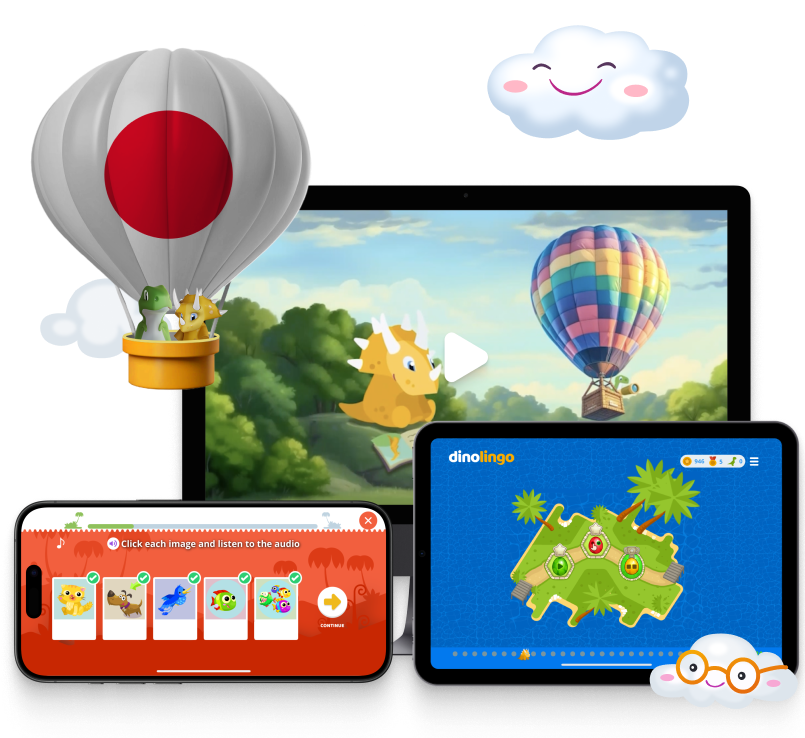
After your hands-on games and storytelling, open Dinolingo for quick follow-up activities. One family subscription unlocks over 50 languages and 40,000+ activities: animated tale modules, contrast videos, matching games, flashcard quizzes, and surprise badge rewards, all organized by age (Pre-readers 2–5, Elementary 6–10, Tween/Teen 11–14). Children revisit words like 大きい and 小さい and echo their own picture stories in bite-size lessons, while parents monitor progress on an ad-free dashboard. Platforms like Dinolingo also offer illustrated versions of traditional folktales, along with engaging videos, games, and songs that introduce kids to the language in a joyful, story-based way.
Pairing folktales with fun hunts, relays, picture sequences, and daily challenges makes Japanese storytelling come alive. Explore these tales with your child, and discover that children do not just learn the words, they use them confidently every day.
Sources
- Tofugu – Learning Japanese Vocab Using Opposites
- JapanesePod101 – Antonyms: 15 Ways to Describe Opposites
- Just One Cookbook – 12 Japanese Cultural Activities & Games for Kids
- The Creativity Hub – Rory’s Story Cubes
- JALT Publications – Storytelling Activities for ELD in Japanese Preschool

They story of Momotaro was not exactly true I think you should change it.
Thank You
Good!
Lmao it looks like she found a giant butt.
If possible, could you please email me the English and Japanese Hiragana/Katakana version of the Stonecutter. I have tried to find it on the Internet with no results. Thank you.
Super merci!!