Charming Italian Baby Names and Their Beautiful Meanings
Italian names are known for their lyrical quality, rich meanings, and strong cultural roots. Whether you’re learning Italian or just love the sound of the language, exploring traditional Italian names can be a wonderful way to connect with the culture. Below are some captivating Italian names for boys and girls, along with their meanings, followed by a complete guide to helping your child discover Italy, build vocabulary, master simple grammar, and fall in love with the language through stories, games, crafts, and food.
Popular Italian Girl Names
Adriana
A graceful name meaning “from Hadria,” an ancient town in northern Italy. Feminine form of Adriano or Adrián.
Allegra
This lively name means “cheerful and lively.” It’s also used as a musical term in classical compositions.
Anjelica
A variant of Angelica, meaning “angelic.” A sweet and timeless choice.
Elisabetta
The Italian form of Elizabeth, meaning “God is my oath.” Elegant and regal.
Gabriella
Feminine form of Gabriele, meaning “God’s warrior” or “woman of God.”
Giovanna
The Italian version of Joanna, meaning “God is gracious.” A strong and spiritual name.
Balbina
An ancient name meaning “little stammerer,” also associated with a Catholic saint and Roman martyr.
Arietta
Derived from Aria, this name means “little song,” perfect for music lovers.
Carmela
Meaning “garden” or “vineyard,” inspired by Mount Carmel in Israel, often considered a paradise.
Donnalee
A compound name combining Donna (lady) with Lee. It evokes elegance and respect.
Popular Italian Boy Names
Arsenio
A strong name meaning “virile,” often associated with courage and masculinity.
Bernardino
A pet form of Bernardo, meaning “bold as a bear.” A brave and enduring name.
Clemente
Meaning “gentle and merciful,” this name evokes kindness and wisdom.
Doriano
Italian form of Dorianus, meaning “from the Dorian tribe,” with classical and poetic connotations.
Elia
The Italian version of Elijah, meaning “The Lord is my God.” A name with deep biblical roots.
Emiliano
A stylish name meaning “rival,” with ancient Roman origins.
Gervasio
An uncommon and strong name meaning “spear servant,” historically noble and warrior-like.
Guido
An old Italian name derived from Wido, meaning “wide,” often linked with leadership and wisdom.
Jovanni
A modern-sounding name with the classic meaning “God is gracious,” variant of Giovanni.
Leonardo
A powerful name meaning “lion-strong,” famously shared with Leonardo da Vinci.
Discover Italy: The Land Behind the Language
Names carry the story of a place, and few places have a story as colorful as Italy. Before diving into vocabulary and grammar, it helps children to picture the country itself. Italy is a country in southern Europe that is easy to spot on a map: it is shaped just like a high-heeled boot, which is why it is sometimes called “Lo Stivale,” meaning “The Boot.” Another nickname is “Bel Paese,” meaning “beautiful country,” and with tall mountains in the north, sunny beaches in the south, and cities full of art, history, and delicious food, it is not hard to see why.
From the Alps to Volcanoes: Italy’s Amazing Land
Italy sits right in the middle of the Mediterranean Sea, surrounded by water on three sides, so it is called a peninsula. It also includes two large islands, Sicily and Sardinia, and many smaller ones, covering about 301,230 square kilometers, slightly larger than the U.S. state of Arizona. To the north, Italy shares borders with France, Switzerland, Austria, and Slovenia. The Alps stretch across this northern border and include Italy’s highest mountain, Monte Bianco (also called Mont Blanc), which stands at 15,770 feet (4,897 meters). Running down the center of the country are the Apennine Mountains, which divide the cooler east and west sides from the hot, dry southern regions along the sea.
Italy is one of the few places in the world with active volcanoes. Mount Vesuvius near Naples is the only volcano in mainland Europe to have erupted in the last hundred years, Mount Etna in Sicily is one of the most active volcanoes in the world, and tiny Stromboli, an island off the coast, is also very active. The country has many rivers too: the longest is the Po, which starts in the Alps and flows to the Adriatic Sea, while the Arno runs through Florence and the Tiber flows through Rome. Italy is home to about 61 million people. The capital is Rome, often called “The Eternal City” because it has been standing for almost 3,000 years, and around 3.5 million people live there today. Italy even surrounds two very small countries: San Marino, the world’s oldest republic, and Vatican City, the smallest country on Earth, home of the Pope and the center of the Roman Catholic Church.
Who Are the Italian People?
Italy is not just a country full of amazing food and beautiful buildings, it is also home to people who are creative, passionate, and full of life. One thing that really stands out about Italian culture is the importance of family. In many Italian homes, grandparents live with their children and grandchildren, and big family meals, laughter, and storytelling are everyday traditions. Italians enjoy many things, but sports are high on the list. Soccer, called calcio in Italian, is the country’s favorite sport, and every city has a team that fans cheer for with great excitement. Cycling, skiing, and car racing are also popular in different regions.
Italy has been home to some of the world’s most famous explorers, scientists, and inventors. Christopher Columbus and Amerigo Vespucci helped uncover new parts of the world, and Marco Polo took a long journey to Asia and brought back stories that amazed Europe. Leonardo da Vinci, a true genius, was both an artist and a scientist, while Alessandro Volta made major discoveries about electricity, and his name lives on in the word “volt.” Italians also invented the piano, the thermometer, and many other tools we use every day.
Italy for Kids: Must-See Places Full of Wonder
Rome is the capital of modern Italy and one of the most historic cities in the world, with ancient ruins, beautiful fountains, Renaissance palaces, and impressive churches at every turn. The Pantheon, built in 27 BC, is a temple decorated with paintings and a garden. The Coliseum, once home to gladiator battles and dramatic plays, is a massive stone arena visible from miles away, and the Temple of Venus and Rome is the largest ancient temple in the city. Rome is also home to the Vatican and the grand St. Peter’s Basilica.
Venice is a magical city built on water in the middle of a lagoon. At its heart is Piazza San Marco with its stunning church, and the city is filled with museums, palaces, and canals, making it fun to explore on foot or by gondola. Florence is the birthplace of the Renaissance, home to the breathtaking Duomo and Baptistery, museums full of famous paintings and sculptures, and elegant Medici palaces and gardens. Milan is one of Europe’s wealthiest and most stylish cities, known for fashion, its marble-covered Duomo, and La Scala, one of the world’s most renowned opera houses.
Naples is a colorful coastal city south of Rome, full of historic and artistic landmarks. Verona is famous as the setting of Shakespeare’s Romeo and Juliet and has a large Roman Arena, the third-largest in Italy, which hosts an annual opera festival. Turin, near the Alps, hosted the 2006 Winter Olympics and is full of baroque buildings, elegant shops, and cozy cafes. Bologna is admired for its beauty, its long archways, and one of Europe’s oldest universities. Perugia is a vibrant hilltop city in the Umbria region, famous for a summer jazz festival and history going back to the 9th century BC. Genoa, Italy’s main seaport, was named a European Culture Capital in 2004 and is home to a large aquarium, the historic port where Christopher Columbus once sailed, and what is said to be the largest medieval quarter in Europe.
Building Your Child’s First Italian Vocabulary
Once children are excited about Italy, the next step is giving them words to describe it. Colors, numbers, days, months, and family names are the friendly, high-frequency vocabulary that lets kids start naming the world around them, and each set pairs beautifully with crafts, songs, and games.
30 Essential Italian Colors
Learning colors becomes unforgettable when each hue comes alive through creativity. Start with these 30 color words: rosso (red), arancione (orange), giallo (yellow), verde (green), blu (blue), indaco (indigo), viola (violet), rosa (pink), marrone (brown), nero (black), bianco (white), grigio (gray), azzurro (light blue), turchese (turquoise), fucsia (fuchsia), oro (gold), argento (silver), beige (beige), crema (cream), corallo (coral), oliva (olive), lime (lime), lavanda (lavender), salmone (salmon), bordeaux (burgundy), pistacchio (pistachio), acquamarina (aquamarine), chartreuse (chartreuse), magenta (magenta), and petrolio (teal).
Bring them to life with hands-on crafts. Make a Rainbow Plate Wheel by dividing a paper plate into 10 segments, painting each a different color while naming it in Italian, then adding a clothespin spinner. Build a Tissue Paper Mosaic from small squares of 10 colors, saying each color aloud while gluing. Try Foam Shape Stamps dipped in paint and labeled with their Italian color name, a Nature Color Collage sorting leaves and flowers by color, and Clothespin Color Clips that children match to colored picture cards. Before long they will joyfully say “vedo un verde oliva.”
Italian Numbers 1 to 100
Counting in Italian unlocks real-world math skills and everyday language: saying your age, understanding prices, and telling time. Italian numbers are largely phonetic, which makes them perfect for young learners. The patterns are simple once you see them: 1 to 10 are unique words (uno, due, tre); 11 to 16 add the -dici suffix (undici, dodici); 17 to 19 use dici- plus the base number (diciassette); tens from 20 to 90 use endings like -anta (venti, trenta, quaranta); and you build the rest by combining, such as ventuno, ventidue, sessantacinque, and ottantotto, all the way to cento (100).
Make practice playful with five games. Number Line Hopscotch: hop on a chalk grid and say each number in Italian. Counting Song and Clap: sing to the tune of “Twinkle, Twinkle,” clapping once per number and twice on multiples of five to internalize stress patterns like venti (ven-TEE) and trenta (TREN-ta). Bingo dei Numeri: call numbers as kids cover a 5×5 grid. Dice Dialogue: roll two dice for tens and units, then say the number. Hundred Chart Puzzles: reassemble a cut-up 10×10 chart while reciting each number. With movement and music, children will say ottantatré and novantacinque with confidence.
Italian Days and Months
Knowing the days and months helps children talk about schedules, birthdays, and holidays. The days of the week are lunedì (Monday), martedì (Tuesday), mercoledì (Wednesday), giovedì (Thursday), venerdì (Friday), sabato (Saturday), and domenica (Sunday). The months of the year are gennaio (January), febbraio (February), marzo (March), aprile (April), maggio (May), giugno (June), luglio (July), agosto (August), settembre (September), ottobre (October), novembre (November), and dicembre (December).
Bring the calendar to life with interactive exercises. Sing the Italian days song to the tune of “Frère Jacques,” encouraging echo responses. Build a Day and Date Wheel from two paper circles, the outer ring labeled with days and the inner ring with numbers 1 to 31, joined with a brad fastener so the inner wheel spins; each morning spin to today and say “Oggi è mercoledì 14 aprile.” Play Month Card Match with 12 picture cards (a snowflake for gennaio, a flower for maggio) matched to printed month names, and an Italian Calendar Hunt where children find hidden month cards and place them in order, saying the full date like “Ho trovato il mese di agosto: 15 agosto.” A daily challenge such as “Qual è il mese dopo luglio?” keeps recall sharp.
La Famiglia: Family Tree in Italian
Because family is at the heart of Italian life, family vocabulary is a natural and emotional place to build words. The essential terms are la mamma (mother), il papà (father), il fratello (brother), la sorella (sister), il nonno (grandfather), la nonna (grandmother), lo zio (uncle), la zia (aunt), il cugino / la cugina (cousin), and il nipote (grandchild).
Turn this vocabulary into a keepsake with a DIY Family Tree craft. Draw a large tree trunk and branches on poster paper, cut leaf shapes from colored paper and write one family term on each, then glue a photo or drawing of that person and attach the leaves to the branches. Have kids point to each leaf and say the term: “Questa è la nonna.” Reinforce with an Interview Game where Child A asks “Come si chiama tuo cugino?” and Child B answers “Si chiama Marco,” and a Matching Quiz pairing term cards with picture cards. Watch vocabulary blossom as children explore la famiglia in a memorable way.
Simple Italian Grammar Every Child Can Understand
With a bank of nouns in hand, children are ready to connect words into sentences. Grammar feels fun when it is broken into bite-sized rules with clear examples, and the building blocks below give kids the confidence to speak and write.
Subject Pronouns: Io, Tu, Lui/Lei and More
Subject pronouns are the building blocks of Italian sentences. Knowing io (I), tu (you informal), lui/lei (he/she), noi (we), voi (you plural), and loro (they) lets kids form clear, confident statements. Pronouns replace nouns to avoid repetition (“Marco è felice. Lui è felice.”), they link directly to verb conjugations to show who does the action, and mastering them opens the door to constructing full sentences in any tense. Practice with a Flashcard Race (call out an English pronoun and have kids slap the Italian equivalent), Mirror Talk (say “io sono” and “tu sei” while watching mouth shapes), and a Pronoun Mix-Up where children fill the blank in a sentence strip like “_____ mangiamo” and read it aloud.
Mastering Essere and Avere
Learning essere (to be) and avere (to have) unlocks the foundation of Italian conversation, since these two verbs appear in countless sentences and form the basis of compound tenses. Essere builds identity and states (“Io sono felice”), while avere expresses possession and age (“Lei ha cinque anni”), and mastery leads to confident sentence-building. Practice with Verb Form Snap, matching pronoun cards to verb-form cards (for example, noi + siamo); a Conjugation Relay where teams race to write new conjugations like “tu hai”; Emotion Charades assigning each form of essere to an emotion (“lui è stanco”) for classmates to guess; and a Treasure Hunt using avere clues like “Hai il pallone?” With practice, children will go from io sono to loro hanno naturally, pronti a parlare.
Six Core Grammar Rules
Six fundamental rules give young learners the structure they need. 1. Subject-Verb Agreement: verbs change to match the subject (Io mangio, Tu mangi, Lui/lei mangia). 2. Gender and Number Agreement: nouns and adjectives agree in gender and number (Il gatto nero, masculine singular; le gatte nere, feminine plural). 3. Plural Formation: most nouns change the final vowel, with –o to –i (il libro to i libri), –a to –e (la casa to le case), and –e to –i (l’amico to gli amici). 4. Basic Sentence Order: Italian follows Subject-Verb-Object order (“Io leggo un libro”). 5. Forming Negatives: add non before the verb (“Io non gioco”). 6. Asking Questions: raise intonation or add question words like Dove? (Where?), Quando? (When?), and Perché? (Why?). Turn each rule into a quick matching, puzzle, or fill-in activity, and Italian confidence will soar.
Learning Italian by Ear: Listening and Stories
Listening is the gateway to speaking. Podcasts, audiobooks, and classic fairy tales expose children to authentic Italian dialogue, varied accents, and storytelling rhythms, which are crucial for developing comprehension and pronunciation.
Best Podcasts and Audiobooks for Young Learners
A handful of audio resources work especially well for kids. The Italian Kids Podcast by DinoKids offers short, animated episodes that guide listeners through vocabulary themes like colors, animals, and daily routines, ending each episode with a quiz. The Favole per Bambini audiobook series presents classic Italian fairy tales narrated by native speakers; encourage kids to draw a scene afterward and describe it (“Nel bosco c’era un lupo grigio”). Storie della Buonanotte offers gentle bedtime stories with soothing repetition, perfect for the “echo round” technique of pausing and repeating each sentence. Italian with Elisa features clear enunciation and sound effects, with prediction questions like “Cosa pensi succederà?” And AudioFiabe builds in comprehension pauses where children answer a question or act out a phrase before the story continues.
A simple 10-minute listening routine keeps progress steady: preview three target words (2 minutes), listen to the segment once without interruption (4 minutes), echo key sentences and act out the verbs (3 minutes), and finish with a related audio drill (1 minute). Regular exposure transforms passive hearing into active comprehension.
Italian Fairy Tales and Folk Stories
Classic tales transport children into a world of imagination while reinforcing listening comprehension. Le avventure di Pinocchio, Carlo Collodi’s timeless story of the wooden puppet, introduces words like burattino (puppet), bugia (lie), and Geppetto (the woodcarver). La Gatta Cenerentola, a Neapolitan Cinderella, brings bacchetta (wand), ceneri (ashes), and regina (queen). Colapesce, a Sicilian legend about a boy who becomes half-fish, teaches mare (sea), pesce (fish), and isola (island). Il Pifferaio Magico (The Pied Piper) adds pifferaio (piper), topo (rat), and borgo (village), and Giufà il Buffone introduces buffone (jester), villaggio (village), and storia (story).
Pair the tales with playful listening activities: a First-Listen Adventure where kids share the gist in simple Italian, Echo the Hero repeating key phrases like “Geppetto, dove sei?” with matching intonation, Character Dramatization performing short dialogues, Fill-in-the-Blank Scripts for words like burattino or pifferaio, and Retell and Illustrate, drawing a scene and narrating it (“Il burattino salta” or “Pinocchio è felice”). These enchanting stories build strong comprehension while delighting in each adventure.
Learning Through Play and Food
Play and cooking turn language practice into a joyful experience. Movement, imagination, social interaction, and hands-on kitchen time all build vocabulary, listening, and speaking skills while making the language feel alive.
Top Games for Little Linguists
Five play-based games stand out. Italian Market Role-Play: set up a mini marketplace with items labeled in Italian (“il pane, la frutta”) and let children take turns as venditore (seller) and cliente (customer), using phrases like “Quanto costa?” and “Prendo due mele.” Vocabulary Scavenger Hunt: hide picture cards and call out a word (“Trova il gatto!”) so children dash to find and name it. Italian Board Game Twist: label each square of Snakes and Ladders with a word that must be pronounced correctly before moving. Simon Says (Simone Dice): give commands like “Simone dice salta” (jump) and “Simone dice tocca il naso” (touch your nose) to reinforce verbs and body parts. Story Dice Adventure: roll picture dice and tell a short tale, so a roll of gatto, luna, casa might prompt “Il gatto vola verso la luna e torna a casa.”
Easy Italian Recipes Kids Will Love
Cooking together is a delicious way to explore Italy and practice vocabulary in the kitchen. Try Pastiera di Maccheroni, a savory pasta pie: sauté chopped red onion and carrot in olive oil, add cubed pancetta, ground pork, and rosemary until browned, then stir in a can of cherry tomatoes and cook 15 minutes. Boil penne rigate until al dente, mix with the meat sauce, fold in beaten eggs and grated Parmesan, pour into an oiled baking dish, and bake at 350°F for about 20 minutes until set and crispy.
For a quick dinner, make Turkey Sausage and Tortellini in Creamy Tomato Basil Sauce: brown Italian turkey sausage in a skillet, drain the fat, then add cream of chicken soup, water, diced tomatoes, and frozen cheese tortellini, simmer 5 minutes, and finish with chopped fresh basil and Parmesan. Or build an Arugula Pesto, Ricotta and Smoked Mozzarella Pizza by blending ricotta with garlic, salt, and pepper, pulsing in smoked mozzarella and arugula, spreading it over a 14-inch round of pizza dough drizzled with olive oil, and topping with sliced plum tomatoes. These simple dishes are full of Italian flavor and a great chance for kids to help in the kitchen and learn about Italy through food.
How to Teach Your Child Italian at Home
Learning a new language is exciting for children, but it is completely normal for their motivation to go up and down. The good news is that helping them stay interested does not require anything complicated. A few fun, consistent strategies keep children engaged and even looking forward to their learning time. Use rewards wisely with a simple sticker or treat system, and tie milestones to experiences like visiting an Italian restaurant or choosing the next Italian cartoon. Surprise and delight very young children with games like peekaboo or hiding a flashcard under a toy. Make learning playful by counting in Italian during hide-and-seek or naming colors while drawing. Keep lessons short and simple, presenting only a few new words at a time, and practice in small ways every day with questions like “What is this in Italian?” or “Which one is the gatto?”
Keep building momentum: turn practice into a game with flashcards and matching, encourage real-world practice by visiting Italian cultural centers, restaurants, or shops so kids hear that the language is alive, and use flashcards and songs together so children make quick associations between objects and Italian words. Add a storytime twist by reading simple English stories and swapping in a few Italian words, then introducing Italian children’s books as they progress. Above all, support and consistency are key: let children watch videos regularly, play language games, and explore printable posters and vocabulary cards. The goal is not perfection, it is joy, confidence, and steady progress.
Learn More Through Language
Learning Italian through names is a fun and memorable way to absorb vocabulary and culture. Kids can explore these names while practicing pronunciation, reading stories, and singing Italian songs.
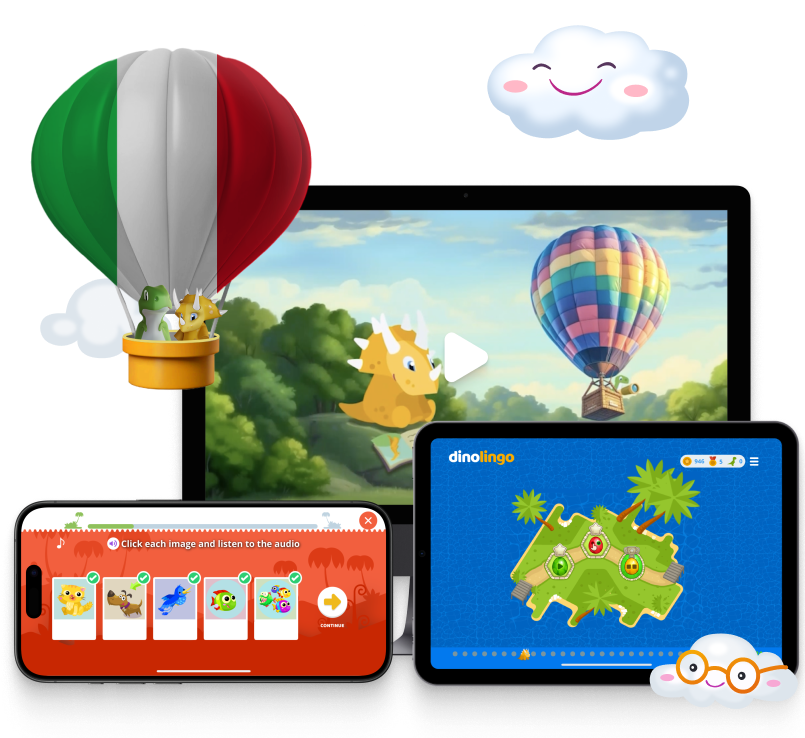
With Dinolingo, children aged 2–14 can learn Italian online through games, songs, videos, and flashcards. The program is available on web, iOS, and Android, and includes offline printable materials and a parent dashboard to track progress. You can reinforce every section of this guide with interactive lessons in the Dinolingo Italian course, where animated games, native-speaker audio, and quizzes give instant pronunciation feedback.
These beautiful names offer more than just identity: they are windows into Italy’s language, history, and music. Why not let your child’s Italian learning journey begin with a name?