Printable German Worksheets: Best Download Sites for Parents
Screen‑free language moments matter: tracing letters, circling verbs, or colouring nouns helps children slow down and absorb new German words. The challenge is finding worksheet downloads that are truly free and still online. Below are five dependable sites (all links tested May 2025), a simple system for using them, a seven‑day starter plan for toddlers, and a shortlist of child‑safe German YouTube channels so you can weave paper, audio, and video into one calm weekly routine alongside Dinolingo’s printable packs.
Top Worksheet Download Sites
| Site | Focus Area | What Parents Love |
|---|---|---|
| Goethe‑Institut „Unterrichtsmaterialien“ | Themed vocabulary & crafts | Professionally designed PDFs backed by Germany’s cultural institute |
| ISLCollective (German) | Mixed grammar & games | Thousands of teacher‑made sheets, easy search filters, free account |
| GermanVeryEasy Worksheets | Numbers, colours, animals | Clean layout and built‑in answer keys for quick self‑check |
| Deutschlernerblog Arbeitsblätter | Verb tenses & song lyrics | Fun worksheets that pair with YouTube videos for auditory support |
| BusyTeacher German Printables | Seasonal packs & conversation cards | Ready‑to‑print PDFs sorted by CEFR level A1–B1 |
How to Use Worksheets Effectively
- Print just two pages at a time, small wins keep motivation high.
- Set a ten‑minute timer; short sprints beat marathon sessions.
- Read instructions aloud in German so kids connect spoken and written forms.
- Reward finished sheets with a sticker chart or a cheerful „Gut gemacht!“ (well done).
Boosting Paper Practice with Dinolingo
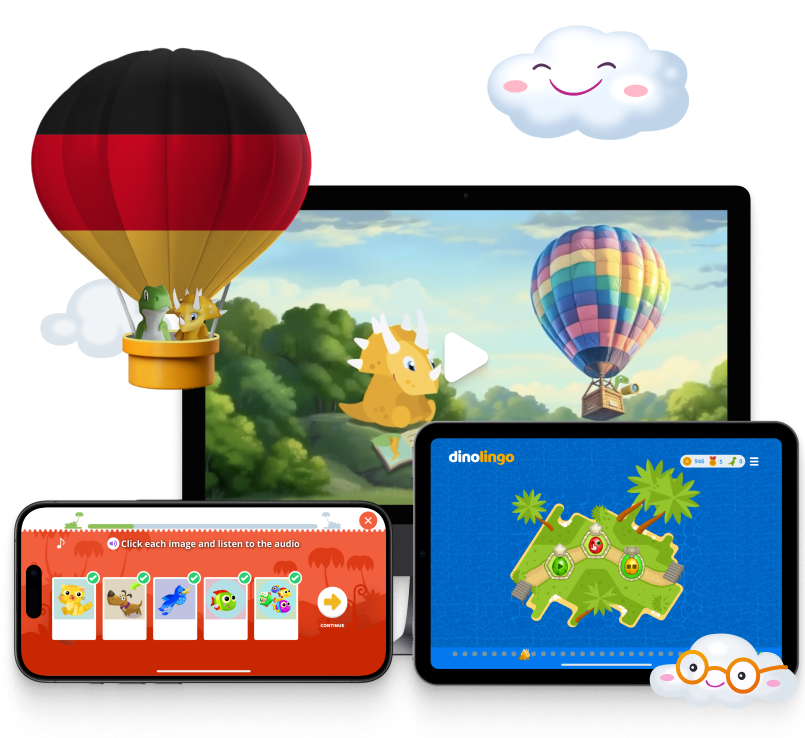
Dinolingo isn’t only digital. Under its curriculum page you’ll find flashcards, colouring pages, and cut‑and‑glue crafts that match each animated lesson. Because the worksheets mirror the app’s vocabulary sets, you can:
- Play a five‑minute Dinolingo lesson on colours.
- Print the matching colouring sheet and finish it at the table.
- Upload a snapshot to earn an in‑app badge motivation with zero ads.
Sample Weekend Worksheet Plan
- Saturday breakfast – Colour the Obst worksheet (apples, bananas, grapes)
- Saturday afternoon – Watch Dinolingo “Fruit Song” and sing along
- Sunday morning – Cut out fruit flashcards and play memory with siblings
Consistent themes link print, audio, and video channels into one easy flow. If you are only just beginning, the seven‑day plan below gives that flow a ready‑made shape.
A 7‑Day German Starter Kit for Toddlers
Toddlers absorb language best when movement, music, and repetition meet everyday life. This one‑week starter kit slips German into breakfast chats, play breaks, and bedtime rituals so that words like der Ball (ball) or hallo (hello) become part of your child’s day without feeling like lessons. Print a themed worksheet to match each day and the paper practice above falls naturally into place.
| Day | Focus | Sample Activities | Key Words |
|---|---|---|---|
| 1 | Greetings | Sing “Hallo, hallo, schön, dass du da bist” at breakfast; roll a soft ball and say “Hallo, ich bin …” | hallo, tschüss |
| 2 | Colors | Finger-paint with rot (red), blau (blue), gelb (yellow); shout color names while sorting toys | rot, blau, gelb |
| 3 | Numbers | Count apple slices aloud: eins, zwei, drei; teddy picnic with three cookies | eins, zwei, drei |
| 4 | Action Verbs | Jumping-jack game chanting springen (jump) and klatschen (clap); splash bath time with planschen (splash) | springen, klatschen |
| 5 | Animals | Picture-book sound game: die Kuh (cow) goes muh; sing “Auf der Farm” with toy animals | die Kuh, der Hund |
| 6 | Directions | Indoor treasure hunt using unter (under) and auf (on); each find earns a cheer “Gut gemacht!” | unter, auf |
| 7 | Bedtime | Read “Gute Nacht, kleiner Bär”; lullaby “Schlaf, Kindlein, schlaf” | der Bär, Gute Nacht |
Hands‑On Highlights
Ball Roll Greeting. Sit on the floor, roll a soft ball back and forth, and say “Hallo, ich bin …”. The physical motion anchors the new phrase and keeps toddlers engaged.
Treasure Hunt. Hide familiar toys around the room. Give one‑word clues such as unter or auf. Toddlers learn prepositions while racing to each hiding place.
Practice Corner. Stick mini labels on household objects (der Tisch – table, die Tür – door). Before every meal, lift one label and say the word together. Repetition in context cements memory.
After each activity, open Dinolingo for a five‑minute follow‑up game that matches the day’s theme: color matching on Day 2, farm‑animal song on Day 5. A single subscription gives up to six children access to over fifty languages and sorts content by age band: Pre‑readers (2–5), Elementary (6–10), and Tween/Teen (11–14). Animated videos, printable flashcards, and surprise rewards keep motivation high, while the parent dashboard shows real‑time progress with no ads or pop‑ups.
Child‑Safe German YouTube Channels Parents Love
Video is the third leg of a balanced routine, sitting alongside worksheets and the daily starter plan. YouTube can feel like a wild ocean of content, yet tucked inside are islands of safe, engaging German videos perfect for children. Choosing the right channels matters: parents need age‑appropriate language, ad filters, and consistent upload quality.
What Makes a Channel Child‑Safe?
- Clear Age Focus – Titles, thumbnails, and scripts aimed at preschool to preteen levels.
- No Unmoderated Comments – Disabled comments or strong moderation protect young viewers.
- Predictable Formatting – Repeated segments such as song, story, and quiz help kids anticipate and retain.
- Educational Credentials – Teachers, linguists, or reputable publishers behind the camera.
Before subscribing, play two random videos and scan for fast cuts, product plugs, or slang that feels off‑brand for your household.
Quick‑Start Viewing Plan
- Five‑Minute Song Warm‑Up – Pick a colour or animal song; clap syllables together.
- Story or Dialogue Clip – Watch a short fairy‑tale retelling; pause to repeat key nouns.
- Active Recall – Close the laptop and ask: “Welche Farbe hast du gehört?” (Which colour did you hear?). Total screen time: about 12 minutes, enough for learning, not enough for screen fatigue.
Linking Videos to Daily Life
- Print screenshots of favourite characters; tape them to the fridge with the word underneath.
- Create a family playlist called Deutsch am Abend (German in the evening) and limit viewing to that list, preventing algorithm wander.
After video time, use Dinolingo’s reviews page to see how other families bridge screen lessons with interactive games. A quick colour quiz or printable worksheet tied to the video topic reinforces vocabulary without extra scrolling.
Channels to Try
- Sing mit mir – Kinderlieder
- BookBox.com – German Stories
- Deutsch für Euch – Kids Playlist
- Learn German with Anja – Beginners
- Easy German – Super Easy German
Final Thoughts
Printable worksheets anchor vocabulary through writing and art while giving eyes a rest from screens. Pair them with a structured starter week and a short list of vetted channels, add time limits and active recall, and your child will sing, laugh, and learn safely. Combine the trusted sites above with Dinolingo’s curriculum downloads and you’ll serve a balanced diet of paper and pixels that keeps German learning fresh all week. Seven focused days prove that toddlers can greet, count, and sing in German without stress: repeat the plan with new songs or toys, and those first words will soon blossom into short phrases.
Sources