Unlocking the Italian Alphabet—Letters Kids Will Love
The Italian Alphabet: Almost Like English, but Not Quite
Italian uses the same 26 letters as the English alphabet. However, five of them — J, K, W, X, and Y — are considered foreign. These letters usually only appear in borrowed words like jazz or kiwi. That means most Italian words are written with just 21 familiar letters. And while the alphabet looks similar, the pronunciation is quite different. For example, “C” sounds like “chee”, “G” sounds like “jee”, and “H” is completely silent in most words.
Here’s how the Italian letters are pronounced:
A (ah), B (bee), C (chee), D (dee), E (eh), F (effe), G (jee), H (ahk-kah), I (ee), L (elle), M (emme), N (enne), O (oh), P (pee), Q (koo), R (err-eh), S (ess-eh), T (tee), U (oo), V (vee), Z (zeh-tah)
A Musical Language with Ancient Roots
Italian is a Romance language, which means it comes from Latin—the language spoken by the Romans over 2,000 years ago. That’s also why many Italian words sound familiar if you’ve learned a bit of French, Spanish, or Portuguese.
One of the most loved things about Italian is how it sounds like a song. Its words flow smoothly, and this soft rhythm is one reason why so many opera songs are written in Italian.
More Than One Italian?
Yes! While Standard Italian (based on the Tuscan dialect) is the official language of Italy, many people still speak regional dialects at home or in their towns. These dialects can be so different that someone from Sicily might sound nothing like someone from Milan. In the north of Italy, you can also hear people speaking German, French, and even Ladin, an old language related to Romansh and Friulian.
Where Else Is Italian Spoken?
Italian isn’t only spoken in Italy. It’s also an official language in:
-
Switzerland
-
San Marino
-
Vatican City
You’ll also hear Italian in parts of Slovenia, Croatia, Malta, and Monaco. Thanks to migration, large Italian-speaking communities now live in countries like the United States, Canada, Brazil, Argentina, and Australia. In total, about 66 million people around the world speak Italian today.
A Great Language for Curious Kids
Italian is not only beautiful—it’s also full of culture, tradition, and fun expressions. Children learning Italian often discover a whole new world of songs, stories, food names, and history.
Looking for an easy and fun way to get started?
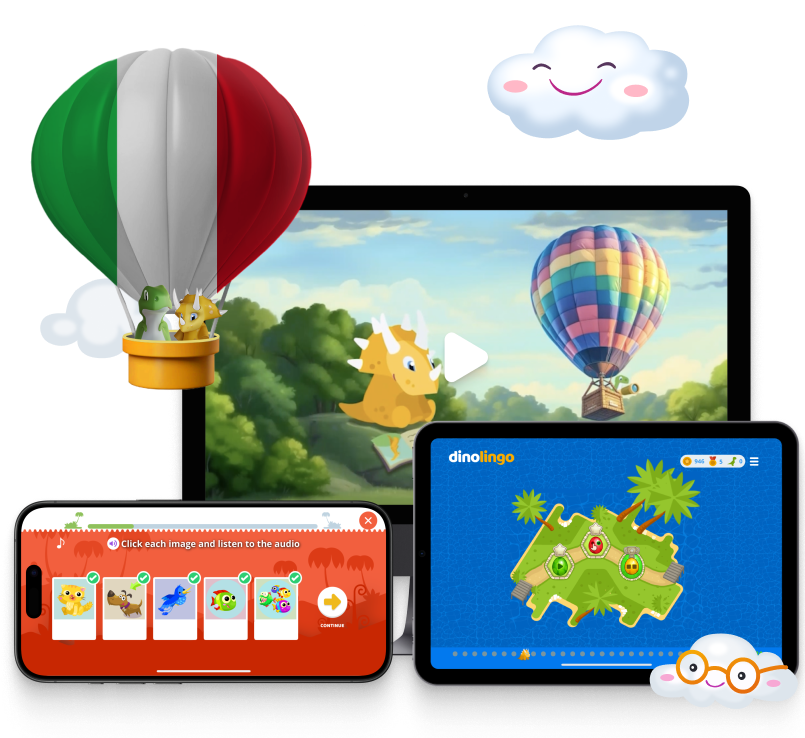
Dinolingo’s online Italian lessons for kids make language learning exciting with songs, games, videos, and more—designed especially for young learners.
.