
Top 10 Japanese Nursery Rhymes Every Child Will Love
Nursery rhymes are a natural gateway into language. Their repetitive melodies and simple lyrics help children remember new words and rhythms. Singing 童謡 (dōyō, nursery rhymes) together builds listening skills, vocabulary, and confidence, all while having fun. In this guide you will find ten beloved Japanese rhymes to sing as a family, a set of catchy hiragana songs that teach the alphabet through melody, hands-on games that turn singing into play, and the best Japanese learning apps to keep the practice going between songs.
Top 10 Japanese Nursery Rhymes
1. Zou-san (ぞうさん, Elephant)
A gentle tune about a little elephant’s walk, repeating ぞうさん to anchor the word elephant.
2. Donguri Korokoro (どんぐりころころ, Acorn Roll)
This playful song follows an acorn (どんぐり, donguri) as it tumbles into a pond, reinforcing ころころ for rolling.
3. Amefuri (あめふり, Rainfall)
Children learn あめ (rain) and パンパン (pitter-patter) while imagining raindrops and umbrellas.
4. Shabondama (しゃぼんだま, Soap Bubbles)
A wistful melody about soap bubbles (しゃぼんだま) rising and popping sparks words for bubble play.
5. Usagi to Kame (うさぎとかめ, The Hare and the Tortoise)
A retelling of the classic fable introduces うさぎ (hare) and かめ (tortoise) through character voices.
6. Koinobori (こいのぼり, Carp Streamers)
Sung each Children’s Day, this rhyme names こい (carp) and のぼり (streamer) as colorful windsocks.
7. Okaasan (おかあさん, Mother)
A sweet lullaby celebrating おかあさん with simple lines perfect for bedtime practice.
8. Mori no Kuma-san (森のくまさん, Bear in the Forest)
Kids follow くま (bear) through the woods, learning 森 (forest) and animal sounds.
9. Kaeru no Uta (かえるのうた, Frog Song)
A lively tune that teaches かえる (frog) and mimics ribbit sounds, great for hopping games.
10. Tanabata-sama (たなばたさま, Star Festival)
Celebrates the starry tale of Orihime and Hikoboshi, introducing ほし (star) and はし (bridge).
Japanese Hiragana Songs for Kids
Once the rhymes have your child humming along, music can do double duty by teaching the alphabet itself. Hiragana, the Japanese phonetic alphabet, comes alive when set to melody. Catchy tunes help children remember each character’s shape and sound, making あいうえお (a-i-u-e-o) stick like a favorite chorus. Songs engage multiple senses, listening, singing, and movement, which anchors sounds in memory. Children’s songs in particular are proven to boost recall through repetition and fun rhythms.
Top Catchy Hiragana Tunes
- “あいうえおのうた” A beloved children’s song that cycles through all 46 characters, pairing each with a simple gesture.
- “Hiragana Rap” A modern take combining beatbox rhythms with kana recitation, perfect for older kids who love movement.
- “Kana Pop Medley” Bright, pop-style mashup of vowel and K-row songs, ideal for sing-along car rides.
- “あ行の歌” by JapanesePod101 Focuses on the A-row (あ, い, う, え, お) with on-screen lyrics and clear pronunciation.
Activities & Games
Rhymes and songs stick best when children sing them with their hands, feet, and imagination. These quick games turn listening into play and pull each new word into the real world.
Bubble Chorus
Mix soapy water and let children blow bubbles while singing Shabondama. Each pop prompts them to name しゃぼんだま aloud.
Acorn Relay
Provide small acorns or balls. In teams, kids roll one across the room while chanting Donguri Korokoro to practice どんぐり and ころころ.
Melody Match
Play short clips of two different hiragana songs and pause. Kids guess which character just played, 「え!」 (e!), then sing the line together.
Hiragana Dance
Assign a dance move to each vowel. Call out あ, and everyone does the “clap-and-spin.” This kinesthetic play cements character-sound links.
Practice Corner
Post lyric cards by the door. When your child passes, they sing the first line of Amefuri or Zou-san before entering. This daily cue reinforces words in context. For the alphabet songs, create a “Song of the Day” jar: each morning, draw a song title and play it twice, once to listen and once to sing, then keep a chart to track how many times each character was sung.
Best Japanese Kids’ Apps
Between singing sessions, the right app can turn screen time into skill time. From playful kana drills to animated story adventures, the best Japanese apps for children combine engagement with structured practice. Below are parent-recommended apps that pair naturally with the rhymes and songs above.
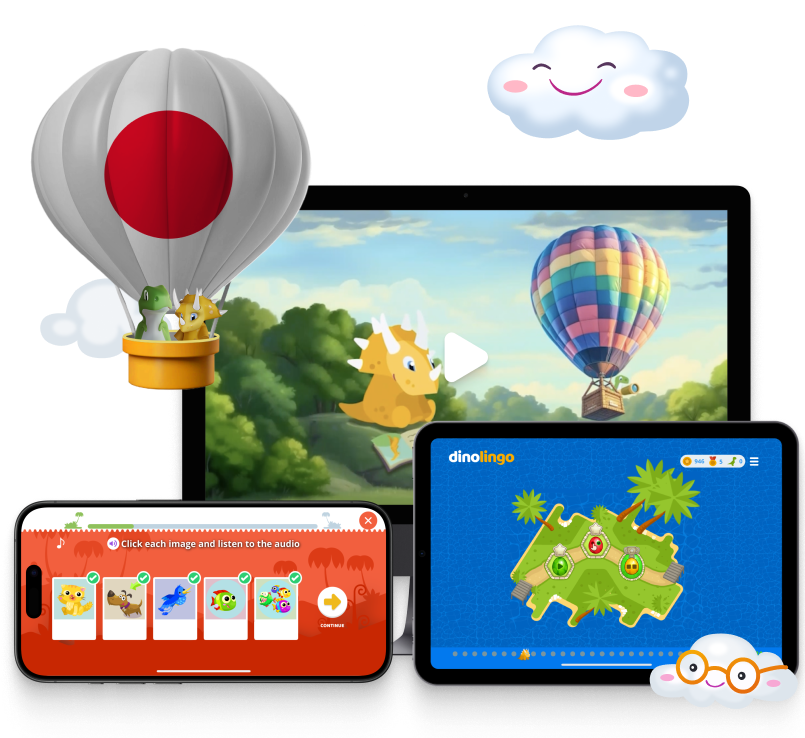
Dinolingo
A family plan unlocks over 50 languages and 40,000+ interactive activities, including animated videos, songs, and printable flashcards, sorted by Pre-readers (2 to 5), Elementary (6 to 10), and Tween/Teen (11 to 14).
Gus on the Go: Japanese
Adventure-style lessons guide kids through themed worlds, どうぶつ (dōbutsu, animals) and たべもの (tabemono, food), earning badges as they go.
LingoKids
Colorful characters, mini-games, and sing-along songs cover greetings (こんにちは), numbers (いち, に, さん), and everyday words across multiple languages.
Kids Kana
Master hiragana and katakana with flashcards, tracing exercises, and arcade-style quizzes. Practice sessions stay under five minutes.
Marugoto for Kids
Based on the popular Marugoto curriculum, this app uses short videos and quizzes to teach polite phrases like おはようございます (ohayō gozaimasu) and いただきます (itadakimasu).
Activities to Reinforce App Learning
App-to-Real-Life Match
Create a picture chart of app icons and Japanese words. After using an app, children pick the matching card and say the word aloud in real life, 「さようなら」 (sayōnara, goodbye) at bedtime or 「ありがとう」 (arigatō, thank you) at snack time.
Screen-Free Replay
After an app session, have kids act out a mini-scene: pretending to order sushi using Marugoto phrases or leading an animal safari with Gus’s vocabulary. This bridges digital practice and speaking.
Weekly Goal
Set a weekly target: three 10-minute app sessions plus one hands-on activity. Track progress on a sticker chart and celebrate milestones with a short Japanese song.
Keep the Learning Going with Dinolingo
Extend rhyme time, song time, and app practice with Dinolingo. Its family plan gives up to six children access to over 40,000 activities across 50+ languages. Age-specific paths, Pre-readers (2 to 5), Elementary (6 to 10), and Tween/Teen (11 to 14), serve animated videos and printable flashcards featuring these very nursery rhymes and hiragana characters, plus surprise badge rewards to keep motivation high and parents in the loop on an ad-free dashboard. Pair Dinolingo’s rich content with the rhymes, songs, and apps above, and your child will be confidently speaking Japanese before you know it, always eager to say “こんにちは” to their next lesson.
Final Thoughts
Japanese nursery rhymes blend melody with repetition, making new words stick like magic, and upbeat hiragana songs make the alphabet feel like second nature. Pair these ten classics and catchy tunes with playful games and Dinolingo’s follow-up activities, and you’ll watch your child hum, sing, read, and speak Japanese with joy and confidence.
Sources
- Tofugu – Japanese Learning Blog
- Tofugu – Learn Hiragana: The Ultimate Guide
- JapanesePod101 – Kids’ Japanese Lessons
- Common Sense Media
- YouTube – Hiragana Song Videos