What’s Your Name in Japanese? Find Out Now!
Have you ever seen your name written in a completely different alphabet? Many people find it exciting and even a little exotic to see their names in foreign scripts. That’s why in popular tourist spots, you’ll often notice long lines of people waiting to get their names written on souvenirs using local characters.
Thanks to technology, doing this has become much easier. With tools like Google Translate, all you need to do is type in your name, and instantly you can see how it looks in Japanese characters and even hear how it’s pronounced. For example:
- If your name is Mr. Smith, it might be written as Sumisu.
- If your name is Jason, it might sound like Jasohn.
The Japanese language uses a special writing system to represent foreign names, and it is a fun way to introduce kids to both the alphabet and pronunciation rules. You can make this into a learning activity with your child: let them hear their name in Japanese and even try writing it using katakana, the alphabet used for foreign words in Japan. From there, names become a doorway into the whole language. This guide walks through the writing systems, first words and vocabulary, rich cultural traditions, pronunciation play, and the best methods for teaching children Japanese at home.
The Three Japanese Writing Systems
One of the most fascinating things about Japanese is that it uses three different writing systems: Hiragana, Katakana, and Kanji.
- Hiragana is used for everyday Japanese words and grammar.
- Katakana is used for foreign words, sound effects, and names from other countries. This is the script your child uses to spell their own name.
- Kanji are characters borrowed from Chinese and are used to represent full ideas or meanings.
Even young children in Japan start learning these scripts in school, beginning with Hiragana. Many children’s books are written in Hiragana, making it the perfect starting point for language learners.
Hiragana: A 5-Minute Daily Practice Plan
Hiragana is the foundation of written Japanese, and early mastery sets kids up for confidence in reading and writing. By practicing just five minutes daily, through songs, flashcards, and hands-on games, children absorb each character (あ (a), い (i), う (u)) without overwhelm. Each day focuses on a small group of characters, and over two weeks kids will cover all 46 basic hiragana:
• Days 1–2: あ (a), い (i), う (u), え (e), お (o)
• Days 3–4: か (ka), き (ki), く (ku), け (ke), こ (ko)
• …continue in rows of five…
A simple daily routine keeps momentum going:
- Flashcard Flip (2 minutes): Show each card, say the sound, and let your child repeat.
- Song & Motion (1 minute): Sing the あいうえお song together, adding claps or jumps for each syllable.
- Writing Practice (1 minute): Trace each character in the air or on paper with colorful markers.
- Quick Read (1 minute): Point to words like あさ (asa, morning) or いぬ (inu, dog) in a simple picture book and sound them out together.
Add movement with hands-on games. For a Character Hunt, hide sticky-note cards with hiragana around the room; when children find one, they call out its sound and match it to a row on a printed chart. For Hiragana Hopscotch, draw a hopscotch grid and write one character per square, then have kids jump while chanting each sound, which is great for kinesthetic learners. Keep a “Character of the Day” on the fridge and encourage your child to spot that hiragana in books, labels, or even on food packaging whenever you go out.
Beginner Kanji: 10 Easy Characters with Memory Tricks
Young learners in Japan tackle over 1,000 kanji by the end of elementary school, nearly half of the 2,136 common characters in daily use. With just ten pictographic kanji, like 山 (やま, mountain) and 川 (かわ, river), children gain confidence early. Fun mnemonics and short drills turn these “mystery symbols” into friendly puzzles. Present two kanji per day, using simple stories:
- 山 (やま, mountain) – Three peaks. Imagine climbing each peak.
- 川 (かわ, river) – Three streams flowing down.
- 木 (き, tree) – A trunk with branches.
- 火 (ひ, fire) – Flames dancing upward.
- 水 (みず, water) – Three drops falling.
- 日 (にち/ひ, sun/day) – A bright circle in a box.
- 月 (つき, moon) – A crescent inside a frame.
- 口 (くち, mouth) – A square “mouth” opening.
- 目 (め, eye) – Two lines above and below.
- 手 (て, hand) – Five strokes like fingers.
Linking each shape to its meaning uses radicals as building blocks, a proven mnemonic method. Digital systems like WaniKani also leverage such tricks, combining radicals into memorable stories. To practice, try Kanji Sketch & Tell: call out a character, such as 火, and ask children to draw flames around the kanji while saying ひ (hi). A Sticky-Note Character Hunt works too: hide notes with one kanji around the room, and when a child finds it, they announce the reading and meaning before adding it to a chart. Keep a “Character of the Day” station on the fridge and challenge your child to spot it in books, signs, or packaging before dinner.
First Words: Sight Words for Easy Reading
Reading Japanese feels less daunting when children first master a handful of common words. Sight words, the characters and words kids recognize immediately, build confidence and fluency. In just a few minutes a day, youngsters can learn 20 essential terms like これ (kore, this) and ありがとう (arigatō, thank you). Introduce these in small groups, using flashcards or labels around the room:
- これ (kore) – this
- それ (sore) – that
- ここ (koko) – here
- そこ (soko) – there
- だいすき (daisuki) – I love (it)
- ありがとう (arigatō) – thank you
- ごめんなさい (gomen nasai) – sorry
- はい (hai) – yes
- いいえ (iie) – no
- ください (kudasai) – please give me
- みて (mite) – look
- たべる (taberu) – to eat
- のむ (nomu) – to drink
- いく (iku) – to go
- くる (kuru) – to come
- おおきい (ōkii) – big
- ちいさい (chiisai) – small
- あか (aka) – red
- あお (ao) – blue
- くろ (kuro) – black
Turn recognition into play. In a Flashcard Sprint, lay out word cards face-up, call out a sight word in Japanese, and have kids sprint to touch the matching card, say it aloud, and return. With a Word Wall Hunt, post the 20 words on a wall, announce one term such as 「たべる!」, and children race to point at or grab a toy representing the word, like a play apple for たべる. Keep a “Sight Word Jar” on the kitchen table: each morning, draw three cards and have everyone say each word three times before bedtime.
Building Everyday Vocabulary by Theme
Once children can sound out first words, the fastest way to grow vocabulary is to attach Japanese to the things, actions, and routines already filling their day. Each theme below pairs a small word set with quick games.
Counting Words: Toys, People & Animals
In Japanese, you don’t just say a number, you pair it with a special “counter” word that fits what you’re counting. Unlike English, Japanese uses 助数詞 (josūshi, counters) to categorize objects as you count. Counters appear after the number and change pronunciation in playful ways. Mastering just a few key counters helps kids speak correctly and feel confident naming quantities.
For most small objects, like blocks, balls, or toy cars, use a general counter. ~つ (–tsu) is the native Japanese counter for “things”: 1: ひとつ (hitotsu, one thing), 2: ふたつ (futatsu, two things), 3: みっつ (mittsu, three things). ~こ (–ko) is the Sino-Japanese counter for small, round objects: 1: いっこ (ikko), 2: にこ (niko), 3: さんこ (sanko). Let children hold up the correct number of toys and say 「ブロックをみっつ!」 (three blocks!).
For people, use ~人 (–nin), with a couple of pronunciation quirks: 1: ひとり (hitori, one person), 2: ふたり (futari, two people), 3: さんにん (sannin, three people). Have siblings line up and count off: 「ひとり… ふたり… さんにん…」. For small to medium animals, use ~匹 (–hiki/–biki/–piki): 1: いっぴき (ippiki, one animal), 2: にひき (nihiki, two animals), 3: さんびき (sanbiki, three animals). Use toy animals or pictures, such as 「うさぎをさんびき!」 (three rabbits!), to practice the sound changes.
Make it a game with a Toy Store Role-Play: set up a “toy shop” with price tags showing numbers plus counter (e.g., ブロック 5こ, five blocks), and children take turns “buying” items, saying 「これをごこください」 (I’d like five of these, please). Or try an Animal Parade: line up toy animals, assign each child a counter card (いっぴき, にひき, さんびき), call out a number, and kids race to pick the matching number of animals and shout the phrase.
Action Verbs: Dance, Jump & Sing Along
Action verbs bring language to life, especially for energetic learners. When children dance, jump, and spin in Japanese, they link movement to meaning. Introduce a handful at a time, pairing each with a gesture:
- 踊る (odoru, to dance)
- 跳ぶ (tobu, to jump)
- 走る (hashiru, to run)
- 歩く (aruku, to walk)
- 歌う (utau, to sing)
- 回る (mawaru, to spin)
Say the verb and perform the action together, 「みんなで踊る!」 (Let’s all dance!), so kids link word to movement instantly. Play Dance Freeze: start a favorite Japanese children’s song, and when the music stops, shout a verb such as 「跳ぶ!」 so everyone must jump in place. Or try Verb Charades: write six action verbs on cards, have a child draw one and silently act it out while others guess the verb in Japanese, like 「走る!」 (run!).
Weather Words: Make a Forecast and Play
Kids notice sunny days and rainy afternoons, so why not name them in Japanese? Introduce each word with real or paper examples:
- 天気 (てんき, tenki) – weather overall
- 晴れ (はれ, hare) – sunny
- くもり (kumori) – cloudy
- 雨 (あめ, ame) – rain
- 雪 (ゆき, yuki) – snow
- 風 (かぜ, kaze) – wind
- 雷 (かみなり, kaminari) – thunder
Build a DIY Forecast Craft as a mini weather station: cut and color five cards (はれ, くもり, あめ, ゆき, かぜ), attach each to a clothespin, draw a sun, cloud, raindrop, snowflake, and wind swirl on a board, and each morning let children place the matching pin on today’s box and say the word aloud. For Weather Hopscotch, label squares with weather words in hiragana and have kids jump while chanting 「はれ!」「あめ!」. With Thunder Clap, call out 「かみなり!」 and clap once, or say 「くもり!」 and pop fingers for clouds.
House Vocabulary: Rooms, Furniture & Chores
Home is where language comes alive: labeling spaces and objects turns daily routines into Japanese lessons. Children learn words like いま (ima, living room) and ベッド (beddo, bed) simply by moving through their own home environment. Introduce these core room names as kids walk from one space to another: いま (ima, living room), だいどころ (daidokoro, kitchen), へや (heya, room/bedroom), おてあらい (otearai, bathroom), and にわ (niwa, garden/yard).
Once rooms are labeled, teach key furniture and fixtures: テーブル (tēburu, table), いす (isu, chair), ソファ (sofa, sofa), ベッド (beddo, bed), and ほんだな (hondana, bookshelf). Stick simple paper labels on each item and read them aloud together. Then turn everyday tasks into language practice by naming simple chores: そうじする (sōji suru, to clean), ぬぐ (nugu, to take off shoes), あらう (arau, to wash), たたむ (tatamu, to fold), and かたづける (katazukeru, to tidy). As kids finish each chore, prompt them to say the action in Japanese.
For a Room Rundown Race, create flashcards for each room, call out a card such as 「だいどころ!」, and children dash to that room, shouting the word before tagging the next racer. For a Furniture Memory Match, use pairs of cards, one with an image and one with the Japanese word, lay them face down, and when a pair is found, children read the word aloud. Display a “Home Word Wall” with a chore chart, and each morning let a child draw a word and challenge the family to use it five times before bedtime.
Transport Words: Car, Train & Bus
Every family ride can become a mini language lesson. By naming vehicles in Japanese, children link words to real-world motion. Introduce these five essential words with toy models or pictures: くるま (kuruma, car), でんしゃ (densha, train), バス (basu, bus), じてんしゃ (jitensha, bicycle), and ひこうき (hikōki, airplane). Say each word aloud together and point to the matching toy or image.
Play a Car Race Relay: set up two finish lines, label one くるま and the other バス, and children roll a toy car to “くるま” then a toy bus to “バス,” announcing the word each time. For Bus Stop Bingo, create cards with images of transport modes and their Japanese names, call out 「でんしゃ!」, and the first to bingo shouts 「ビンゴ!」. With a Train Track Puzzle, draw a track, cut it into pieces, and children assemble it while saying each part, like 「せん」 (sen, line) and 「トンネル」 (tonneru, tunnel), then finish by pronouncing 「でんしゃ」.
Exploring Japanese Culture
Language and culture grow together. Sharing Japan’s traditions, history, and food gives children a reason to care about the words they are learning, and a richer picture of the country behind the script.
Samurai Tales and Warrior Vocabulary
Samurai warriors once upheld honor, bravery, and loyalty in feudal Japan. Sharing their thrilling stories brings history to life and introduces children to important Japanese words. The word さむらい (samurai, warrior) literally means “one who serves.” Samurai followed ぶしどう (bushidō, the way of the warrior), a code emphasizing respect (けいい, keii), courage (ゆうき, yūki), and loyalty (ちゅうじつ, chūjitsu). Retelling the legend of Miyamoto Musashi or the Forty-Seven Ronin in simple sentences, like むさしはまけない (Musashi never gives up), helps children connect each word to action and character.
Introduce six key terms through flashcards or simple scripts: さむらい (samurai, warrior), ぶしどう (bushidō, way of the warrior), かたな (katana, samurai sword), よろい (yoroi, armor), かぶと (kabuto, helmet), and しんじつ (shinjitsu, truth). Have children practice each word aloud while miming the gear: drawing an imaginary かたな or bowing in よろい. In a Samurai Gear Relay, scatter paper cutouts of armor, helmet, and sword, call out a term such as 「かたな!」, and kids race to find and wear the matching item. In an Honor Code Circle, pass an “honor token” while naming one samurai value: けいい (respect), ゆうき (courage), or ちゅうじつ (loyalty).
Bento Boxes: O Bento in Japanese Culture
In Japan, food isn’t just about eating, it’s about care, routine, and beauty. One of the most charming examples is the bento box, affectionately called “o bento” (お弁当). While bento boxes are loved worldwide for their tidy and delicious presentation, they hold a deeper cultural role in Japan, especially for young children. In many Japanese families, packing a bento is a daily ritual filled with love and responsibility: the parent prepares a bento that is nutritious, visually appealing, and something the child will fully eat, and the child, in turn, is expected to eat all of it, ideally without leaving even a grain of rice behind.
Dr. Anne Allison, a cultural anthropologist at the University of Colorado, explored the social and symbolic meaning of obento in her 1991 study “Japanese Mothers and Obentos: The Lunch-Box as Ideological State Apparatus.” According to her research, the bento box acts as a tool of social education in Japanese nursery schools. As she writes, these boxed lunches follow Japanese codes for food preparation, with multiple courses aesthetically arranged, and so carry cultural order and meaning: the child must eat the obento, the mother must prepare one the child will eat, and both are being judged by the school.
The general principles parents follow when preparing a child’s bento include: make the food easy to eat, especially for small hands; ensure the bento can be completely finished, with no leftovers; choose foods that help the child practice using chopsticks; decorate with cute touches, known as kawairashii yume or “adorable dreams”; increase variety with balanced meals as kids grow; gradually mix in foods the child dislikes to expand their tastes; and use creative tricks for picky eaters. This structure teaches discipline, appreciation, and independence from an early age, all packed into a little box.
Obon: Japan’s Festival for Remembering Loved Ones
If you’re learning about Japanese culture, you’ve probably heard of Obon (お盆), one of the most important and beautiful traditions in Japan. It is a three-day Buddhist holiday held in mid-August, usually around August 13–15. In ancient times it followed the lunar calendar and took place in the 7th month. Today, it’s a time to remember loved ones who have passed away. Many people believe that during Obon the spirits of the deceased return to visit their family homes, so homes are cleaned and families gather to welcome the spirits with love and respect. Families also go to the graves of their loved ones, place flowers, and often leave their favorite foods and drinks in front of the tombstone as a symbol of love, memory, and respect.
Obon brings a five-day national break similar to Christmas holidays in Western countries, and since so many people travel to visit family, both domestic and international flight and train prices go up significantly, making it one of Japan’s busiest and most crowded travel seasons. The festival is also full of joy. In many towns, especially near the sea, you’ll see fireworks shows (Hanabi 花火), and one highlight is Bon Odori, a special dance festival held across Japan where people of all ages sing and dance in circles, often wearing traditional yukatas.
During Obon, many people visit sacred sites like Kiyomizu Temple in Kyoto. One of the most famous symbols is the huge “大” (dai) fire, lit on a nearby mountain during the Daimonji Festival, marking the end of Obon and guiding spirits back to the other world. In Kyoto, you might see Maikos (apprentice geisha) wearing beautiful kimonos, and visitors often write their wishes on small wooden plaques (ema) or pieces of paper to send messages to Kami-sama (God). And of course, don’t forget to enjoy a local meal.
Fascinating Facts About the Japanese Language
The Japanese language is full of interesting details that make it both fun and unique to learn, especially for kids who are curious about how languages work around the world. Did you know that Japanese is the second most spoken language in Brazil after Portuguese? This is because many Japanese families moved to Brazil over 100 years ago, and today there’s a large Japanese-Brazilian community that keeps the language and culture alive.
Some Japanese words are so popular that they’ve become part of everyday language in other parts of the world. Words like sushi, kimono, karate, and ikebana (flower arranging) are now recognized and used across many countries, even by people who don’t speak Japanese. Pronunciation in Japanese is also quite different: there are no separate R and L sounds in the language. Instead, there’s a sound somewhere in between, which can be tricky for English speakers at first but fun to learn through songs and repetition.
Japanese also has many borrowed English words, called wasei-eigo (Japanese-made English). These words sound like English but can have completely different meanings. For example, vacancy means “vacation” in Japanese-English, and maker often means “manufacturer” or “brand.” This can be surprising and fun to discover, especially for kids who already speak English.
Japanese Communication Style for English Speakers
Understanding the nuances of communication styles across cultures can be a powerful tool, especially for language learners seeking not only to speak fluently but also to connect meaningfully. The table below offers a side-by-side comparison of Japanese and American communication patterns, based on Gudykunst & Nishida’s intercultural research (1994). These insights are particularly helpful for educators, older learners, and culturally curious parents.
| Aspect | Japanese Communication Style | American Communication Style |
|---|---|---|
| Self-Conception | Interdependent (“I belong to…”) | Independent (“I am…”) |
| Harmony (Wa) | Highly valued and ever-present | Less emphasized |
| Conformity (Enryo) | Strong, with preference for self-deprecating statements | Low conformity; independence is encouraged |
| Context Effects | High context; implicit and indirect language | Low context; explicit and direct speech |
| Power Distance | High; clear social distance between superiors and subordinates | Low; casual communication between all ranks |
| Directness | Indirect; harmony maintained through careful, holistic speech | Direct; message-focused and analytic |
| Turn-Taking in Conversation | Even turn-taking with frequent aizuchi (backchannel cues) | Dominant speaker leads; questions and comments used |
| Silence | Comfortable, often used when unsure or respectful | Disliked, considered awkward |
| Self-Disclosure | Low; honne (true feelings) hidden behind tatemae (social mask) | High; openness valued, more personal questions |
| Relationship Development | Intimacy grows through amae (dependence) and sasshi (empathy) | Relationships less intimate; workplace bonds less central |
This comparison highlights just how different two communication cultures can be. For children learning Japanese, age-appropriate stories, expressions, and characters gently introduce these cultural concepts. As learners grow, understanding not just what to say, but also how and when to say it, becomes the key to true cross-cultural competence.
Pronunciation Play: Japanese Tongue Twisters
Tongue twisters are fast, fun ways to sharpen pronunciation and build confidence. In Japanese, repeating tricky sound combinations, like 生麦生米生卵 (nama-mugi nama-gome nama-tamago), turns practice into play. Here are five kid-friendly twisters to try:
- 生麦生米生卵 – なまむぎ なまごめ なまたまご (nama-mugi nama-gome nama-tamago): Raw wheat, raw rice, and raw egg.
- 裏庭には二羽鶏がいる – うらにわ には にわ とり が いる (ura-niwa niwa niwa-tori ga iru): In the back garden there are two chickens.
- 東京特許許可局 – とうきょう とっきょきょかきょく (Tōkyō tokkyo kyoka-kyoku): Tokyo Patent Permission Bureau.
- 坊主が屏風に上手に坊主の絵を描いた – ぼうず が びょうぶ に じょうず に ぼうず の え を かいた: The monk skillfully drew a monk on the folding screen.
- 新春シャンソンショー – しんしゅん シャンソン ショー (shinshun shanson shō): New Year’s chanson show.
Make the practice silly and social. In Mirror Me, two children stand face-to-face; one says a twister line while stretching lips and tongue, and the partner mimics both the sound and the silly expression. In a Tongue Twister Relay, place flashcards at one end of the room, and on “Go!” the first player runs, reads a card aloud, then races back to tag the next. For an Echo Chant, play a short beat or clap pattern, call out one phrase such as 「生麦生米生卵!」, and have everyone chant in unison; the rhythm helps anchor tricky syllables. Keep a “Twister Jar” and draw one strip each day at breakfast.
Best Methods to Teach Children Japanese
Teaching your child Japanese can be a joyful adventure when it’s woven into everyday play, music, and storytelling. With the right tools and ideas, you can turn simple moments into meaningful language learning experiences. The methods below combine reading, play, real-world practice, and a little structure.
- Shared reading and storybooks: Read Japanese fairy tales using books with good illustrations to connect visuals with new words. Ask questions, act out stories, and encourage your child to retell them.
- Puppet and imaginative play: Use puppets or favorite plush toys to bring characters to life with simple Japanese phrases.
- Real-world practice: Visit the zoo and name animals in Japanese, or play hide and seek using Japanese numbers to reinforce counting while staying active.
- Games and flashcards: Play classic board games like snakes and ladders in Japanese, or use flashcards to match words with images and play memory games. Let your child be the caller.
- Music and songs: Sing Japanese children’s songs in the car, at bedtime, or during play, adding gestures. Listen to catchy, kid-appropriate pop songs and sing along together.
- Media and online content: Watch Japanese cartoons on YouTube so kids understand language through visuals and context, and use curated playlists of songs and kids’ content.
- Movement and creativity: Draw, paint, and dance while using Japanese, and do Japanese crafts or cooking together to introduce new vocabulary while making something tangible.
- Interpersonal activities: Set up Japanese playdates or video chats, invite Japanese-speaking relatives to visit, or consider a Japanese-speaking tutor for authentic exposure.
- Books and visual aids: Buy a picture dictionary and alphabet book, and put up learning posters and Japanese-themed decorations to create a rich language environment at home.
- Organized learning: Follow a kids’ language syllabus, use a personalized notebook your child decorates, and set monthly and yearly goals to stay motivated.
- Track progress and celebrate wins: Create a progress chart to track learned words, and reward milestones with stickers, hugs, or high-fives.
Bring Japanese Language and Culture Home with Dinolingo
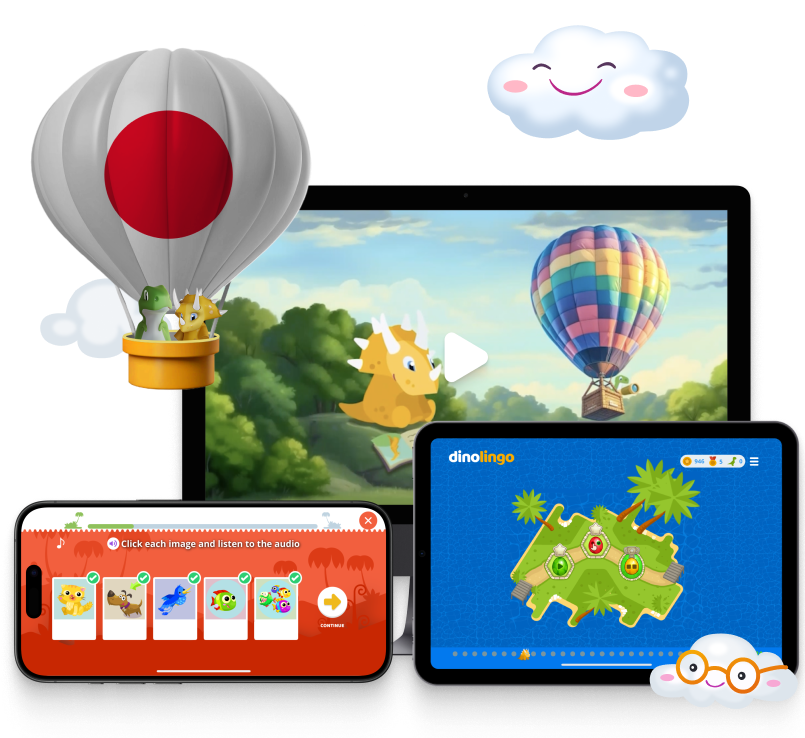
To explore more about the Japanese language, check out the Dinolingo Japanese lessons for kids, where children can learn not just names, but colors, animals, numbers, and much more through songs, games, and fun videos. Designed especially for ages 2–14, Dinolingo offers animated videos, catchy songs, fun games, printable flashcards, worksheets, and storybooks, alongside cultural stories that bring traditions like Obon and obento to life.
Children learn at their own pace through age-specific learning paths, whether they are pre-readers or middle school learners. The platform works on web, iOS, and Android, provides offline printables for screen-free practice, and includes a parent dashboard to track progress, all with no ads or distractions. With one flexible subscription for up to 6 users and access to 50+ languages, Dinolingo is perfect for multilingual households or young language enthusiasts. Let your child explore Japanese in a playful, immersive, and meaningful way, right from home.