Irish Names for Kids: Meanings, Pronunciation & Fun Facts
Irish names are some of the most beautiful and meaningful names in the world. Many popular Irish names come from ancient Gaelic words that describe nature, bravery, and wisdom. Whether you are curious about Irish baby names meanings or just love how Gaelic names sound, this guide will help you discover amazing Irish boy and girl names along with how to say them. From there, we will travel deeper into the Irish language and culture: the magical words, the legends, the food, the music, and the customs that make Ireland so special.
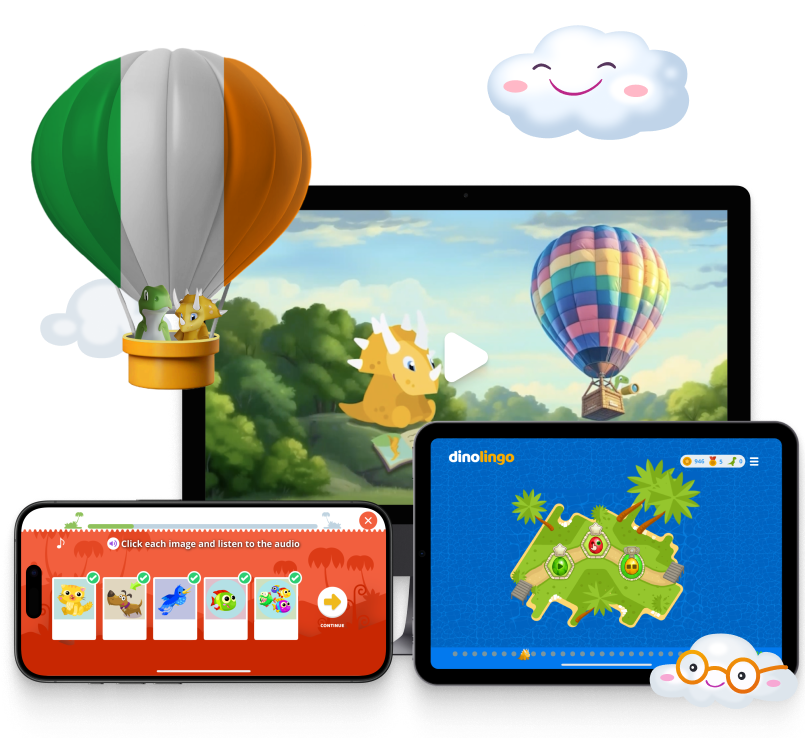
Want to hear how these names sound in the Irish language? Try Dinolingo’s Irish for Kids program and start learning Irish today!
Popular Irish Names and Their Meanings
Popular Irish Girl Names
These popular Irish names for girls have been loved in Ireland for centuries. Each one has a special meaning rooted in Irish culture and mythology.
- Aoife (EE-fa) – Means “beautiful” or “radiant.” Aoife was a legendary warrior princess in Irish mythology.
- Saoirse (SEER-sha) – Means “freedom.” This powerful Gaelic name has become popular around the world.
- Niamh (NEEV) – Means “bright” or “radiant.” In Irish legends, Niamh was a goddess who lived in a magical land.
- Ciara (KEER-ah) – Means “dark-haired.” It comes from the Irish word “ciar,” meaning dark.
- Róisín (ROH-sheen) – Means “little rose.” This sweet name has been used in famous Irish poems and songs.
- Aisling (ASH-ling) – Means “dream” or “vision.” It is also a type of Irish poetry.
- Caoimhe (KEE-va) – Means “gentle” or “graceful.” A truly elegant Irish name.
- Aoibhín (ay-veen) – Means “pleasant” or “radiant.” A lovely modern favorite in Ireland.
- Fiadh (FEE-ah) – Means “wild” or “deer.” One of the fastest-growing Irish baby names today.
Popular Irish Boy Names
Irish boy names often come from legends about brave heroes and wise kings. Here are some of the most popular Irish names for boys.
- Oisín (UH-sheen) – Means “little deer.” Oisín was a famous poet and warrior in Irish mythology.
- Cian (KEE-an) – Means “ancient” or “enduring.” Cian was the father-in-law of the great hero Lugh.
- Conor (KON-or) – Means “lover of hounds.” Conor Mac Nessa was a legendary king of Ulster.
- Liam (LEE-um) – Means “strong-willed warrior.” Liam is the Irish short form of William and is one of the most popular names worldwide.
- Seán (SHAWN) – The Irish form of John, meaning “God is gracious.” A classic Gaelic name used for generations.
- Fionn (FIN) – Means “fair” or “bright.” Fionn Mac Cumhaill was the greatest hero in Irish legends.
- Darragh (DAR-ah) – Means “oak tree.” Oaks were sacred trees in ancient Ireland.
- Tadhg (TYG, rhymes with “tige”) – Means “poet” or “philosopher.” A classic name that has been used in Ireland for over a thousand years.
Irish Names From Mythology
Many Gaelic names come straight from Ireland’s incredible myths and legends. Ancient Irish stories are full of heroes, gods, and magical creatures, and their names live on today. Some of these names are still favorites in Irish schools and playgrounds, proving that a name born in an old legend can feel perfectly modern.
- Fionn Mac Cumhaill (FIN mak COO-al) – The legendary leader of the warrior band called the Fianna. He gained all the world’s knowledge by tasting the Salmon of Knowledge.
- Oisín – Son of Fionn, a great poet who traveled to the magical land of Tír na nÓg (the Land of Youth).
- Niamh – The golden-haired princess who brought Oisín to Tír na nÓg on her white horse.
- Aoife – A fierce warrior queen who was one of the greatest fighters in all of Irish legend.
- Lugh (LOO) – The god of light and skills, one of the most important figures in Irish mythology.
How Irish Names Work
Irish names follow some interesting patterns that are different from English names. Here is how they work:
- First names are often Gaelic words with deep meanings connected to nature, personality, or mythology.
- Surnames with “Ó” mean “grandson of” or “descendant of.” For example, Ó’Brien means “descendant of Brien.”
- Surnames with “Mac” mean “son of.” For example, Mac Carthaigh (McCarthy) means “son of Carthach.”
- Ní and Nic are used for girls and women. A girl from the Ó’Brien family would be called Ní Bhriain, and a girl from the McCarthy family would be Nic Carthaigh.
This naming system has been used in Ireland for over a thousand years and is still a big part of Irish culture today!
Fun Facts About Irish Names
- The name Liam has been the most popular baby name in the United States for several years in a row!
- Many Irish names look tricky to spell but follow Gaelic pronunciation rules. Once you learn the patterns, they become easy to read.
- The Irish alphabet has only 18 letters. It does not include J, K, Q, V, W, X, Y, or Z.
- In Ireland, some families still choose names to honor grandparents, keeping traditional Gaelic names alive for generations.
- The fada (the accent mark, like the one in Seán) changes how a vowel sounds, making it longer. It is an important part of Irish spelling.
Beautiful Irish Words Every Kid Should Know
Just as Irish names carry meaning, the Irish language itself is full of words that sound like they belong in a fairy tale. Learning a handful of them is a fun and easy first step, and many connect directly to the names and legends above.
Magical Words for Fairies and Wonder
Many old Irish stories are filled with wonder, nature, and fantasy, and kids love learning the words that bring them to life.
- Sí (pronounced “shee”) = fairy
- Draíocht (pronounced “dree-ukht”) = magic
- Púca = mischievous spirit
- Cailleach = wise old woman or witch
These words come straight from Irish myths and legends, which are packed with fairies, forests, and glowing lights. In Irish-speaking regions, tales of the Aos Sí (the fairy folk) are still told today. They live in hills, protect nature, and appear in stories passed from generation to generation. To learn them the magical way, try a Fairy Word Treasure Hunt: hide Irish words like “sí” and “draíocht” around the room, and when kids find one they act it out or draw it. You can also let them create their own magical storybook using Irish words for fairies, forests, and mystery.
Celtic Words for Love, Courage, and Hope
Irish is more than a language. It carries values from ancient Celtic culture, and some words tell a story about what people believed long ago.
- Grá (pronounced “graw”) = love
- Misneach (pronounced “mish-nakh”) = courage
- Dóchas (pronounced “doe-khuss”) = hope
- Croí (pronounced “kree”) = heart
Ancient Celts believed that love, courage, and hope made a strong person, and these values showed up in their stories, battles, songs, and symbols. To bring them to life, kids can draw Celtic symbols and match them with words like “grá” and “misneach,” or make a courage poster about something brave they have done with the word “misneach” written in big letters.
Wise Old Sayings (Seanfhocail)
The Irish language is full of short, powerful sayings called “seanfhocail” (pronounced “shan-uk-ill”), or proverbs. These old words carry lessons that still matter today.
- Is fearr cairde ná ór. = Friends are better than gold.
- Tús maith leath na hoibre. = A good start is half the work.
- Ní neart go cur le chéile. = There is no strength without unity.
These teach values like friendship, teamwork, and effort in a playful, memorable way. Try a Proverb Puzzle: cut up each part of an Irish proverb and let kids put the pieces back together and guess the meaning. Older children can even write their own wise sentence and translate it into Irish.
Everyday Greetings and Holiday Phrases
A few friendly phrases go a long way. The traditional Irish greeting is Dia duit (dee-ah gwit), which literally means “God to you,” and the proper response is Dia is Muire duit (dee-ah iss mwir-eh gwit), meaning “God and Mary to you.” When you say goodbye, the Irish word is slán (slawn), and you might hear slán abhaile (slawn ah-wall-yeh), meaning “safe home.” To say thank you, use go raibh maith agat (guh rev mah ah-gut).
Holidays are a great time to learn new words too. These festive greetings are perfect for holiday cards or friendly chats:
- Nollaig Shona Duit! (pronounced “Null-ig hun-a gwitch”) = Merry Christmas!
- Athbhliain faoi mhaise duit! (pronounced “Ah-vleen fwee vosh-a gwitch”) = Happy New Year!
- Go mbeire muid beo ar an am seo arís. = May we all be alive at this time next year.
- Lá Fhéile Pádraig sona duit (law ay-leh paw-drig sun-ah gwit) = Happy Saint Patrick’s Day!
Where in the World Is Irish Still Spoken?
Irish (also called Gaelic), or Gaeilge (GALE-geh), is one of the oldest living languages in Europe, and yes, kids still speak it today! In western parts of Ireland there are special regions called the Gaeltacht, where Irish is spoken at home, at school, and in daily life. Places like County Galway, County Donegal, and County Kerry are full of beautiful Irish signs and native speakers.
Even outside the Gaeltacht, Irish is taught in every school across Ireland, and all road signs in the country are written in both Irish and English. Kids might speak English most of the day, but they still learn songs, poems, and fun expressions in Irish class. Some schools, called Gaelscoileanna, teach everything in Irish. You can also hear Irish in other countries like the USA, Canada, and Australia, where Irish families and communities have kept their heritage alive through dance schools, festivals, and language groups. To explore this, print a map of Ireland and let kids color in the Gaeltacht regions while learning one Irish word from each area.
A Time-Travel Adventure Through Irish History
Many of those names, words, and legends were shaped by thousands of years of history. This green island on the edge of Europe has a past packed with mystery, bravery, and incredible inventions, from stone-age builders who lined up their tombs with the stars to warriors who sailed longships across stormy seas.
Ancient Celts and Druids (Around 500 BC)
Our first stop is Celtic Ireland, roughly 2,500 years ago. The Celts crossed from mainland Europe and settled across the island, organizing themselves into dozens of small kingdoms called tuatha (TOO-ah-ha), each ruled by a rí (ree), meaning king. Celtic artists created dazzling spiral designs in gold and bronze that you can still see on artifacts in the National Museum of Ireland. The most mysterious figures of Celtic Ireland were the druids, who served as priests, healers, astronomers, and judges all at once. They memorized enormous amounts of knowledge because they believed sacred wisdom should never be written down. Even before the Celts arrived, ancient people had built Newgrange around 3200 BC, a passage tomb in County Meath older than Egypt’s Great Pyramid. On the winter solstice each December, a beam of sunlight creeps through a narrow roofbox and floods the inner chamber for exactly 17 minutes. The builders had to understand astronomy to pull that off!
St. Patrick and the Spread of Christianity (5th Century AD)
One of the most famous names in Irish history is Naomh Pádraig, Saint Patrick. Born in Roman Britain around 385 AD, Patrick was kidnapped at age 16 by Irish raiders and spent six years herding sheep on Slemish Mountain in County Antrim. After escaping back to Britain, he felt called to return and bring Christianity to Ireland. According to legend, he used the three-leafed shamrock (seamróg, SHAM-rohg) to explain the Holy Trinity to the Irish people. Patrick’s mission transformed the island. Monasteries sprang up everywhere, turning Ireland into a center of learning while much of Europe struggled through the early Middle Ages. Irish monks like Colmcille (also called Columba) carried their knowledge abroad, founding famous monasteries at Iona in Scotland and Bobbio in Italy. Historians often call this period Ireland’s “Golden Age” of faith and scholarship.
Vikings in Ireland: Dublin Was a Viking City! (795–1014 AD)
Fast-forward to 795 AD, when longships appeared off the Irish coast. Viking raiders from Norway and Denmark attacked monasteries looking for gold chalices and jeweled book covers. But the Vikings did not just steal and leave. They set up trading camps that grew into Ireland’s first real towns: Dublin, Waterford, Wexford, Cork, and Limerick. The name “Dublin” actually comes from the Irish words Dubh Linn (duv lin), meaning “black pool,” after a dark tidal pond where Viking ships anchored. For over 200 years, Norse and Irish cultures mixed as they traded, intermarried, and even borrowed words from each other’s languages. The Viking age in Ireland ended dramatically at the Battle of Clontarf in 1014, when High King Brian Boru (Brian Bóroimhe) defeated a Viking alliance. Brian Boru is still celebrated as one of Ireland’s greatest heroes, even though he was killed on the day of his own victory.
Castles, High Kings, and the Book of Kells (5th–12th Century)
Ireland’s High Kings ruled from the Hill of Tara (Teamhair, pronounced CHOW-ir) in County Meath, a sacred site where kings were crowned for centuries. Below the High King, dozens of lesser kings controlled their own territories, so Ireland was a patchwork of tiny kingdoms constantly forming alliances and rivalries. Meanwhile, Irish monks were doing something extraordinary. In scriptoriums lit by candles, they created the Book of Kells around 800 AD, a lavishly decorated copy of the four Gospels now kept at Trinity College Dublin. Every page bursts with intertwined animals, spirals, and colors so vivid they still glow after 1,200 years. When the Normans arrived from England in 1169, they brought a new kind of building: the stone castle. Trim Castle in County Meath, built in the 1170s, is the largest Norman castle in Ireland and was even used as a film location for the movie Braveheart.
The Irish Language Through History
The Irish language, Gaeilge, has roots stretching back over 2,000 years. The earliest written Irish appears in Ogham (OH-am) inscriptions, a code-like alphabet carved as notches along the edges of standing stones from around the 4th century. After Christianity arrived, monks adapted the Latin alphabet for Irish and produced masterpieces like the Book of Kells. For centuries, Irish was the everyday language of most people on the island. English rule gradually pushed Irish aside, especially after laws in the 1300s (the Statutes of Kilkenny) tried to ban it. Today, Irish is an official language of Ireland and is taught in every school, and the Gaeltacht regions keep the language alive in daily life.
The Great Famine: An Gorta Mór (1845–1852)
One of the saddest chapters in the history of Ireland is the Great Famine, known in Irish as An Gorta Mór (on GUR-tah more), meaning “the great hunger.” By the 1840s, millions of Irish families depended on the potato as their main food source. When a plant disease called blight destroyed the potato crop year after year starting in 1845, the results were devastating. Roughly one million people died from starvation and disease, and at least another million left Ireland on crowded ships bound for America, Canada, Australia, and Britain. Ireland’s population dropped from about 8 million to just over 6 million in only seven years. The famine scattered Irish communities across the globe and fueled a deep desire for self-rule. Famine memorials in Dublin, New York, and other cities remind us of this important chapter so that it is never forgotten.
Independence and Modern Ireland (1916–Today)
The fight for Irish independence reached a turning point during the Easter Rising of 1916, when rebels seized key buildings in Dublin, including the General Post Office on O’Connell Street, and declared an Irish Republic. Although British forces defeated the rising within a week, the execution of its leaders turned public opinion sharply in favor of freedom. The Irish War of Independence followed from 1919 to 1921, led by figures like Michael Collins. In 1922, the Irish Free State was established, and in 1949 Ireland officially became a republic, Poblacht na hÉireann (PUB-lokht nah HAIR-uhn). Today, Ireland is a vibrant, modern country with a booming technology sector (many global tech companies have their European headquarters in Dublin), a rich literary tradition that produced writers like W.B. Yeats and Oscar Wilde, and a worldwide reputation for traditional music and warm hospitality.
Timeline: Key Dates in Irish History
- ~3200 BC – Newgrange passage tomb is built in County Meath
- ~500 BC – Celtic tribes settle across Ireland, bringing Gaeilge
- ~400 AD – Ogham stone inscriptions appear, the earliest written Irish
- 432 AD – St. Patrick begins his mission to spread Christianity
- ~800 AD – Monks create the Book of Kells
- 795 AD – First Viking raids hit Irish shores
- 1014 – Brian Boru defeats the Vikings at the Battle of Clontarf
- 1169 – Norman invasion begins; stone castles rise across Ireland
- 1845–1852 – The Great Famine (An Gorta Mór) devastates the country
- 1916 – The Easter Rising in Dublin sparks the independence movement
- 1922 – The Irish Free State is established
- 1949 – Ireland officially becomes a republic
Irish Myths, Legends, and Folklore
Ireland has one of the richest storytelling traditions in the world. For thousands of years, Irish people have passed down incredible tales of brave heroes, magical creatures, and enchanted lands. These are the very stories that gave us so many beautiful names.
The Tradition of Seanchaí
In ancient Ireland, storytellers called “seanchaí” (shan-a-key) held a very special place in society. These talented people memorized hundreds of stories and traveled from village to village, sharing tales by the fireside. Before books and television existed, the seanchaí was how people learned about history, morals, and entertainment. The tradition of oral storytelling is so important to Ireland that it continues today at festivals and cultural events across the country.
Fionn mac Cumhaill and the Salmon of Knowledge
Fionn mac Cumhaill (Finn McCool) is one of Ireland’s greatest legendary heroes. As a young boy, Fionn studied under a poet named Finnegas, who had spent seven years trying to catch the Salmon of Knowledge, a magical fish that would grant all the world’s wisdom to whoever ate it first. When Finnegas finally caught the salmon, he asked young Fionn to cook it but warned him not to eat any. While cooking, Fionn burned his thumb on the fish and instinctively put it in his mouth. That tiny taste gave him all the salmon’s wisdom! From that day on, whenever Fionn needed to know something, he simply sucked his thumb. Fionn grew up to lead the Fianna, a legendary band of warriors who protected Ireland.
The Children of Lir
One of Ireland’s most beloved stories is “The Children of Lir” (Clann Lir in Irish). King Lir had four children whom he loved dearly: Fionnuala, Aodh, Fiachra, and Conn. When their jealous stepmother Aoife cast a spell on them, the children were turned into swans for 900 years. They had to spend 300 years on Lake Derravaragh, 300 years on the Sea of Moyle, and 300 years on the Isle of Inishglora. Despite their hardship, the children kept their human voices and sang beautiful songs that enchanted everyone who heard them. This story teaches about the power of love, patience, and family bonds.
Tír na nÓg: The Land of Eternal Youth
One of the most enchanting Irish legends tells of Tír na nÓg (Teer na Nohg), the Land of Eternal Youth. The warrior Oisín fell in love with the beautiful fairy princess Niamh, who invited him to travel with her across the sea to this magical land where nobody ever grew old. Oisín lived there happily for what felt like three years, but when he returned to Ireland, he discovered that 300 years had passed. The story reminds us how precious time is and how the magic of stories can make it feel like it stands still.
Magical Creatures of Irish Folklore
Irish folklore is full of fascinating magical creatures that have captured imaginations for centuries:
- Leprechauns: These small fairy cobblers are perhaps Ireland’s most famous mythical beings. According to legend, if you catch a leprechaun, he must lead you to his pot of gold. But be careful, leprechauns are very tricky and will try to escape!
- Banshees: The “bean sí” (woman of the fairy mounds) is a spirit whose wailing cry warns of a coming death in the family. Though she sounds scary, she is actually a protective spirit connected to ancient Irish families.
- Púca: This shapeshifting creature can appear as a horse, goat, rabbit, or even a human. The púca is mischievous but not usually dangerous, and farmers once left a share of their harvest for the púca as a gift.
- Selkies: These magical beings live as seals in the ocean but can shed their skins to become humans on land. Many romantic and sad tales tell of selkies who fall in love with humans.
- Changelings: Irish fairy lore warned that fairies might swap a human baby with a fairy child. These stories were told as explanations when babies behaved unusually.
These ancient tales are more than just entertainment. They teach values like bravery, kindness, and cleverness, and they connect Irish children to a cultural heritage that stretches back thousands of years. Today, Irish schools still teach these stories, and many children’s books retell them with colorful illustrations.
Fun Facts About Ireland
Ireland is a beautiful island nation in Europe known for its green hills, ancient castles, and friendly people. It is often called the “Emerald Isle” because of its lush green countryside.
Where Is Ireland, and Why Is It So Green?
Ireland is an island located in the Atlantic Ocean, just west of Great Britain. The country is divided into the Republic of Ireland, which is an independent nation, and Northern Ireland, which is part of the United Kingdom. The capital of the Republic of Ireland is Dublin, called “Baile Átha Cliath” in Irish. Ireland is one of the westernmost countries in Europe, and on a clear day you can look out over the Atlantic Ocean and know that the next stop is North America. The secret behind all that green is rain. Ireland gets plenty of rainfall throughout the year, which keeps the grass and plants looking bright and fresh. The mild climate, thanks to the warm Gulf Stream ocean current, means it rarely gets very hot or very cold.
Cool Facts You Might Not Know
- Ireland has no native snakes! According to legend, Saint Patrick drove all the snakes out of Ireland, but scientists say the island has simply never had any since the last Ice Age.
- The Irish harp is the national symbol of Ireland. It even appears on Irish euro coins! In Irish, the harp is called “cláirseach.”
- Halloween originally comes from Ireland! The ancient Celtic festival of Samhain, celebrated over 2,000 years ago, is the origin of modern Halloween traditions.
- Ireland is home to the oldest pub in the world, Sean’s Bar in Athlone, which has been serving customers since around 900 AD.
- The Cliffs of Moher, one of Ireland’s most famous landmarks, rise over 700 feet above the Atlantic Ocean and stretch for about 8 miles along the coast.
Famous Irish Landmarks
Ireland is packed with incredible places to visit. The Giant’s Causeway in Northern Ireland is made up of about 40,000 interlocking basalt columns formed by an ancient volcanic eruption, though legend says it was built by the giant Fionn mac Cumhaill! Newgrange is an ancient passage tomb older than the Egyptian pyramids, built around 3200 BC, and every year on the winter solstice sunlight floods through a small opening and lights up the inner chamber. The Rock of Cashel, a stunning medieval fortress perched on a limestone hill, was once the seat of the kings of Munster.
Irish Sports and Fun
Ireland has its own unique sports that you will not find anywhere else! Hurling is one of the fastest field sports in the world, played with a wooden stick called a “hurley” (or “camán” in Irish) and a small ball called a “sliotar.” Gaelic football is another popular Irish sport that combines elements of soccer and rugby. Both sports are organized by the Gaelic Athletic Association (GAA), and the All-Ireland finals held at Croke Park in Dublin draw huge crowds every year.
Traditional Irish Food
If you think Irish food is just potatoes, think again! Traditional Irish cuisine is hearty, warm, and full of simple ingredients that taste amazing together. From bubbling stews to golden soda bread, Irish dishes have been keeping families happy for hundreds of years.
Classic Irish Dishes
The most famous Irish dish is probably Irish stew (stobhach in Irish). This thick, warming stew is made with lamb or mutton, potatoes, onions, and carrots, all simmered together until everything is tender and flavorful. Soda bread (arán sóide) is another Irish favorite. Unlike most breads, it does not use yeast. Instead, bakers use baking soda and buttermilk to make it rise, giving a crusty loaf with a soft, slightly tangy inside. Colcannon (cál ceannann) is creamy mashed potatoes mixed with cabbage or kale, butter, and milk, and at Halloween coins or small charms are sometimes hidden inside it for children to find. Boxty is an Irish potato pancake made from a mix of grated raw potato and mashed potato, crispy on the outside and soft on the inside. There is a famous Irish saying: “Boxty on the griddle, boxty in the pan, if you can’t make boxty, you’ll never get a man!”
The Full Irish Breakfast
A full Irish breakfast (bricfeasta iomlán) is a big deal in Ireland. Imagine sitting down to a plate piled high with bacon rashers, sausages, eggs, black and white pudding, grilled tomatoes, baked beans, mushrooms, and toast. Black pudding (putóg dhubh) is made from oatmeal and pork blood. It sounds unusual, but it is a crispy, savory treat that many Irish people love! White pudding is similar but without the blood. This hearty breakfast gives everyone plenty of energy for the day ahead.
Snacks, Sweet Treats, and Drinks
Barmbrack (bairín breac) is a traditional Irish fruit bread packed with raisins and dried fruit, often enjoyed with a cup of tea. At Halloween, families bake special barmbracks with hidden objects inside: a ring might mean you will get married, and a coin means wealth is coming your way! No trip to Ireland is complete without trying Tayto crisps, Ireland’s most beloved potato chips, with cheese and onion as the national favorite flavor. Some people even make Tayto crisp sandwiches by stuffing them between two slices of buttered bread! Ireland is also famous for tea, drinking more per person than almost any other country in the world. Barry’s Tea and Lyon’s Tea are the two most popular brands, and every family has a strong opinion about which one is best. Tea (tae in Irish) is served with milk and sometimes sugar, and kids also enjoy MiWadi, a fruity squash drink that comes in flavors like orange, blackcurrant, and lime.
Food Traditions and Holidays
Food plays a big role in Irish holidays and celebrations. On St. Patrick’s Day (March 17), families enjoy traditional meals like corned beef and cabbage or bacon and cabbage (bagún agus cabáiste). At Halloween, which actually started in Ireland as the ancient festival of Samhain, colcannon and barmbrack take center stage. On Shrove Tuesday, Irish families make stacks of pancakes to use up butter and eggs before Lent begins. Sharing food (bia) with family and neighbors has always been an important part of Irish culture, and Sunday dinners with roast meat and potatoes bring everyone around the table.
Irish Food Words to Learn
- Bia – Food
- Arán – Bread
- Prátaí – Potatoes
- Im – Butter
- Bainne – Milk
- Tae – Tea
- Uisce – Water
- Feoil – Meat
Irish Traditional Music and Instruments
Ireland is famous around the world for its beautiful traditional music. From lively jigs played in cozy pubs to haunting melodies that echo across green hills, Irish music has a special magic that people of all ages enjoy.
The Fiddle
The fiddle is simply a violin played in the Irish traditional style. It is one of the most popular instruments in Irish music. What makes Irish fiddle playing special is the ornamentation: players add quick grace notes, rolls, and slides that give the music its distinctive lively sound. Different regions have their own styles, with the Donegal style in the northwest fast and energetic and the Clare style in the west more flowing and smooth. Many children in Ireland start learning the fiddle at a young age through local music schools and Comhaltas Ceoltoiri Eireann, the organization that promotes Irish traditional music.
The Bodhran
The bodhran (BOW-rawn) is a frame drum made from goatskin stretched over a circular wooden frame. It is played with a small wooden stick called a tipper or cipin. The bodhran provides the rhythmic backbone of Irish music, and skilled players can create an amazing variety of sounds by pressing their hand against the back of the drum skin while striking the front. It is a great first instrument for kids because it is relatively easy to start playing.
The Tin Whistle
The tin whistle (also called a penny whistle or feadog stain in Irish) is a small, six-holed wind instrument. It is one of the most common starting instruments for children learning Irish music because it is affordable, lightweight, and you can learn simple tunes quickly. Do not let its small size fool you: in the hands of an expert, the tin whistle can produce incredibly fast and complex melodies. The tin whistle in the key of D is the standard for Irish music.
The Uilleann Pipes
While Scotland is famous for its Highland bagpipes, Ireland has its very own type called the uilleann pipes (ILL-en). Unlike Scottish pipes, uilleann pipes are played sitting down, and the air is pumped using a bellows strapped to the elbow. The word uilleann actually comes from the Irish word uillinn, meaning “elbow.” They produce a softer, sweeter, and more complex sound than Scottish bagpipes, and are considered one of the most difficult instruments in the world to master.
The Irish Harp
The harp (clairseach in Irish) holds a very special place in Irish culture. It is so important that it appears on Irish coins, the presidential seal, and the logo of famous Irish brands. The harp has been associated with Ireland for over 1,000 years, and in the past harpists were among the most respected musicians in Irish society. The oldest surviving Irish harp, known as the Brian Boru harp, is on display at Trinity College Dublin. It is over 600 years old and is the model for the harp symbol used throughout Ireland today.
Types of Irish Tunes
- Jig: A lively dance tune in 6/8 time, think “jiggity-jig!”
- Reel: A fast, driving tune in 4/4 time, the most common type in Irish music.
- Hornpipe: Similar to a reel but with a more dotted, bouncy rhythm.
- Slow air: A beautiful, slow melody, often based on old Irish songs.
- Polka: A quick, cheerful tune especially popular in County Kerry.
Irish Children’s Songs
Children’s songs are a wonderful way for kids to connect with Ireland’s traditions, and they are a brilliant way to start learning the Irish language through melody and rhythm.
- Beidh Aonach Amarach (There Will Be a Fair Tomorrow): One of the most popular Irish children’s songs, learned by nearly every child in Ireland at school. The chorus, “Beidh aonach amarach i gContae an Chlair,” means “There will be a fair tomorrow in County Clare.” It is simple, repetitive, and perfect for beginners.
- Oro, Se do Bheatha ‘Bhaile (Oh, Welcome Home): A rousing song sung in Ireland for hundreds of years. Originally a welcoming song, it was later adopted as a patriotic anthem with a bold, stirring melody.
- Peigin Leitir Moir (Peggy from Lettermore): A lively, bouncy tune from the Connemara region about a girl named Peigin from the village of Lettermore. The fast pace and playful words make it a favorite for sing-alongs.
- Baidin Fheilimi (Feilimi’s Little Boat): A charming song about a little boat that sails across Lough Erne. “Baidin Fheilimi d’imigh go Gabhla” means “Feilimi’s little boat went to Gola.”
- Molly Malone (Cockles and Mussels): Though in English rather than Irish, it is one of the most famous songs associated with Dublin. Its chorus, “Alive, alive, oh!” is instantly recognizable, and there is even a bronze statue of Molly Malone on Grafton Street in Dublin.
Singing is one of the best ways for children to learn a new language: the melody aids memory, singing slows down words so kids hear each sound clearly, songs naturally repeat phrases, and best of all it is fun. A few more music words to know are Amhran (OW-rawn) for song, Ceol (KYOHL) for music, Canadh (KAN-uh) for singing, Rince (RIN-keh) for dance, Damhsa (DOW-suh) also for dance, Seisiun (SHEH-shoon) for a session where musicians play together, and Craic (KRAK) for fun and entertainment.
Irish Fashion and Traditional Clothing
Ireland has a wonderful fashion heritage that blends ancient traditions with modern style. From the world-famous Aran sweater to the colorful costumes worn by Irish dancers, Irish clothing tells the story of the country’s history, climate, and culture.
The Famous Aran Sweater
The Aran sweater is one of Ireland’s most iconic clothing items, originally made by the women of the Aran Islands off the west coast of Ireland. These thick, cream-colored wool sweaters are covered in beautiful knitted patterns, and each pattern has a special meaning. The cable stitch represents the fisherman’s ropes and wishes for a good catch, the diamond stitch stands for wealth and success, the honeycomb pattern symbolizes hard work like the busy bee, and the tree of life stitch represents family roots growing strong. Traditionally, each island family had their own unique combination of patterns, making every sweater one of a kind. The Irish word for sweater is “geansaí” (gan-see).
Ancient Irish Clothing
Long ago, the ancient Irish wore clothing quite different from what we see today. The “léine” (lay-neh) was a long tunic made from linen, worn by both men and women. Over the léine, people wore a “brat,” a large woolen cloak held in place by a decorative pin called a “dealg” (jal-ig). These cloaks were dyed in bright colors using natural materials: yellow from saffron, blue from woad, red from madder root, and green from a mix of plants. The color and quality of your brat showed your social status, and kings and nobles wore cloaks with the most vibrant colors and finest brooches.
Irish Dance Costumes
Irish dance dresses are some of the most elaborate and beautiful traditional outfits in the world. Here is what makes them special:
- Embroidered designs: The dresses feature intricate Celtic patterns inspired by ancient Irish art, including knots, spirals, and crosses, often hand-embroidered or appliquéd onto the fabric.
- Bright colors: Modern competition dresses come in every color of the rainbow and are decorated with crystals and sequins that sparkle under stage lights.
- Stiff skirts: The skirts are lined with stiff fabric so they stay in place and look dramatic during the fast footwork and high kicks.
- Capes: Many dresses include a short cape at the back, inspired by the ancient Irish brat.
- Curly wigs: Dancers often wear curly wigs that bounce as they dance, inspired by traditional Irish ringlet hairstyles.
Tweed, Donegal Fabric, and the Claddagh Ring
Donegal tweed is a world-famous handwoven wool fabric from County Donegal in northwest Ireland, known for its distinctive flecks of color that reflect the Irish landscape: the purples of heather, the greens of moss, the oranges of autumn leaves, and the grays of stone walls. It is used to make jackets, caps, scarves, and blankets, and the traditional flat cap, or “paddy cap,” is still a popular accessory. The Claddagh ring is one of Ireland’s most famous fashion accessories. Originating from the fishing village of Claddagh in Galway, this ring features two hands holding a heart topped with a crown: the hands represent friendship, the heart represents love, and the crown represents loyalty. Worn on the right hand with the heart pointing outward, it means you are looking for love; on the left hand with the heart pointing inward, your heart is taken. The Irish phrase “grá, dilseacht, cairdeas” (graw, dil-shocked, kar-jis) means “love, loyalty, friendship,” the three values of the Claddagh. Today, Ireland also has a thriving modern fashion scene that honors traditional craftsmanship while embracing new ideas, with many brands focusing on sustainable and ethical production.
Irish Etiquette and Customs
Irish people are famous around the world for being warm, welcoming, and great fun to be around. Ireland has a unique set of customs and social traditions that have developed over centuries.
Greetings, Friendliness, and “The Craic”
One of the first things visitors notice about Ireland is how friendly everyone is. Irish people love to chat and will often strike up a conversation with complete strangers. When greeting someone, a smile, a handshake, and a cheerful “How are you?” is the standard approach, and don’t be surprised if people in small towns wave at you as you pass by. In Ireland, “craic” (pronounced “crack”) is a very important word that means fun, entertainment, and good conversation all rolled into one. When Irish people ask “What’s the craic?” they are asking what is happening or how things are going. Having “good craic” means having a great time with friends, telling stories, laughing, and enjoying each other’s company. Irish culture places enormous value on socializing, humor, and storytelling.
Hospitality and Visiting Someone’s Home
Irish hospitality, or “fáilte” (fall-cheh), is legendary. If you visit an Irish home, you will almost certainly be offered tea and something to eat, and it would be considered rude to refuse! The tradition of welcoming guests goes back to ancient Brehon laws that required people to provide food and shelter to travelers. Some customs to know when visiting an Irish home:
- Always accept the offer of tea, even if you only take a few sips. Refusing tea in Ireland is practically unheard of!
- It is polite to bring a small gift when visiting, like chocolates, biscuits, or flowers.
- Take off your shoes at the door if the host does, as many Irish families prefer this.
- Expect to be fed well! Irish hosts love to make sure their guests are never hungry.
- Do not be surprised if the visit lasts longer than expected. In Ireland, rushing a visit is considered impolite.
Modesty, Humor, and Saying Goodbye
Irish people tend to be modest and do not like to boast about themselves. If you compliment an Irish person, they will likely downplay the praise or make a joke about it, because showing off is considered bad manners. Instead, Irish humor is full of self-deprecation, witty remarks, and gentle teasing, so if an Irish friend teases you, it usually means they like you. Saying goodbye also takes a long time: the “Irish goodbye” involves long, drawn-out farewells that can last 30 minutes or more, said at the table, then again at the door, then once more at the car. Ireland also has many special celebrations through the year. Saint Patrick’s Day on March 17th is the biggest, celebrating Ireland’s patron saint with parades, music, and wearing green, while “Wren Day” on December 26th involves people dressing in straw costumes and going door to door with music, and Bealtaine (May 1st) celebrates the start of summer with bonfires.
Best Ways to Help Kids Learn Irish
Teaching Irish to children can be an exciting and meaningful journey. Whether you are a native speaker or just starting out, there are countless fun and effective ways to introduce your child to the Irish language and culture. You do not need fluency or formal training, just positive, playful experiences woven into daily life.
- Use books and storytelling: Choose illustrated Irish books, encourage kids to guess new words from context, use different voices for characters, and let them act out favorite stories.
- Play with puppets and toys: Turn a favorite plush toy into an Irish-speaking puppet, or build a puppet theater to reinforce language through play.
- Learn through real-life experiences: Name animals in Irish at the zoo, use simple Irish instructions while cooking, and describe food items on supermarket trips.
- Play language-based games: Count in Irish during hide and seek, use board games like Snakes and Ladders for numbers, and play memory or matching with vocabulary flashcards.
- Use music and songs: Play Irish songs during car rides, add movements to help memorization, and let kids sing along to traditional or pop songs.
- Set goals and track progress: Create a progress chart with stickers to celebrate milestones and set monthly or yearly language goals together.
- Embrace multimedia tools: Curate YouTube playlists, play Irish-language radio, and try reading pens and apps for independent learning.
- Tap into cultural resources: Visit cultural centers or Irish festivals, hang Irish-themed posters, and explore craft activities about Irish traditions.
- Involve the community: Connect with other families through playgroups and video chats, and invite native-speaking grandparents to interact in Irish.
- Make learning creative and kinesthetic: Talk about colors while coloring, use alphabet and picture books, and pick a “word of the day.”
- Incorporate Irish into daily routines: Sing lullabies in Irish, use homeschooling curricula, and consider summer camps with Irish language immersion.
One of the most engaging and accessible ways to teach Irish to children is through Dinolingo. It offers online Irish lessons, videos, songs, stories, games, worksheets, and flashcards designed for children aged 2–14. With gamified rewards, offline access, and one subscription covering up to six users, it is a flexible tool for families that weaves Irish culture and language together.
Start Learning Irish With Dinolingo!
Now that you know so many wonderful Irish names and their meanings, along with the words, legends, food, music, and customs that bring Ireland to life, why not learn the Irish language itself? With Dinolingo’s Irish for Kids, children ages 2–14 can learn Irish through fun videos, games, songs, and stories. You will be able to say these beautiful Gaelic names like a native speaker in no time. Start your Irish adventure today!