
Singing in Danish: Songs Every Kid Will Love
The Danish language is part of the Germanic family within the larger Indo-European language group. This means it shares roots with other languages like English, German, Swedish, Norwegian, and Icelandic. All of these languages have evolved from an older language called Teutonic, making them somewhat similar in sound and structure.
Today, around 5.5 million people speak Danish. Most of them live in Denmark, but there are also Danish-speaking communities in Greenland, Germany, Norway, Sweden, Canada, the United Arab Emirates, and the United States. In the past, Danish was even the official language of Norway and Iceland, which is why some older documents from those countries were written in Danish.
One of the first important pieces of Danish literature is Gesta Danorum (History of the Danes). It was written in Latin and tells stories about the early history of Denmark. This book also includes many Scandinavian myths and legends, including the original tale of Hamlet, which later inspired Shakespeare’s famous play.
Learning the Danish Alphabet
The Danish alphabet is similar to the English one, but it includes a few extra letters and sounds. Here’s how the alphabet looks in Danish, with the way each letter is pronounced:
Aa (a), Bb (be), Cc (se), Dd (de), Ee (e), Ff (aef), Gg (ge), Hh (hå), Ii (i), Jj (jåd), Kk (kå), Ll (ael), Mm (aem), Nn (aen), Oo (o), Pp (pe), Qq (ku), Rr (aer), Ss (aes), Tt (te), Uu (u), Vv (ve), Ww (dobbelt-ve), Xx (aeks), Yy (y), Zz (saet)
The letters C, Q, W, X, and Z are mainly used in words borrowed from other languages. One interesting fact is that before 1948, the letter Å was written as “aa.” That’s why some older city names like Aalborg and Aabenraa still use the double “a” spelling.
Danish Children’s Songs
Music plays a big part in Danish childhood. Children’s songs in Denmark are often about the seasons, nature, family traditions, and everyday play. Many of these songs include movements or finger play, making them fun and interactive.
Here are some popular Danish children’s songs and their English meanings:
- Den Lille Ole med Paraplyen – The Little Sandman with the Umbrella
- Hist, Hvor Vejen Slår en Bugt – Over Where the Road Makes a Turn
- Hun skal Leve – Live for Long (a birthday song)
- Jeg Gik Mig over Sø og Land – I Traveled Over Sea and Land
- Klap, Klap, Kage – Clap, Clap, Cake
- Lille Peter Edderkop – Itsy Bitsy Spider
- Mester Jakob – Brother John (also known as Frère Jacques)
- Nu det Jul Igen – Now, It’s Christmas Time
Singing these songs helps children not only build vocabulary but also enjoy the rhythm and melody of the Danish language in a joyful way.
Fun and Easy Danish for Kids
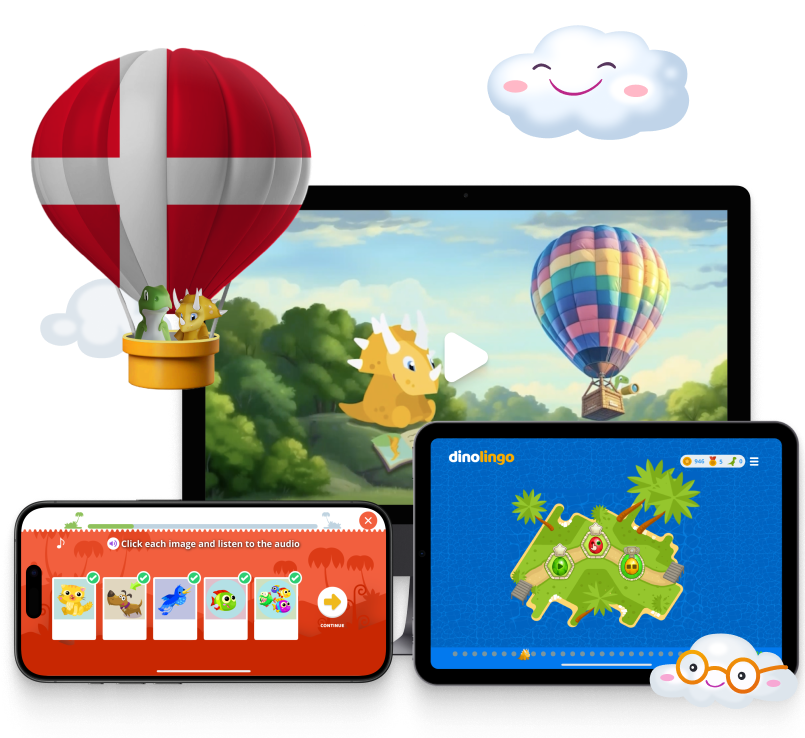
Children can learn Danish in a playful and engaging way through platforms like Dinolingo. Dinolingo offers lessons through songs, games, stories, videos, and printable materials. The program is designed for children ages 2 to 14 and is available on the web, iOS, and Android. One subscription works for the whole family and includes over 50 language options, so it’s easy to switch or add more languages anytime.
Start Learning a New Language Today!
Best Language App for Kids.
7-day free trial. Then only $19/month. Cancel anytime.
Its such as you read my thoughts! You appear to know so much about this,
such as you wrote the e book in it or something. I feel that you simply
can do with some p.c. to pressure the message house
a bit, but other than that, that is excellent blog. A fantastic read.
I will certainly be back.
Woah! I’m really digging the template/theme of this blog.
It’s simple, yet effective. A lot of times it’s very
difficult to get that “perfect balance” between usability and appearance.
I must say you’ve done a fantastic job with this. In addition, the blog loads very quick
for me on Opera. Exceptional Blog!