
Dutch Names & Language Secrets: A Fun Guide for Kids
Dutch is a cheerful, friendly language that kids can start speaking right away, and it opens the door to a colorful country full of canals, windmills, tulips, and tasty treats. This guide walks young learners from their very first Dutch words all the way through Dutch names, everyday vocabulary, songs, food, holidays, and history, so language and culture grow together.
What Do the Dutch Speak?
Dutch is the official language of the Netherlands and one of the West Germanic languages, just like German and English. That’s why many Dutch words might sound familiar to English speakers! About 90% of people in the Netherlands speak Dutch every day, in schools, homes, stores, and on TV.
But Dutch isn’t only spoken in the Netherlands. You’ll also hear Dutch in Belgium (where it’s called Flemish), in the South American country of Suriname, and in parts of the Caribbean, too. In fact, Dutch is one of the few languages spoken across multiple continents.
In the northern part of the Netherlands, another language is spoken: Friesian (Frisian). Over 500,000 people use Friesian as their first or second language. It’s even older than Dutch and is taught in schools in the Friesland province. Many Dutch children grow up hearing both Dutch and Friesian!
Dutch is full of fun sounds and interesting spellings, and it’s known for its guttural “g” and soft “ij” sound. There are over 25 dialects of Dutch, meaning that people from different parts of the country might speak a little differently, but they all understand each other.
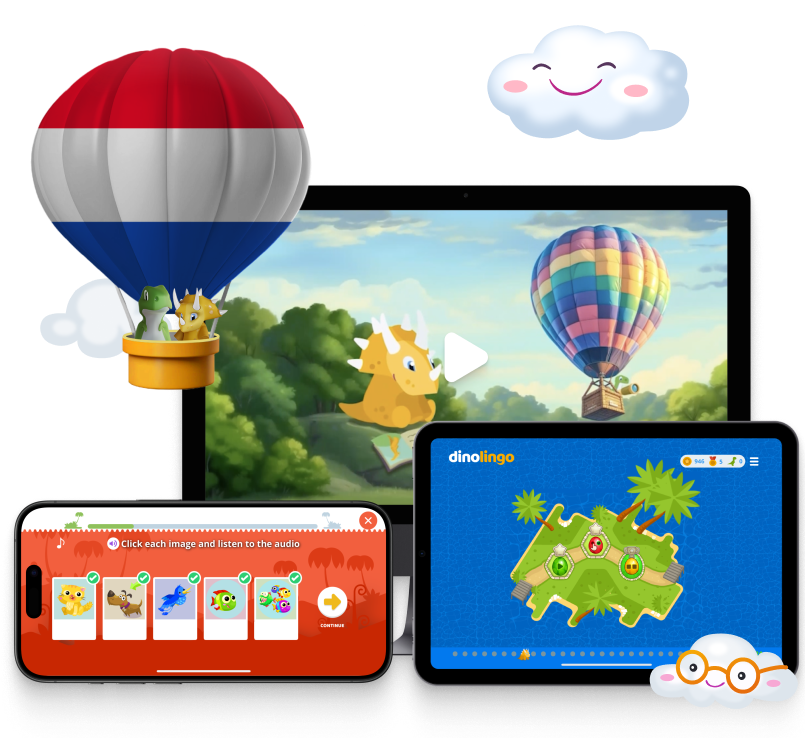
Kids learning Dutch can start by listening to cartoons, songs, and stories with clear pronunciation and easy vocabulary. That’s where Dinolingo comes in. With interactive lessons, songs, videos, and flashcards, Dinolingo makes learning Dutch feel like playtime!
Your First 10 Dutch Words
Starting small helps children build focus and remember words better. Ten is a perfect number, not too many to feel overwhelmed, but enough to use in real life. These first Dutch words are common, useful, and fun to say, and kids will hear them a lot whether they’re at home, at the park, or watching a Dutch cartoon.
- Hallo – Hello
- Dag – Bye
- Dank je – Thank you
- Alsjeblieft – Please / Here you go
- Ja – Yes
- Nee – No
- Mama – Mom
- Papa – Dad
- Water – Water
- Hond – Dog
To help kids remember their new words, hear and use them in context. Try “My First Dutch Word Cards,” where your child draws a picture for each Dutch word on a card with the Dutch word and English meaning below. These cards can be a matching game or stuck on the fridge for daily review. Or play the “Say It in Dutch!” game: pick a word and say it in Dutch, and the child has to find it or act it out. If you say hond, they can bark or bring a toy dog.
Friendly Dutch Greetings
The first thing kids usually learn in a new language is how to say “hello!” In Dutch, greeting phrases are simple, cheerful, and used every day. They help kids join conversations politely, feel more like native speakers, and use Dutch in real-life settings right away.
- Hallo! – Hello!
- Hoi! – Hi! (informal)
- Goedemorgen – Good morning
- Goedemiddag – Good afternoon
- Goedenavond – Good evening
- Tot ziens! – Goodbye!
- Doei! – Bye! (informal)
- Hoe gaat het? – How are you?
Practice them with dolls, toys, or during daily routines: Hoi, teddybeer! Hoe gaat het? Two games make it stick. In the “Dutch Doorbell Game,” pretend to ring a doorbell and greet someone using a different Dutch phrase each time, with kids responding in character: Goedemiddag! Wil je binnenkomen? (Good afternoon! Do you want to come in?). In the “Hello & Goodbye Circle,” sit in a circle and pass a ball, and each child says a greeting or goodbye when they get it, adding motions or funny voices for extra fun.
Tiny Polite Words with Big Meaning
Good manners matter in every language, and Dutch is no different. Polite phrases are used often in daily life, easy to remember and repeat, and a great way to start conversations with kindness. Teaching them early builds confidence and shows respect.
- Alsjeblieft – Please (informal)
- Alstublieft – Please (formal)
- Dank je – Thank you (informal)
- Dank u – Thank you (formal)
- Graag gedaan – You’re welcome
- Sorry – Sorry
- Mag ik…? – May I…?
- Excuseer – Excuse me
Use these phrases during meals, playtime, or when asking for help. Try a “Dutch Manners Match-Up” with flashcards that pair polite phrases to situations like receiving a snack or asking for a toy, then say the phrase aloud. Or set up a “Please & Thank You” toy shop where your child asks for items in Dutch: Mag ik een bal, alsjeblieft? and you respond: Dank je! Graag gedaan! Words like alsjeblieft and dank je may be small, but they teach kids big lessons about kindness, confidence, and connection.
Everyday Dutch Vocabulary Kids Will Actually Use
Once kids have greetings and polite words, the next step is naming the world around them. Feelings, opposites, weather, and picture words all come up every single day, which makes them easy to practice and hard to forget.
Say How You Feel
Feelings are one of the first things kids learn to express, and naming them in Dutch helps young learners connect language with everyday emotions. It builds emotional vocabulary and awareness, supports natural sentence building, and helps children feel seen, heard, and confident in a second language.
- Blij – Happy
- Verdrietig – Sad
- Boos – Angry
- Bang – Scared
- Moe – Tired
- Opgewonden – Excited
- Rustig – Calm
- Verlegen – Shy
These are perfect for morning check-ins, story time, or play. Make a “How Do You Feel?” mood board with faces and Dutch labels and ask: Hoe voel jij je vandaag? (How do you feel today?), letting kids move a clip to match their mood. Or play “Act It Out”: say an emotion word in Dutch and let kids show a matching face, like Blij! with a big smile or boos! with crossed arms.
Dutch Opposites: Big, Small, Fast, Slow
Concepts like big vs. small or fast vs. slow are already familiar to most children, which makes opposites perfect for early lessons. They help kids understand meaning through comparison, make sentence-building easier when paired with visuals and movement, and boost retention.
- Groot / Klein – Big / Small
- Snel / Langzaam – Fast / Slow
- Hoog / Laag – High / Low
- Warm / Koud – Warm / Cold
- Licht / Donker – Light / Dark
- Nat / Droog – Wet / Dry
Use toys, drawings, or real-life situations to make these words stick. In an “Opposites Hunt,” give your child a list of Dutch adjectives and ask them to find examples in the room or outside: Zoek iets groots en iets kleins! (Find something big and something small!). In “Opposites Charades,” act out a word silently and have the child guess in Dutch, like running quickly for snel or moving slowly for langzaam.
Dutch Weather Words
Weather is one of the easiest and most natural topics for language learning. It changes every day, kids love talking about it, and they can see and feel the vocabulary in action. Words like regen (rain) or zon (sun) come up often in daily conversation.
- Zon – Sun
- Regen – Rain
- Wolken – Clouds
- Wind – Wind
- Sneeuw – Snow
- Het is mooi weer – It’s nice weather
- Het regent – It’s raining
Practice these while looking out the window or playing outside. Let your child be a “Weather Reporter” for the day, stepping outside to announce the weather in Dutch: Vandaag is het zonnig! (Today is sunny!). Or make a “Weather Wheel” craft with weather symbols and Dutch labels, spinning it each morning and saying the sentence together.
Learn Dutch with Pictures
Children learn naturally through images. Picture-based Dutch learning helps kids associate new words with visuals, develop early reading and speaking skills, and feel more confident identifying everyday items. It’s perfect for beginners, especially ages 2–14, who need context and repetition. Start with these easy categories:
- Animals: hond (dog), kat (cat), vogel (bird)
- Objects: stoel (chair), auto (car), boek (book)
- Nature: boom (tree), zon (sun), regen (rain)
- Colors and Numbers: rood, blauw, één, twee
Use books, flashcards, or labeled drawings to teach them. In “Read & Point” time, read a word or sentence in Dutch and have your child point to the matching picture, repeating together: Dit is een hond! (This is a dog!). In the “Picture Match” game, mix picture cards and word cards, and kids match them, say the word, and use it in a simple sentence.
Songs, Trips, and Playful Practice
Vocabulary sticks fastest when it is wrapped in music and adventure. Songs and travel themes turn practice into play, so kids keep speaking Dutch without even realizing they are learning.
Easy Dutch Songs for First-Time Learners
Songs are one of the best tools for language learning. Music introduces words and sounds in a way that feels playful, not like studying, and it boosts memory, pronunciation, and listening skills. Even the simplest tunes help children recognize and repeat new words, practice sentence rhythm and flow, and retain vocabulary through melody. Because songs are catchy, kids often sing them again and again. Here are a few favorites for beginners:
- Hoofd, schouders, knie en teen (Head, shoulders, knees and toes)
- Vader Jacob, Vader Jacob (Are you sleeping, Brother John?)
- Ik zie, ik zie wat jij niet ziet (I spy with my little eye…)
Pair these songs with actions to help with word meaning and retention. In the “Sing & Point” game, sing a Dutch song and have children point to body parts, objects, or pictures as they hear them. You can also make “My First Dutch Songbook,” a homemade book with lyrics, drawings, and translations that kids decorate and sing along to anytime.
Easy Dutch Phrases for Train Travel
Trains are one of the best ways to explore the Netherlands and a fun way to learn Dutch too. Dutch transportation gives kids real-world vocabulary with visual cues, repetition of key travel phrases, and a chance to connect words with exciting new places. It’s also great for pretend play at home or preparing for a real trip.
- Trein – Train
- Station – Station
- Kaartje – Ticket
- Perron – Platform
- Instappen – Board (the train)
- Uitstappen – Get off (the train)
- Vertrektijd – Departure time
- Waar is het station? – Where is the station?
Practice these while looking at a map, train schedule, or during pretend journeys. In “Ride the Train” pretend play, set up chairs as a train, hand out Dutch “tickets,” and call out: Instappen! De trein vertrekt! (Board now! The train is departing!). In the “Ticket Match” game, create ticket cards with times and destinations, match them to station names or platforms, and say the details aloud: Kaartje naar Amsterdam, perron 4.
Dutch Names: What Do Dutch Kids Call Each Other?
Names in the Netherlands are often short, cute, and full of meaning! Here are some of the most popular baby names for Dutch boys and girls:
Top 10 Girls’ Names in the Netherlands:
Emma
Julia
Sophie
Lotte
Isa
Lisa
Saar
Lieke
Eva
Anna
Top 10 Boys’ Names in the Netherlands:
Daan
Shem
Milan
Levi
Luuk
Luca
Jayden
Thomas
Stijn
Jesse
You might notice that many names are easy to pronounce in both Dutch and English. This is helpful because Dutch families love traveling and often learn other languages too!
Dutch Last Names: What’s in a Name?
Many Dutch last names describe what a person’s ancestor did (like a job) or where they lived (like near a forest or a lake). Here are some examples of common Dutch surnames and what they mean:
- Bakker – Baker
- Bos – Forest
- De Boer – Farmer
- Brouwer – Brewer
- Van Dijk – From the dike (a wall to hold back water)
- De Vries – The Frisian (from Friesland)
- Visser – Fisher
- Smit – Smith (like a blacksmith)
- Prins – Prince
- Jansen / Janssen – Son of Jan (like “Johnson” in English)
In Dutch, you’ll often see “van,” “van der,” or “de” at the beginning of a name. These mean things like “from” or “the.” So “Van der Meer” means “from the lake,” and “De Wit” means “the white,” possibly describing someone with blonde hair! Learning names is a fun way for children to connect with another culture. They can try:
- Giving their dolls or stuffed animals Dutch names,
- Drawing family trees using Dutch-style names,
- Or making name tags with their first name written in Dutch script.
A Tour of Dutch Culture, History, and Daily Life
Words become more meaningful when kids know the country behind them. Learning about Dutch history, cities, food, and holidays helps children understand the language, customs, and traditions, and makes lessons more exciting.
A Colorful History
The people who live in the Netherlands are called Dutch, and their land has a long and fascinating history. Long ago, Germanic tribes lived in the area now known as the Netherlands. Later, part of the land was taken over by the Roman Empire, and after that, other countries tried to control the region. But the Dutch people wanted to be free. In 1579, they formed the Republic of the United Netherlands so they could rule themselves.
In the 17th century, the Netherlands became very powerful at sea. With its strong navy, the Dutch built an empire and had colonies on many other continents. You can still see signs of this history in Dutch buildings, foods, and language around the world. However, the country also faced many wars, with Spain, France, and England, and after each war it lost some of its colonies. Later, during World War II, the Dutch people fought against Nazi Germany. One of the most famous stories from this time is that of Anne Frank, a Jewish girl who hid with her family during the war and wrote a diary that is still read by children all over the world.
After the war, most Dutch colonies became independent, and the Netherlands focused on rebuilding. Today, it is a monarchy, with a king or queen who takes part in national ceremonies, but the country is mostly run by a parliament and elected leaders. Many Dutch laws are influenced by early Roman laws and German systems.
Although the Netherlands is a small country, it is made up of twelve provinces, grouped into four unique regions:
- Western Netherlands (Randstad): This region includes the four largest cities (Amsterdam, Rotterdam, The Hague, and Utrecht) and is known for its tulip fields, canals, and traditional windmills.
- Northern Netherlands: A peaceful area filled with lakes and islands. It’s perfect for boating and enjoying nature.
- Eastern Netherlands: Home to the country’s largest national park and many medieval cities with old castles and riverside towns.
- Southern Netherlands: This region has its own festive style with colorful carnival celebrations, strong Catholic traditions, and local foods and drinks.
The Kingdom of the Netherlands also includes Caribbean islands, such as Aruba, Curaçao, and Sint Maarten, which are considered countries, and Bonaire, Sint Eustatius, and Saba, which are municipalities. These islands have their own unique cultures and climates, but they are still part of the Dutch kingdom. To bring these stories to life, children can read illustrated books about Dutch history, draw Dutch castles or flags, watch kid-friendly documentaries set in Dutch cities, and learn simple Dutch words connected to each region or event, like koning for king and feest for party.
Iconic Dutch Cities
The Netherlands is home to some of Europe’s most fascinating cities, each with its own story, character, and charm. From canals and tulips to modern skylines and vibrant art scenes, two cities stand out.
Amsterdam is often called the “Gateway to Europe.” It is famous for its beautiful canals, historic architecture, and world-renowned museums, and it is also known for its thriving arts and graphic design culture. As the financial center of the BeNeLux region (Belgium, Netherlands, Luxembourg), Amsterdam plays a major role in European commerce. It has the fourth largest tourism economy in Europe, after London, Paris, and Rome.
Rotterdam is home to the largest seaport in the world. Unlike other Dutch cities, Rotterdam has a highly modern skyline. This is because the city was heavily bombed during World War II and had to be rebuilt. Today, it is known for its bold architecture, excellent museums, and creative energy. Locals often describe Rotterdam as having a “no-nonsense” attitude, a city that’s always looking forward.
Traditional Dutch Food
Dutch cuisine offers a wide variety of savory and sweet dishes that reflect the country’s farming culture, love for dairy, and creative use of local ingredients. Many dishes are perfect for children, too, and exploring food is one of the best ways to connect with a new culture.
- Fresh fries with sauces: The most popular fast food in the Netherlands is freshly cut French fries, special for the range of sauces served with them, from classic mayonnaise to peanut satay sauce.
- Sandwiches and cheese rolls: Some local favorites include sandwiches made with smoked eel or raw herring. Kid-friendly options like deep brown bread rolls with slices of creamy Gouda cheese are a Dutch lunch staple.
- Warm potato dishes: Kids grow up eating hearty meals like hutspot and boerenkool. Hutspot is a mash of boiled potatoes, carrots, and onions, blended with butter and cheese and served with sausage and mushroom gravy.
- Sweet treats: The iconic stroopwafel is two thin waffles sandwiched with gooey caramel syrup. Place it on top of a warm cup of tea or hot chocolate to soften the syrup before taking a bite. You’ll also find spiced cookies, rich chocolates, and other baked goodies in nearly every bakery.
Children can learn Dutch food names and recipes while enjoying the flavors, connecting words with tastes and smells one word and one dish at a time.
Dutch Holidays and Traditions Kids Will Love
Dutch celebrations are filled with color, music, and delicious treats, making them especially fun for children.
Sinterklaas is one of the most beloved holidays in the Netherlands. This cheerful bishop, originally from Spain, arrives with his helper, Colorful Peter. Riding a white horse named Schimmel, Sinterklaas travels from rooftop to rooftop delivering gifts, while Peter climbs down chimneys to leave presents in children’s shoes placed by the fireplace. It is celebrated in early December and is the main occasion for gift-giving in Dutch culture.
Koninginnedag, or Queen’s Day, is celebrated on April 30th. People of all ages dress in orange and gather in the streets to enjoy music, games, and street food. It’s also the perfect time to join a massive city-wide garage sale, where families sell old toys and items they no longer need. This day is all about joy, community, and fun.
Christmas and Easter are celebrated with a Dutch twist. Unlike in many countries, there are two Christmas Days and two Easter Days, centered around family meals and quality time rather than gifts. Presents are usually reserved for Sinterklaas, making Christmas a more peaceful and reflective time. To help kids get used to the different ways Dutch is spoken, you can listen to regional music, stories, and cartoons, and watch how characters use formal vs. informal speech.
Why Dutch Children Are Ranked the Happiest in the World
According to a widely cited 2007 UNICEF report, Dutch children are considered the happiest in the developed world. The study compared 21 wealthy nations on six dimensions of child well-being, and the Netherlands consistently ranked at or near the top across almost all categories. So what makes Dutch kids so happy?
- Family life and emotional support: Dutch families prioritize spending time together. Many children report regularly sharing meals with their parents and feeling listened to and supported.
- Health and safety: The Netherlands ranks high in child healthcare, safety at early ages, and access to preventive medical services.
- Education and school life: Dutch students score well in academic assessments and report less stress around school. The transition from school to employment is also smoother.
- Material well-being: Although not the richest country, the Netherlands has low levels of child poverty and a strong social support system, with education and healthcare available regardless of income.
- Relationships with peers: A large percentage of Dutch children find their peers “kind and helpful,” which boosts their emotional health.
Across the six measured dimensions (ranked out of 21 countries), the Netherlands placed 1st in material well-being, 3rd in health and safety, 6th in educational well-being, 2nd in family and peer relationships, 3rd in behaviors and risks, and 1st in subjective well-being. Parents anywhere can take inspiration from the Dutch approach: emphasize open communication, share regular family meals, support emotional well-being as much as academic success, and focus on creating safe, stable environments. Happiness doesn’t always come from wealth, but from feeling seen, heard, and supported.
Best Methods to Teach Children Dutch
Teaching Dutch to children can be a rewarding and imaginative journey. From storytelling to song nights, there are countless fun and effective ways to support language development. Whether you’re a parent, teacher, or caregiver, these practical ideas are enjoyable, educational, and culturally enriching.
Stories, Play, and Hands-On Activities
- Storybooks and fairy tales: Reading together builds vocabulary and emotional connection. Choose Dutch books with vivid illustrations and ask, “What do you think this word means?” Encourage children to retell stories, take on character roles, or change endings.
- Puppet play and plush toy performances: Use hand puppets or turn a favorite stuffed toy into a Dutch-speaking character for storytelling, songs, or re-enacting everyday conversations.
- Zoo trips and animal vocabulary: Review animal names in Dutch before a visit, point out and describe animals with Dutch adjectives during the trip, then draw favorites afterward.
- Numbers with hide and seek: Practice counting in Dutch, starting with 1 to 10 and counting backward or higher as skills grow.
- Familiar board games: Games like snakes and ladders or memory cards reinforce counting and vocabulary with Dutch instructions.
- Flashcard games: Play Go Fish or matching games, match sounds with pictures, or touch the correct card when a word is called out.
- Kinesthetic and arts-based learning: Coloring books, sketchpads, and movement reinforce vocabulary. Talk in Dutch about colors, actions, and materials while drawing or dancing.
- Reading pens and talking toys: Reading pens, singing plush toys, and multilingual dolls offer interactive pronunciation help.
- Classic games and bedtime stories: Read bedtime stories in Dutch and play rock-paper-scissors, hopscotch, or clapping games using Dutch words.
Music, Media, and Everyday Exposure
- Dutch songs for all ages: Sing children’s songs with actions, play playlists in the background, and create a “song night” with performances.
- Cartoons and videos: Find Dutch-language cartoons on YouTube or DVDs and let kids rewatch favorites to reinforce comprehension.
- YouTube playlists and streaming: Build playlists of Dutch songs, tutorials, and cultural videos for easy daily exposure.
- DVDs, CDs, radio, and Spotify: Play Dutch media during car rides or quiet times, even passively, to absorb intonation and rhythm.
- Online language games: Memory games, matching, and simple vocabulary tests make practice feel like play.
- Apps and chat tools: Use WhatsApp or Line to send voice notes, stickers, and messages in Dutch with other families.
Resources, Routines, and Community
- Printable worksheets and flashcards: Focus on vocabulary, numbers, or shapes, reward completed sheets with stickers, and post flashcards around the home.
- Picture dictionaries and alphabet books: Ask “What does it do?” or “What color is it?” to encourage engagement.
- Personalized notebooks: Create a Dutch notebook for drawing, labeling, and journaling that your child decorates and revisits.
- Progress charts, goals, and rewards: Track achievements with stickers and visual charts, set yearly goals broken into monthly milestones, and celebrate with praise or a small treat.
- Cook recipes and visit Dutch shops: Cook traditional dishes saying ingredients in Dutch, and explore local Dutch stores or restaurants where children order or ask questions.
- Culture at home: Use culture books, decorate with posters of Dutch cities and flags, and add stickers, T-shirts, mugs, and magnets with Dutch phrases.
- Social opportunities and video chats: Arrange playdates with families learning Dutch, and encourage calls with Dutch-speaking grandparents, cousins, or friends.
- Libraries, communities, camps, and festivals: Visit public libraries for Dutch books and storytimes, join Facebook groups or forums, consider Dutch camps or homeschooling programs, and attend cultural festivals or parades.
Learn Dutch for Kids with Dinolingo
Dinolingo offers a full Dutch language program for children ages 2 to 14. It includes online lessons, songs, printable activities, worksheets, posters, and interactive games, all woven through with greetings, vocabulary, and cultural references so kids absorb them naturally. Available on web, iOS, and Android, Dinolingo also provides a parent dashboard for tracking progress and a built-in reward system, so children can learn at their own pace in a fun and structured environment. Try Dinolingo here: Dinolingo.
With consistent exposure, fun activities, and cultural experiences, children can develop Dutch language skills in an enjoyable and natural way. From first words and friendly greetings to songs, food, holidays, and history, every step is a chance to speak a little more and feel a little more like a local.

Hi all. I came across your blog post the application of bing. This is a nicely authored content. I am going to make sure to take note of the idea along with return to read extra of your practical information and facts. Was looking for posting. I’ll certainly come back.