Greek Numbers You’ll Actually Use—And Love!
Counting in Greek is more than just saying numbers, it’s about using them in real life! Whether you’re asking for ice cream or telling your age, numbers are everywhere. And numbers are only the beginning. Once kids start counting in Greek, it’s easy to keep the momentum going with Greek music, dance, and the stories that gave the world the Olympics. This guide brings all of it together so children can learn the language and the culture at the same time.
Everyday Greek Numbers
Here are the numbers kids will hear and use most often:
- ένα (éna) – one
- δύο (dýo) – two
- τρία (tría) – three
- τέσσερα (téssera) – four
- πέντε (pénte) – five
- δέκα (déka) – ten
You can go even further, but even 1–10 gives kids a strong start!
Where Numbers Pop Up
- Ages: Είμαι πέντε! (I’m five!)
- Counting snacks: Θέλω δύο μπισκότα. (I want two cookies.)
- Talking time: Είναι τρεις η ώρα. (It’s three o’clock.)
Fun Activities with Greek Numbers
Number Hunt: Hide number cards around the room. When kids find one, they say the number in Greek!
Snack Counter: Let kids count snacks (grapes, crackers) in Greek before eating them.
From Bouzouki to Zorba: Greek Music and Words You’ll Love
Music is one of the most joyful ways to learn a language, and Greek music is full of rhythm, emotion, and unforgettable melodies. Just like counting, kids can explore new Greek words while clapping, dancing, and singing along.
Why Greek Music Helps Language Learning
- Repetition makes vocabulary stick
- Rhythm adds natural fluency to speaking
- Cultural music builds emotional connection to words
Greek Musical Words to Learn
- μπουζούκι (bouzoúki) – Bouzouki (traditional instrument)
- χορός (chorós) – Dance
- τραγούδι (tragóudi) – Song
- μουσική (mousikí) – Music
- ρυθμός (rythmós) – Rhythm
- φωνή (foní) – Voice
Try this phrase: Μου αρέσει η μουσική με μπουζούκι! (I like music with bouzouki!)
Greek Music Activities for Kids
Zorba Dance Steps: Watch a clip of the famous Zorba dance. Teach kids simple steps while repeating the word χορός with each movement.
Name That Sound Game: Play sounds of instruments (like μπουζούκι) and have kids match them to the Greek name. You can use flashcards or toy instruments!
From string instruments to traditional dancing, Greek music gives kids a fun way to speak and move. Let them explore language with sound, joy, and rhythm.
The History Behind the Olympics
Greek culture also gave the world one of its greatest traditions. The Olympic Games are among the most celebrated events in the world, bringing together athletes from nearly every country. The Summer Olympics take place every four years, while the Winter Olympics are held every two years, alternating to keep the Olympic spirit alive. But did you know that the original idea for the Olympics started in ancient Greece?
From a Simple Race to a Global Tradition
The first Olympic Games were held in 776 B.C. in Olympia, Greece. At the time, it was a sacred event dedicated to honoring Zeus, the king of the gods. The earliest games included only a simple footrace. Over time, more events were added, including wrestling, discus, long jump, and javelin. These games were meant to highlight physical strength, mental discipline, and unity among the city-states of ancient Greece.
By 708 B.C., the pentathlon had become one of the main events. It included five challenging activities: running, jumping, javelin throwing, wrestling, and discus. These contests were considered a way to show true balance between body and mind.
The Revival of the Olympics
Centuries later, in the 1800s, French educator Baron Pierre de Coubertin admired the values of the ancient Greek games. He believed the world needed a peaceful competition that would encourage physical and mental strength. Thanks to his efforts, the first modern Olympic Games were held in Athens in 1896. Fourteen countries sent athletes to compete.
One of the most memorable winners was Spyridon Louis, a Greek athlete who won the marathon in front of thousands of cheering fans. Since then, the Olympic Games have grown into a worldwide celebration, promoting sportsmanship, teamwork, and cultural pride.
Built-In Daily Practice with Dinolingo
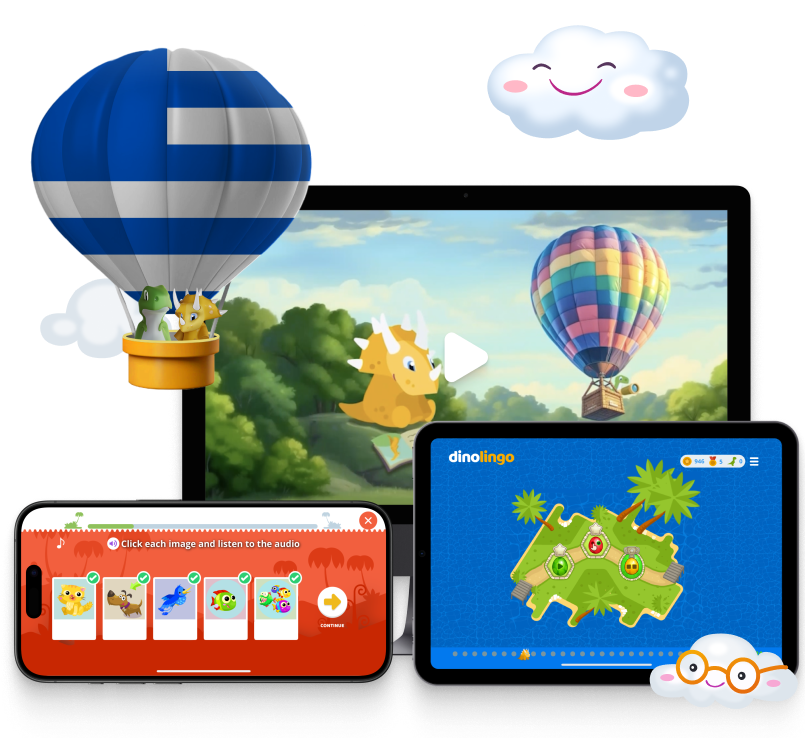
Dinolingo weaves numbers, music, and culture into games, songs, and flashcards so kids naturally absorb Greek in fun ways. With videos, songs, games, and printable materials, children ages 2 to 14 can enjoy learning not just the language but also the culture that gave birth to the Olympics. Its music-based lessons and Greek songs keep kids moving while they build vocabulary.
If your child is fascinated by Greek stories, mythology, or ancient traditions, learning Greek can bring history to life. Explore Dinolingo’s Greek learning program to help your child connect with ancient history, music, and everyday language in a fun, age-appropriate way.
Final Thoughts
Once kids learn how to count in Greek, they’ll start using numbers all over the place, and from there it’s a short hop to Greek songs, the Zorba dance, and the stories behind the Olympics. It’s a great way to build confidence and have fun at the same time.
Sources