What Makes Denmark So Special?
Denmark, officially called the Kingdom of Denmark, is a small but beautiful country in Northern Europe. It is the southernmost country of Scandinavia and also the smallest. Around 5.5 million people live in Denmark, and most of them are of Danish background. Some people have moved there from South Asia or the Middle East, but they are a small part of the population. This guide takes families on a tour of everything that makes Denmark special, from its geography and traditions to its cozy, whisper-soft language and the words kids love to say.
Where Is Denmark?
Denmark shares a land border with Germany and is surrounded by two seas: the North Sea and the Baltic Sea. It also includes two special places far away, Greenland in North America and the Faroe Islands in the Atlantic Ocean. Denmark has many islands. 76 of them are lived on, and many others are tiny and empty.
The capital city is Copenhagen, located on the island of Sealand. More than 1.6 million people live there. The land in Denmark is mostly flat, with some small hills, lakes, and forests. Because of the flat land, riding bikes is very common.
What’s the Weather Like?
The weather in Denmark is often rainy and windy. Winters are not too cold, and snow usually lasts just a few weeks. The sea rarely freezes, and summers can get quite warm.
Regions and Cities
Denmark is divided into five regions, which take care of health services like hospitals. Each region has smaller areas called municipalities (kommuner). There are 98 municipalities in total. In the past, many people lived in the countryside, but now about 85% live in cities.
Religion and Symbols
About 80% of Danish people are Protestant and belong to the Church of Denmark. The national flag is red with a white cross and is one of the oldest flags still used in the world. The white cross represents Christianity.
Sports and Hobbies
Danes love sports! The most popular sport is football (soccer). Denmark’s national team even won the European Championship in 1992. Other fun sports include cycling, swimming, kayaking, tennis, handball, and gymnastics. People also enjoy going to the beach, fishing, and racing motorcycles in a sport called speedway.
Farming and Work
Denmark is well known for producing furniture, machines, and food. People farm many different foods like dairy, beef, pork, and barley. One out of every four people in Denmark works in farming.
Beautiful Places to Visit in Denmark with Children
Denmark is filled with charming cities, fairytale castles, and vibrant coastal landscapes, making it an ideal place to explore with children. Whether you’re discovering ancient Viking towns or visiting the birthplace of Hans Christian Andersen, there’s something magical in every region.
Copenhagen: A Fairytale Capital
Copenhagen, one of Europe’s oldest capitals, is a city of museums, parks, and colorful row houses. Kids can enjoy a day at Tivoli Gardens, one of the world’s oldest amusement parks, filled with rides, games, and musical shows. A walk along Strøget, Europe’s longest pedestrian street, offers plenty of shopping and entertainment for families.
The royal Amalienborg Castle, made up of four elegant palaces surrounding a courtyard, is open to visitors. Children especially enjoy watching the daily changing of the guards. Nearby, the harbor of Langelinie is home to the famous Little Mermaid statue, a symbol of Denmark inspired by Andersen’s tale.
Funen Island: The Land of Castles and Stories
Funen, also known as Fyn, is a picturesque island and the birthplace of the beloved storyteller Hans Christian Andersen. This island is filled with Renaissance architecture, charming towns, and over 120 castles. Egeskov Castle is particularly popular with families for its playgrounds, gardens, and maze.
Grenen and the Northern Peninsula
At the northernmost point of Denmark, children can stand with one foot in the North Sea and the other in the Kattegat Sea at Grenen. The surrounding peninsula is full of natural wonders like the Lønstrup Cliffs and the moving sand dunes of Råbjerg Mile, both perfect for a day of adventure and learning.
Jutland: History and Beaches
Jutland, the mainland part of Denmark, offers a mix of modern cities and old-world charm. Aarhus and Aalborg are lively cities with museums and family-friendly attractions. Ribe, Denmark’s oldest town, features cobblestone streets and medieval buildings. Kids can learn about Viking history at the Viking Museum, or explore the Ribe Cathedral and St. Catharinæ Church.
Kronborg Castle and Hamlet’s Legacy
Near the town of Helsingør stands Kronborg Castle, known worldwide as the inspiration for Shakespeare’s play Hamlet. The impressive fortress welcomes visitors with towers, ballrooms, and views over the Øresund Strait. Children can imagine themselves as characters from a royal drama while exploring the vast castle grounds.
The Bridge to Sweden
Denmark and Sweden are connected by the Øresund Bridge, a ten-mile engineering marvel that carries cars and trains across the sea. Built over nine years and completed in 2000, the bridge is a fascinating sight for children interested in transportation and construction.
The Original Legoland in Billund
Billund, the hometown of LEGO, is where the world’s first Legoland park opened in 1968. This theme park is made of millions of LEGO bricks and includes a 4D cinema, interactive exhibits, and rides for all ages. Kids love Miniland, where famous landmarks from around the world are recreated in LEGO form.
Danish Holidays and Celebrations
Denmark celebrates many holidays throughout the year with food, family gatherings, and music. These celebrations are deeply rooted in Danish culture, often centered around seasonal changes and family life.
What Makes Danish Christmas (Jul) So Unique?
In Denmark, Christmas is called Jul, a word that comes from the Old Norse jól, meaning “midwinter.” Long before Christianity, midwinter festivals were important cultural events in Scandinavia. Today, Jul blends ancient traditions with modern holiday cheer.
Unlike many countries that focus on December 25th, Danes celebrate Christmas Eve, called Juleaften, on December 24th. Families usually gather around 6 p.m. for a festive dinner. The traditional meal includes boiled potatoes, red cabbage, and brown gravy, often served with roast duck or goose. Some families prefer a special Danish version of roast pork called flæskesteg or a spiced sausage called medisterpølse.
For dessert, families enjoy ris à l’amande, a cold rice pudding with chopped almonds and vanilla, topped with warm cherry sauce. One whole almond is hidden inside, and whoever finds it wins a small prize. After dinner, candles are lit on the Christmas tree, and families sing songs and sometimes dance around the tree before opening presents.
Other Danish Holidays
Each celebration has its own unique customs and meals:
- New Year’s Eve: Traditionally includes a dinner of boiled cod and is celebrated with fireworks and seasonal beer.
- Easter: Families gather for a special lunch that often includes roast lamb and springtime dishes.
- Martin Mass (Martinsdag): Celebrated in November, this holiday often features roast goose.
- Fastelavn (Shrovetide): Held in February, children dress in costumes and go door to door singing and asking for treats or coins.
- May 1st: Originally a labor celebration, it now includes public speeches, food, and music in parks and town squares.
- Saint Hans’ Eve (June 23rd): A midsummer celebration with large bonfires, songs, and speeches. A straw figure representing a witch is often burned as part of the tradition.
- Harvest Festivals: In August and September, rural areas celebrate the harvest season with food, dancing, and local fairs.
- Summer Holidays: Many Danish families take a three-week vacation in July or August, often spending time near the sea or countryside.
The Wonderful World of Danish Storytelling
Danish folklore is full of magical creatures, beautiful stories, and old legends that have been told for hundreds of years. These stories are a fun way for children to learn about Danish culture while using their imagination. Hans Christian Andersen, born on the island of Funen, gave the world fairytales that still shape how children everywhere picture mermaids, princesses, and brave little heroes.
The Danish Language: Roots, Alphabet, and Soft Sounds
The people of Denmark are called Danes, and they speak Danish. The Danish language is part of the Germanic family within the larger Indo-European language group. This means it shares roots with other languages like English, German, Swedish, Norwegian, and Icelandic. All of these languages have evolved from an older language called Teutonic, making them somewhat similar in sound and structure. Many Danes also speak English or German, and in some parts of the country, like the Faroe Islands or Greenland, people speak other languages such as Faroese and Inuit.
Today, around 5.5 million people speak Danish. Most of them live in Denmark, but there are also Danish-speaking communities in Greenland, Germany, Norway, Sweden, Canada, the United Arab Emirates, and the United States. In the past, Danish was even the official language of Norway and Iceland, which is why some older documents from those countries were written in Danish. One of the first important pieces of Danish literature is Gesta Danorum (History of the Danes). It was written in Latin and tells stories about the early history of Denmark. This book also includes many Scandinavian myths and legends, including the original tale of Hamlet, which later inspired Shakespeare’s famous play.
Learning the Danish Alphabet
The Danish alphabet is similar to the English one, but it includes a few extra letters and sounds. Here’s how the alphabet looks in Danish, with the way each letter is pronounced:
Aa (a), Bb (be), Cc (se), Dd (de), Ee (e), Ff (aef), Gg (ge), Hh (hå), Ii (i), Jj (jåd), Kk (kå), Ll (ael), Mm (aem), Nn (aen), Oo (o), Pp (pe), Qq (ku), Rr (aer), Ss (aes), Tt (te), Uu (u), Vv (ve), Ww (dobbelt-ve), Xx (aeks), Yy (y), Zz (saet)
The letters C, Q, W, X, and Z are mainly used in words borrowed from other languages. One interesting fact is that before 1948, the letter Å was written as “aa.” That’s why some older city names like Aalborg and Aabenraa still use the double “a” spelling.
Special Letters You’ll Love: æ, ø, and å
Danish has some special letters that make the language extra fun to say and learn, like æ, ø, and å. These letters look different and sound unique, and they show up in some of Denmark’s most delicious and interesting words:
- æbleskiver – sweet pancake balls
- øl – beer (a grown-up word kids love to say!)
- rødgrød med fløde – red berry pudding with cream (also a pronunciation challenge!)
- blå – blue
- båden – the boat
These words don’t just sound cool, they’re also a great way to get comfortable with Danish pronunciation. Try a Letter Detectives game: print out Danish words with æ, ø, and å, and ask your child to circle the special letters and say each one out loud.
What Makes Danish the Softest Language in the North?
If Danish were a blanket, it would be the softest one in the stack. Unlike the sharp tones of some neighboring Nordic languages, Danish flows with gentle sounds, relaxed endings, and quiet letters that feel like a whisper. Danish often softens or drops final consonants, making words sound round and smooth. Compare “god morgen” (good morning): in Danish it often sounds like “go’ morn,” while in Norwegian it is pronounced more clearly, with sharp sounds. Even simple words like hej (hi) or tak (thanks) are said with a soft tone and a friendly smile.
To practice, try a Whisper Words Game: write down some gentle Danish words, say them in a whisper, and ask your child to repeat. This builds confidence and trains the ear to Danish sounds. At bedtime, read out Danish words softly and let your child repeat, even using stuffed animals for roleplay.
Danish Isn’t Swedish: How to Tell Them Apart
Danish and Swedish may look alike, but they’re not the same! Danish is known for its soft, smooth sounds and dropped endings. Swedish, on the other hand, sings with a musical rhythm that makes even short words sound happy. Take the word for butter: Danish smør is soft and almost whispered, while Swedish smör is clear and singsong.
Some words share roots but change slightly between the languages. For example, barn means child in both, and hej means hello in both, but with a different tone. It’s fun to discover how the same word can sound totally different depending on where you are. Try a Word Swap Game: make flashcards with matching Danish and Swedish words, mix them up, and see if your child can guess which is which based on the spelling and sound. Add flag drawings for a fun visual.
The Big Differences Between Nordic Languages
Danish, Swedish, and Norwegian are a bit like cousins. They look and sound alike, but they each have their own style, flavor, and fun surprises for young learners. All three use the Latin alphabet, and they even share letters like å, ä, and ø, but they don’t always sound the same. In Danish, “r” can sound soft and throaty; Swedish sings its words and is super melodic; and Norwegian sounds smooth and easy to follow.
Some words are similar but not quite the same. The word for “boy” is dreng in Danish, pojke in Swedish, and gutt in Norwegian. Kids love comparing how the same idea sounds in each language, like a puzzle with three fun answers. Play Language Detective: make a chart with a few simple words (like cat, ice cream, or thank you) and let your child find the Danish, Swedish, and Norwegian versions and spot the differences. You can also draw the flags of Denmark, Sweden, and Norway, then match a unique word to each flag and say it out loud.
One Big Word or Three? Danish Compound Words
Danish has a playful way of building long words from smaller ones, called compound words. It’s like making LEGO towers with vocabulary! A word like “skolebuschauffør” might seem huge, but it’s just made of three small ones: skole (school), bus (bus), and chauffør (driver). Put them together and it means “school bus driver.” Breaking down long words helps kids understand more with less effort.
Try a Compound Detective challenge: give your child a list of long Danish words and ask them to find the smaller words inside, using pictures to match the meanings. Or play a Build-a-Word Game by cutting out cards with short Danish nouns like “hund” (dog), “hus” (house), “sol” (sun), and “briller” (glasses), then letting your child mix and match to form their own silly compound words.
Fun Danish Words for Kids, by Theme
Some words just feel good to say, and Danish is full of them. The best way to introduce these words is through everyday life: meals, play, and little adventures around the house. Here are a few themed word sets kids love.
Cozy and Happy Words: Hygge and More
One of Denmark’s most famous words is hygge (pronounced “hoo-gah”), which means cozy comfort, like cuddling up with a book or sharing hot chocolate. It’s a feeling kids already love, and now they can learn the word for it. Danish also has plenty of words that sound like fun when you say them:
- kram – hug
- grine – to laugh
- is – ice cream
- kat – cat
- ven – friend
Make a small, cozy reading space at home and call it your “hygge” corner, then learn new Danish words there with blankets, soft lighting, and quiet fun. For a Happy Word Hunt, pick five joyful Danish words (like is or kram), hide them around the room, and let your child go on a “smile word” scavenger hunt.
Food Words for the Kitchen
The kitchen can be one of the best places to learn a language. Danish food words are short and playful, perfect for beginners:
- brød – bread
- mælk – milk
- smør – butter
- ost – cheese
- æble – apple
Try using them at breakfast or snack time to make each meal a little language lesson. Pretend to be chefs in a Danish café and let your child “order” or “serve” simple foods using Danish words, or make colorful labels with words like mælk or æble and stick them on items around the kitchen, since repetition turns into recognition.
How to Order Ice Cream in Copenhagen
What’s better than learning a new language? Learning it with ice cream! In Copenhagen, kids can pick up Danish words while ordering their favorite scoop. Start with the essentials:
- is – ice cream
- vaffel – cone
- chokolade – chocolate
- jordbær – strawberry
- en kugle – one scoop
- tak – thank you
Now you can say: “En kugle jordbær, tak!” (“One scoop of strawberry, please!”) Turn your kitchen or living room into a pretend ice cream stand and use Danish words to order, serve, and pay for your cones. You can also print or draw a simple menu with Danish flavor words and prices in kroner, so kids can read, choose, and say what they want.
Bike Words on the Go
In Denmark, biking isn’t just for grown-ups, it’s a favorite way for kids to get around, explore, and have fun. Thanks to the country’s flat land, it’s also a great way to learn practical Danish words that come up in everyday life:
- cykel – bike
- hjelm – helmet
- pedal – pedal
- kurv – basket
- stoppested – stop
Your child can say: “Min cykel har en kurv.” (“My bike has a basket.”) Go on a mini biking adventure in your yard or park and use Danish words to describe what you see or do, like “hjælp mig med hjelmen!” (“Help me with the helmet!”). For a Word Hunt on Wheels, hide small signs or pictures of Danish bike words around the yard and let your child bike to each one and read the word aloud.
LEGO: The Words a Danish Toy Made Famous
Did you know LEGO comes from Denmark? These colorful bricks have inspired kids all over the world not just to build, but to speak new words too. The word LEGO comes from the Danish phrase “leg godt”, which means “play well,” a perfect example of how language and fun go hand in hand. Here are a few playful Danish words to build with:
- klods – brick
- bygge – to build
- tårn – tower
- farver – colors
- fantasi – imagination
Set up a Danish LEGO Lab where your child builds something and describes it in Danish, like “Mit tårn er rødt!” (“My tower is red!”). For a Brick by Brick Word Match, write Danish words like klods and bygge on stickers, place them on bricks, and match the word to the action or object while building.
Singing in Danish: Songs Every Kid Will Love
Music plays a big part in Danish childhood. Children’s songs in Denmark are often about the seasons, nature, family traditions, and everyday play. Many of these songs include movements or finger play, making them fun and interactive. Here are some popular Danish children’s songs and their English meanings:
- Den Lille Ole med Paraplyen – The Little Sandman with the Umbrella
- Hist, Hvor Vejen Slår en Bugt – Over Where the Road Makes a Turn
- Hun skal Leve – Live for Long (a birthday song)
- Jeg Gik Mig over Sø og Land – I Traveled Over Sea and Land
- Klap, Klap, Kage – Clap, Clap, Cake
- Lille Peter Edderkop – Itsy Bitsy Spider
- Mester Jakob – Brother John (also known as Frère Jacques)
- Nu det Jul Igen – Now, It’s Christmas Time
Singing these songs helps children not only build vocabulary but also enjoy the rhythm and melody of the Danish language in a joyful way.
Learn More About Denmark with Dinolingo
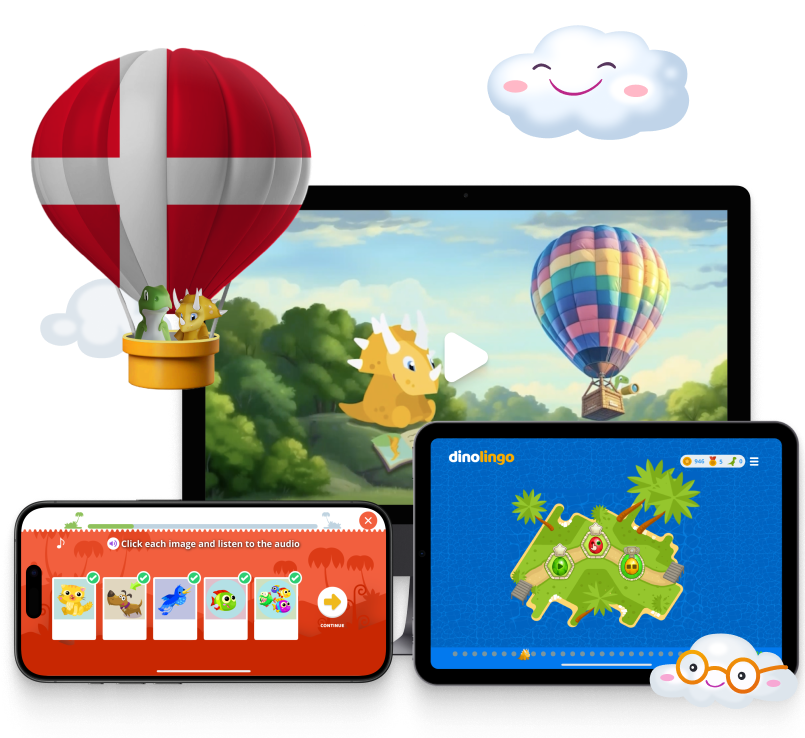
Children who want to explore the Danish language and culture can have fun learning with Dinolingo. Dinolingo offers games, songs, videos, stories, and printable activities in over 50 languages. The Danish course gently introduces everything from cozy words and food to special letters, compound words, and culture, all through playful animated lessons. It’s perfect for kids aged 2 to 14 and can be used on the web, iOS, or Android. Families can even download offline content and enjoy learning together at their own pace.