Travel Through Italy with Words—Learn the Language Kids Love
Learning the Italian Language: A Melodic Adventure for Kids
Italian is often called the “language of music,” and for good reason! With its flowing vowels and sing-song rhythm, it almost sounds like a melody. This beautiful language is spoken by millions around the world, and it’s a great choice for kids to learn early on. But where do we begin? With the alphabet, of course!
The Italian Alphabet: Similar but a Little Different
The Italian alphabet has 26 letters, just like the English one. However, five of those letters, j, k, w, x, and y, are used mostly for foreign words (like “jeans” or “kiwi”) and don’t appear in traditional Italian vocabulary. Native Italian words usually skip these, so children really focus on 21 core letters plus a handful of accented characters. The good news for young learners is that Italian is largely phonetic: once kids know the letters, they can decode nearly any word they encounter.
Here’s how you pronounce the main letters in Italian:
A (a), B (bi), C (ci), D (di), E (e), F (effe), G (gi), H (acca), I (i), L (elle), M (emme), N (enne), O (o), P (pi), Q (cu), R (erre), S (esse), T (ti), U (u), V (vu), Z (zeta)
Each letter has its own unique sound, and they are often softer and rounder than in English, perfect for singing and speaking with expression!
Why Learn the Italian Alphabet First?
Mastering the alphabet builds a foundation for phonics and reading. Because Italian spelling closely matches its sounds, knowing the letters gives children a reliable key to read, spell, and pronounce new words on their own. By turning each letter into a playful activity, kids can sing, move, and draw their way to fluent ABC recall, and that early confidence carries over into reading and speaking.
10 Simple Steps to Master the Italian ABCs
These multisensory steps turn the alphabet into a hands-on adventure. Mix and match them to keep practice fresh:
- Sing the ABC Song: Use a catchy tune and point to each letter on a poster.
- Air Writing: Trace large letters in the air with big arm movements to lock muscle memory.
- Sandpaper Letters: Feel the shape by tracing sandpaper cutouts with a fingertip.
- Picture Match: Associate each letter with an image (A = albero, B = barca).
- Vowel Echo Game: Clap and yell vowels (A, E, I, O, U) in unison to reinforce clear sounds.
- Consonant Club: Practice special pairs (GL, GN, CI, CH) with mouth-shape mirrors.
- Letter Hunt: Hide alphabet cards around the room and call out sounds as kids find them.
- Printable Flashcards: Download Italian alphabet cards from the Dinolingo offline kit, pin them to a string, and flip through daily.
- Mirror Pronunciation Check: Stand together in front of a mirror and say each letter, watching mouth shapes.
- Daily Review Ritual: Choose five random letters each morning for a quick recall game.
A Quick 15-Minute Alphabet Routine
Short, consistent practice works best. Here is an easy daily routine you can run in just 15 minutes:
- Warm-Up Song (2 min): Sing the Italian ABC song.
- Focus Letters (8 min): Trace, match picture, and pronounce three new letters.
- Movement Game (3 min): Letter Hunt or Echo Clap.
- Cool-down Review (2 min): Rapid-fire letter naming with flashcards.
Dinolingo Power-Ups
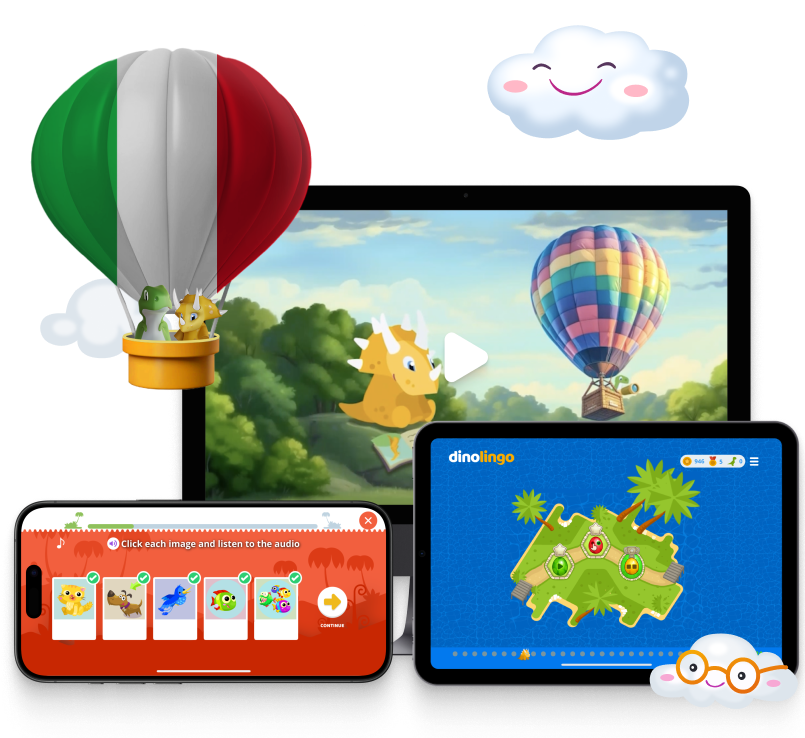
Jump into the interactive Italian course for animated letter tutorials, native audio, and drag-and-drop games. Explore all language pathways on Dinolingo language courses. By mixing these multisensory steps with Dinolingo’s interactive tools, young learners turn each letter into a memorable adventure and set themselves up for confident reading and spelling.
Italiano and Its Many Friends
The Italian that most people speak today is based on Tuscan, a dialect from the region around Florence. It’s known as Italiano, and it’s the official language of Italy. But did you know Italy is also home to dozens of regional dialects? Some of them, like Lombard, Sicilian, or Neapolitan, sound so different they can feel like entirely separate languages!
In northern regions, kids might also grow up hearing German, French, or Ladin, a rare and ancient language that shares roots with Romansh and Friulian. This mix makes Italy a fascinating place for young language learners.
The Melody of Italian
Italian is a Romance language, meaning it evolved from Latin, the language of the ancient Romans. Many Italian words look and sound like their Latin ancestors, and even like words in Spanish or French!
Thanks to its flowing rhythm and clear pronunciation, Italian is the language of opera. When people sing in Italian, the words blend like music. That’s why so many songs, arias, and musical pieces are written in it.
Learning and Literacy
Education is very important in Italy. Children start learning foreign languages early, including English, German, or French. Today, over 98% of Italians can read and write. That means most kids grow up with books, songs, and stories in both Italian and other languages.
Italian Around the World
Italian isn’t only spoken in Italy. It’s also an official language in Switzerland, San Marino, and Vatican City, and it’s widely spoken in parts of Slovenia, Croatia, Malta, and Monaco. There are about 66 million Italian speakers globally.
And guess what? There are large Italian-speaking communities in places like Canada, the United States, Brazil, Argentina, and Australia, where the children and grandchildren of Italian immigrants still speak the language of their roots.
Final Thoughts
Building alphabet mastery sets children up for confident reading and spelling, and learning Italian opens a door to music, culture, and a global community of speakers. To help your child begin their own Italian adventure through music, games, and storytelling, try Dinolingo, a fun and interactive language-learning platform made just for kids.