Where in the World Is Dutch Spoken? Fun Facts from Each Country
Dutch isn’t just spoken in the Netherlands! Kids learning Dutch will be excited to know it’s used in many parts of the world, each with its own twist on the language. From Europe to the Caribbean, Dutch connects cultures, communities, and classrooms. And once you know where Dutch lives, the next adventure is learning the colorful, magical, and everyday words that bring it to life.
Why It’s Fun to Learn Where Dutch Is Spoken
Geography meets language! By exploring where Dutch is spoken, kids can:
- Understand the global reach of the Dutch language
- Learn about new countries and cultures
- Pick up unique words or accents from each place
Countries Where Dutch Is an Official or Common Language
- Netherlands – The heart of Dutch culture and home to standard Dutch.
- Belgium – Home to Flemish Dutch (Vlaams) with fun regional words like amai! and goesting.
- Suriname – A South American country where Dutch is spoken alongside Sranan Tongo and many other languages.
- Aruba, Curaçao, and Sint Maarten – Caribbean islands where Dutch is used officially, especially in schools and government.
Cool Words from Different Dutch-Speaking Places
- Goesting (Belgium) – Craving or desire
- Bromki dyugudyugu (Suriname slang) – Very informal fun expression (use with care and context!)
- Kas di kunuku (Curaçao) – Country house
- Dushi (Aruba/Curaçao) – Sweet, nice, or good
Kids can create a Dutch-language world map and add these words by region!
Describing the World: Easy Dutch Adjectives for Children
Once kids know where Dutch is spoken, the next step is learning words to describe everything they see along the way. Adjectives help children make sense of the world by adding color and detail to their sentences. In Dutch, just like in English, they describe size, color, mood, and more, making language vivid and exciting!
Why adjectives matter: Learning adjectives helps kids talk about the things they see, feel, and experience, make more complete and expressive sentences, and notice the details in their environment. And because many Dutch adjectives are used daily, they’re great for early learners to pick up through repetition and play.
- Blij – Happy
- Boos – Angry
- Mooi – Beautiful
- Luid – Loud
- Zacht – Soft
- Lekker – Tasty
- Klein / Groot – Small / Big
- Vies / Schoon – Dirty / Clean
Use them with familiar nouns: de grote hond (the big dog), een zachte knuffel (a soft stuffed toy), or het lekkere ijsje (the tasty ice cream).
Paint Your World in Dutch: Vocabulary for Creative Kids
Art is a powerful way to explore language. When kids draw, paint, and create, they also label, describe, and express. Teaching Dutch vocabulary through art lets children connect new words with their imagination and have fun while doing it. Art activates multiple senses, which helps children learn visually and kinesthetically, remember words by connecting them to images, and speak naturally while describing their own creations. It’s especially effective for visual learners and kids who enjoy hands-on activities.
Kleuren – Colors
- rood (red), blauw (blue), geel (yellow), groen (green), zwart (black), wit (white)
Vormen – Shapes
- cirkel (circle), vierkant (square), driehoek (triangle), rechthoek (rectangle)
Materialen – Materials
- papier (paper), potlood (pencil), verf (paint), kwast (brush)
Put these words to work right away with simple sentences: De zon is geel. (The sun is yellow.) or Ik zie een blauwe vogel. (I see a blue bird.)
Dutch That Feels Like Magic: Vocabulary from Holland’s Most Enchanting Park
Efteling is more than a theme park, it’s a storybook world where Dutch comes to life. With castles, dragons, and fairytale forests, this beloved destination in the Netherlands is the perfect backdrop for learning Dutch words that feel like magic. Children learn best when they’re curious and engaged, and in magical settings like Efteling, language becomes part of the adventure. Learning fairytale-themed words helps kids expand vocabulary in creative ways, connect words with visual and emotional meaning, and explore Dutch stories and traditions.
- Sprookje – Fairytale
- Kasteel – Castle
- Tovenaar – Wizard
- Draak – Dragon
- Elf – Elf
- Bos – Forest
- Prinses – Princess
- Avontuur – Adventure
Pair these with storybooks, videos, or drawings to reinforce meaning, and try labeling a scene out loud: Dit is een draak. Hier is een tovenaar.
Art, History & Language: Learn Dutch in the Museum World
Museums aren’t just for looking, they’re for learning! For kids studying Dutch, museums offer a rich environment to explore language through art, history, science, and culture. With the right vocabulary, children can describe what they see and talk about what they experience. In a museum, language becomes real: children use words to describe objects, colors, and actions, hear and read new vocabulary in meaningful context, and build curiosity-driven language skills. It’s a great way to combine learning with adventure.
- Museum – Museum
- Kunst – Art
- Schilderij – Painting
- Beeld – Sculpture
- Oud – Old
- Geschiedenis – History
- Tentoonstelling – Exhibition
- Kaartje – Ticket
Use these words when looking at pictures of museum exhibits or on a real or virtual museum visit, for example: Dit is een schilderij van een kat. (This is a painting of a cat.)
Games and Activities to Explore Global Dutch
From mapping the Dutch-speaking world to describing a painting, these playful activities tie every theme together.
“Dutch Around the World” Map Game
Print or draw a map and place a word or phrase from each Dutch-speaking region. Practice saying them aloud with fun flags and stickers.
“Say It the Local Way” Roleplay
Act out mini travel scenes where kids pretend to visit each country. Use regional greetings and words to buy snacks, ask directions, or say thank you.
“Describe & Draw” Game
Say a Dutch adjective and noun combo like een boos monster (an angry monster) and let your child draw it. Then swap roles and let them describe for you to draw!
“Adjective Treasure Hunt”
Hide cards around the room with Dutch adjectives. When kids find one, they must find an object that matches and say a sentence using it: Dit is een mooie bloem! (This is a beautiful flower!)
“Color & Name It!” Poster Craft
Let kids create a color wheel or shape collage. Label each color and shape in Dutch. Add drawings or real items for texture and fun.
“Fairytale Word Quest”
Create a treasure hunt with Dutch word cards hidden around the house or yard. Each clue leads to the next: Zoek het kasteel! (Find the castle!).
“My Dutch Fantasy World” Drawing
Ask your child to draw their own magical park. Label characters and places in Dutch: Dit is een draak. Hier is een tovenaar.
“Mini Gallery Tour”
Set up a pretend art gallery at home using your child’s drawings or printed artwork. Walk through and describe each piece in Dutch: Dit is een schilderij van een kat. (This is a painting of a cat.)
“Museum Word Match”
Create flashcards with pictures and Dutch words like beeld or kaartje. Let kids match the words and say them out loud, using them in a sentence.
Learn Dutch Naturally with Dinolingo
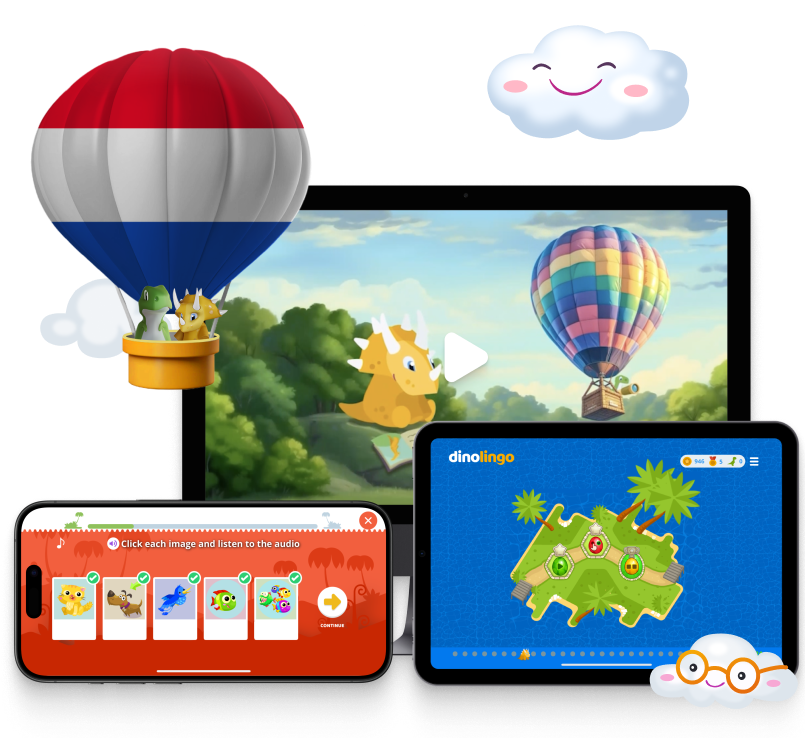
Dinolingo provides a rich foundation in standard Dutch, helping kids aged 2–14 speak confidently and understand global variations. Its interactive platform makes learning Dutch for kids fun and engaging, with videos, games, songs, and printable tools, plus imaginative themes, animations, and stories that bring fantasy elements and real-world vocabulary like bos and prinses to life. The program introduces real-life Dutch through cultural and thematic lessons, combines speaking, listening, and creating in flexible ways, and includes a built-in reward system and parental dashboard that make tracking progress easy. Want to explore how the program works? Their How It Works page explains all the features.
Final Thoughts
Dutch is a global language, and every region adds its own sparkle. It doesn’t just live in textbooks, it lives in castles, forests, flying fairytales, colorful paintings, and museum halls. With fun facts, vivid adjectives, and playful words, kids can explore the Dutch-speaking world, no passport needed, one magical word at a time.
Sources