
Discover Dutch Music and Instruments
Traditional Dutch music is a rich and vibrant part of the Netherlands’ cultural heritage, and it is one of the most joyful doorways into Dutch language and traditions for children. One of the most iconic genres is the “levenslied”, meaning “life song.” These songs are often emotional and relatable, touching on everyday themes such as love, happiness, loneliness, and nostalgia. They usually follow a simple melody with rhyming couplets and repeating refrains, making them easy for children to follow and sing along with. From there, music opens the door to the wider world of Dutch food, festivals, games, stories, and customs that kids find so much fun to explore.
Popular Instruments in Dutch Folk Music
- Accordion: Central to many Dutch folk songs, the accordion adds a joyful and lively rhythm that children love.
- Violin, Recorder, and Harmonica: These instruments are often used in traditional melodies passed down through generations.
- Draaiorgel (Mechanical Street Organ): A fascinating Dutch invention, the draaiorgel plays music automatically using a crank and perforated strips of paper or cardboard. These street organs are beautifully decorated and often seen at Dutch festivals or markets.
- Barrel Organ: Similar to a pipe organ, the barrel organ produces music through bellows and wooden barrels. In the past, organ grinders would turn the crank by hand; today, many are battery operated.
These instruments are not only unique in their design but also fun to explore visually and audibly. Watching videos of draaiorgels or listening to accordion-led folk songs can spark children’s curiosity and deepen their interest in the Dutch language.
How to Use Dutch Music in Learning
- Play traditional Dutch music in the background during playtime or meals.
- Create a playlist of Dutch children’s songs, including both folk and modern tunes.
- Watch YouTube clips of draaiorgels in action or virtual performances from the Netherlands.
- Encourage your child to clap, dance, or play along with simple rhythm instruments like tambourines or homemade shakers.
- Sing along to levenslied songs and explain the meaning of the lyrics using simple Dutch phrases.
Try These At-Home Music Activities
- Make a mini draaiorgel craft: Use cardboard, markers, and paper rolls to make a pretend draaiorgel and let your child “perform” with it.
- DIY music time: Turn pots, pans, or toy instruments into a musical show while singing Dutch songs.
- Music and drawing: Play a Dutch folk song and ask your child to draw how it makes them feel, or what story the music might tell.
- Create a “Dutch Song Night”: Once a week, have a short music night where the family sings a new Dutch song together.
Including Dutch music in your child’s language routine can boost vocabulary, pronunciation, listening skills, and cultural appreciation, all while having fun.
Amazing Dutch Fun Facts for Kids
The Dutch national soccer team has played in three World Cup finals: in 1974 (against Germany), 1978 (against Argentina), and 2010 (against Spain), but they have never won the cup. It is quite remarkable that such a small country plays such a major role in international soccer. Soccer is the number one sport in the Netherlands, followed by cycling and speed skating.
Amsterdam is the capital of the Netherlands. This city is known for its tolerant atmosphere. Historically, during the 1700s, Amsterdam was a safe haven for refugees and free thinkers fleeing dictatorships across Europe. As long as taxes were paid, people were welcomed in the city, regardless of their background. The Netherlands is also often associated with windmills, colorful tulips, and stories like that of Hans Brinker. Anne Frank, a young Jewish girl whose diary became world famous, represents an important part of Dutch history too.
Dutch Festivals and Traditions
Music and celebration go hand in hand in the Netherlands, and several festivals are favorites with children. Sinterklaas is one of the most beloved holidays. Sinterklaas, a bishop from Spain, travels with his helper to deliver gifts to children. While he rides a white horse on rooftops, the helper places presents in children’s shoes by climbing down the chimney.
Another popular celebration is Koninginnedag (Queen’s Day), now celebrated as Koningsdag (King’s Day) on April 27. People flood the streets in orange outfits to celebrate with music, dancing, and street markets where they sell second-hand items.
Christmas and Easter are also widely celebrated. In the Netherlands, both holidays include a first and second day. Christmas is for family gatherings and meals, but gifts are more commonly given on Sinterklaas rather than Christmas.
Traditional Dutch Clothing: Wooden Shoes and Clogs
Dutch culture is filled with charming traditions, and one of the most recognizable symbols is the wooden shoe. These traditional shoes, also called clogs, have played an important role in Dutch life for centuries. They are practical, comfortable, and surprisingly helpful in both farming and everyday life.
Why Wooden Shoes?
Wooden shoes may seem unusual today, but in the Netherlands, they’ve always had a purpose. They are remarkably light and surprisingly comfortable when worn with thick socks. Farmers especially love them, as they protect the feet from being stepped on by large animals like cows. Since they’re made of wood, they provide extra safety on slippery barn floors and muddy fields.
Winter Warmth and Clever Reuse
Wooden shoes aren’t just for protection, they also help keep feet warm in the winter. People traditionally placed straw inside to insulate the shoe, creating a cozy space for their feet during cold months. And when the clogs are too old to wear, the Dutch get creative: they often hang them on walls or barns and fill them with flowers, using worn-out clogs as planters outside barns or homes. This gives a second life to old shoes and adds charm to the countryside.
A Unique Symbol of Dutch Culture
Today, clogs are mostly worn during traditional celebrations, festivals, or by farmers in rural areas. They are also popular souvenirs and reminders of the Netherlands’ rich cultural heritage. Children learning about Dutch traditions often enjoy painting or decorating miniature wooden shoes as a craft activity.
Delicious Dutch Food
The most popular fast food in the Netherlands is fresh-cut French fries served with a variety of sauces. Other local favorites include eel and raw herring sandwiches, dark bread rolls with Gouda cheese, and mashed potato dishes like hutspot (made from potatoes, carrots, and onions) and boerenkool (mashed kale and potatoes with sausage).
Sweet treats are also plentiful. Stroopwafels, for instance, are thin waffle cookies filled with caramel syrup. People often warm them by placing them on top of a hot drink. The Dutch also enjoy chocolate and spiced biscuits.
Dutch Children’s Games
“Sjoelbakken” is a popular Dutch shuffleboard game. Kids and adults alike enjoy sliding wooden disks into numbered slots on a long wooden board. Each player gets three turns to score the highest points.
“Kinkkeren” is a traditional marble game that dates back to Roman times. Dutch children have special names for different marbles, like the large one called “giant giant bonk.” The goal is to shoot other players’ marbles out of a large circle drawn on the ground. The last player with remaining marbles wins.
Beloved Dutch Stories
One well-known story is that of Hans Brinker, a young Dutch boy who saved his village from flooding. On a stormy day, Hans noticed a hole in the dyke and held it closed with his finger. His friend ran for help, and together they saved the town. Hans Brinker became a national hero.
The Dutch Language, Dialects, and Names
Dutch is a West Germanic language spoken by about 90% of people in the Netherlands. It is also spoken in Belgium (where it’s called Flemish) and Suriname. Dutch is closely related to German and English. Although the Netherlands is relatively small, it has over thirty different regional dialects. The southern part of the country (below the rivers Rijn, Waal, and Maas) is historically Catholic and culturally connected to Belgium and France, with dialects such as Brabants, Limburgs, and Zeeuws. The northern part is traditionally Protestant and oriented toward Scandinavia, with dialects like Gronings, Drents, and Achterhoeks. Fries (Friesian) is an official second language spoken by over 500,000 people in Friesland.
When speaking, it is customary to use the formal form “U” or “Uw” when addressing someone, especially older individuals or in formal settings. The informal form “je/jij” is only used when the other person invites you to do so.
Names are a fun way to practice Dutch too. Popular girls’ names include Emma, Julia, Sophie, Lotte, Isa, Lisa, Saar, Lieke, Eva, and Anna. Popular boys’ names include Daan, Shem, Milan, Levi, Luuk, Luca, Jayden, Thomas, Stijn, and Jesse. Common Dutch last names often begin with “van” or “van der,” such as van Dijk (from the dike), de Boer (farmer), or de Vries (the Frisian).
Dutch Manners and Customs
A handshake is a common greeting. People often stand up and say the other person’s name when shaking hands. Among close friends, a triple air kiss (left, right, left) is also common. When entering a waiting room, it is polite to say “hello” to everyone.
If invited to someone’s home, guests usually bring a small wrapped gift, like chocolates or flowers. Flowers should be an odd number, but not thirteen.
Dining is formal. Wait to sit until invited, and start eating only when the host begins. It is polite to eat everything on your plate and place your knife and fork parallel across your plate when finished. Helping clean up afterward is appreciated. Dutch people value punctuality and usually plan visits in advance.
About Dutch Culture and Family Life
Dutch culture varies by region, with four main regions making up the country. Families typically have one or two children, and both parents often work. Children begin primary school at age four.
The Dutch value cleanliness, organization, saving money, and punctuality. They prefer privacy and do not brag about success. Respect for others and education are highly important.
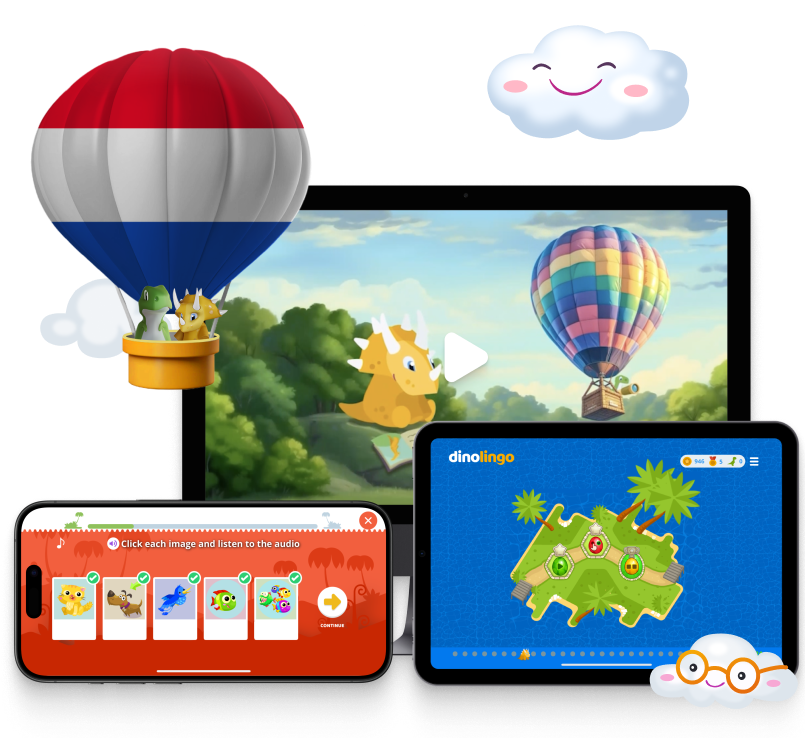
Including Dutch music, food, games, and traditions in your child’s language routine brings culture and language together in a playful, effective way. You can explore more traditional songs, music-themed games, animated musical videos, flashcards, and stories on Dinolingo, which offers a full Dutch learning program for kids. Songs are age-appropriate, catchy, and designed to support both language learning and memory retention.
Growss