Spanish for Kids: The Complete Guide to Helping Your Child Learn Spanish
Spanish is the second most spoken language in the world, with over 500 million native speakers across more than 20 countries. Teaching your child Spanish early opens doors to new friendships, stronger cognitive skills, and a genuine competitive advantage in school and beyond. Whether your child is 2 or 14, this guide covers everything you need to know about Spanish for kids—from the best age to start, to practical methods that actually work at home and in the classroom.
Why learn Spanish as a kid?
Children are natural language learners. Their brains are wired to absorb new sounds, grammar patterns, and vocabulary faster than adults ever could. Research from Harvard University shows that children who learn a second language before age 10 achieve near-native pronunciation and develop stronger problem-solving skills. Spanish, with its consistent phonetics and straightforward grammar, is one of the most accessible languages for young learners.
Here are the top reasons parents choose Spanish for their kids:
- Global reach: Spanish is an official language in 20 countries and is widely spoken in the United States, making it immediately useful.
- Academic benefits: Bilingual children consistently score higher on standardized tests in reading, math, and critical thinking.
- Career opportunities: Spanish-speaking professionals earn 5–20% more on average in fields like healthcare, education, business, and law.
- Cultural awareness: Learning Spanish introduces kids to diverse traditions, music, literature, and foods from Latin America and Spain.
- Easier gateway language: Once a child knows Spanish, learning other Romance languages like French, Italian, and Portuguese becomes significantly easier.
What is the best age to start learning Spanish?
The short answer: as early as possible. Neuroscience research confirms that the “critical period” for language acquisition runs from birth to about age 7, during which the brain is exceptionally receptive to new languages. However, children up to age 14 still benefit enormously from starting a second language.
Here is how different age groups approach Spanish learning:
Ages 2–4: The immersion sponge
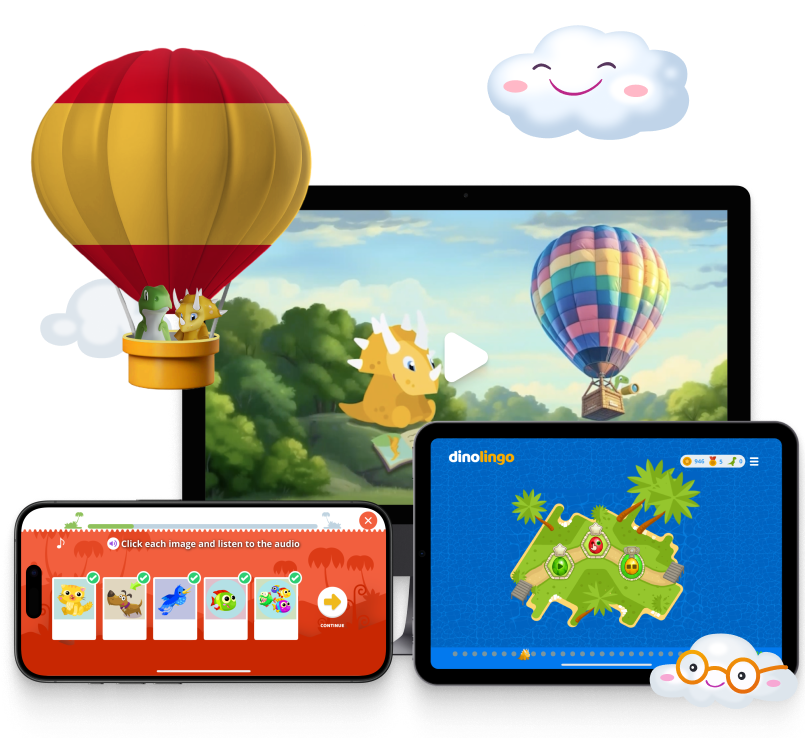
Toddlers learn through repetition, songs, and play. At this stage, the goal is exposure—hearing Spanish words, repeating simple phrases, and associating sounds with objects. Dinolingo’s animated lessons are designed specifically for this age group, using colorful characters and repetition to build vocabulary naturally.
Ages 5–7: The confident beginner
Kids at this age can start forming sentences, understanding basic grammar, and reading simple Spanish words. Interactive games, flashcards, and short stories work particularly well. This is the sweet spot where children can still develop accent-free pronunciation while also grasping structure.
Ages 8–10: The strategic learner
Older children bring analytical skills to language learning. They can compare Spanish grammar to English, learn verb conjugations, and start writing short paragraphs. Combining structured lessons with real-world practice—like ordering food in Spanish at a restaurant—keeps motivation high.
Ages 11–14: The motivated explorer
Preteens and teens can handle more complex grammar, longer reading passages, and conversation practice. They benefit from goal-setting, cultural projects, and connecting Spanish to their interests—whether that is music, sports, travel, or social media.
How do kids learn Spanish? Proven methods that work
Not all learning methods are created equal, especially for children. The most effective approaches combine multiple senses and keep the experience enjoyable. Here are the proven methods for teaching Spanish to kids:
1. Interactive apps and online platforms
Digital tools like Dinolingo use animated videos, games, quizzes, and stories to teach Spanish in a way that feels like play, not homework. The platform covers 50 languages and is designed for ages 2–14, with progress tracking so parents can monitor their child’s advancement. The key advantage is consistency—kids can practice every day for just 15–20 minutes and see real results within weeks.
2. Songs and music
Music is one of the most powerful memory tools for language learning. Spanish children’s songs teach vocabulary, pronunciation, and rhythm simultaneously. For a deeper dive into this method, check out our guide on learning Spanish through songs and music. Songs like “Los Pollitos Dicen,” “De Colores,” and “La Bamba” are catchy enough that kids sing them on repeat—which is exactly the point. Repetition through music builds long-term memory without any effort.
3. Storytelling and read-alouds
Reading Spanish books together—even simple picture books—exposes children to sentence structure, new vocabulary, and cultural context. Start with bilingual books where English and Spanish appear side by side, then gradually transition to Spanish-only stories as your child’s confidence grows. Need recommendations? See our list of the best Spanish books for early learners.
4. Games and play-based learning
Board games, card games, and scavenger hunts adapted for Spanish make learning social and fun. Simple games like “Simon Says” (Simón Dice) or labeling objects around the house with Spanish sticky notes turn everyday moments into learning opportunities. Explore more ideas in our roundup of the best Spanish learning apps and games for kids.
5. Conversation practice
Even basic daily phrases make a difference. Try incorporating Spanish into your routine: say “buenos días” at breakfast, count objects in Spanish during car rides, or name colors at the grocery store. The goal is to make Spanish a normal part of daily life, not a separate “study session.”
6. Cultural immersion
Expose your child to Spanish-speaking culture through cooking traditional recipes together, watching age-appropriate Spanish cartoons, celebrating holidays like Día de los Muertos and other Spanish traditions, or listening to Spanish music during family time. When kids connect language to real experiences, retention skyrockets.
Essential Spanish words and phrases every kid should know
Starting with high-frequency words gives kids quick wins and builds confidence. Here are the must-know basics:
Greetings and polite words
- Hola – Hello
- Adiós – Goodbye
- Por favor – Please
- Gracias – Thank you
- De nada – You’re welcome
- Buenos días – Good morning
- Buenas noches – Good night
Numbers 1–10
- Uno, dos, tres, cuatro, cinco, seis, siete, ocho, nueve, diez
Colors
- Rojo (red), azul (blue), verde (green), amarillo (yellow), naranja (orange), morado (purple), blanco (white), negro (black)
Family members
- Mamá (mom), Papá (dad), Hermano (brother), Hermana (sister), Abuelo (grandfather), Abuela (grandmother)
Everyday phrases
- ¿Cómo te llamas? – What is your name?
- Me llamo… – My name is…
- ¿Cuántos años tienes? – How old are you?
- Tengo … años – I am … years old
- ¿Puedo ir al baño? – Can I go to the bathroom?
Common mistakes parents make when teaching kids Spanish
Even well-intentioned parents can accidentally slow down their child’s progress. Here are the pitfalls to avoid:
- Expecting perfection too soon: Language learning is messy. Kids will mix up words, use wrong verb forms, and make pronunciation errors. That is completely normal and part of the process. Correcting every mistake discourages risk-taking.
- Making it feel like homework: The moment Spanish feels like a chore, motivation drops. Keep sessions short (15–20 minutes), playful, and pressure-free.
- Inconsistency: Learning a language requires regular exposure. Practicing once a week will not produce results. Aim for daily practice, even if it is just five minutes of Spanish songs in the car.
- Relying on a single method: No single tool covers everything. Combine apps, books, music, and conversation for a well-rounded approach.
- Not celebrating small wins: When your child correctly says “gracias” or counts to ten in Spanish, celebrate it. Positive reinforcement builds the habit loop that keeps kids coming back.
How Dinolingo makes Spanish fun for kids
Dinolingo is specifically built for children ages 2–14 and is used by thousands of schools, libraries, and families worldwide. Here is what makes it effective:
- Animated lessons: Cartoon characters teach vocabulary and phrases through engaging storylines that kids actually want to watch again.
- Game-based practice: Interactive games reinforce what kids learn in videos, turning repetition into play.
- Progress tracking: Parents and teachers can see exactly what their child has learned and where they need more practice.
- Offline access: Download lessons for car rides, flights, or anywhere without internet.
- 50 languages available: If your family is interested in more than just Spanish, Dinolingo offers 49 other languages using the same proven method.
- Free 7-day trial: You can try the full platform before committing, with no risk.
Creating a Spanish learning routine at home
Consistency is the single biggest predictor of success in language learning. Here is a simple weekly routine that works for most families:
- Monday–Friday (15–20 min): One Dinolingo lesson or video, followed by a quick game or quiz.
- Daily mini-moments (2–5 min): Use Spanish greetings at breakfast, count objects in Spanish, or name colors during playtime.
- Weekend activity (30 min): A Spanish cooking project, a bilingual storybook, or a cultural craft activity.
- Weekly review: Revisit the week’s vocabulary with flashcards or a fun quiz to reinforce memory.
The key is to make Spanish part of your family’s daily rhythm rather than an isolated event. Even five minutes a day adds up to over 30 hours of exposure per year.
Frequently asked questions about Spanish for kids
At what age should my child start learning Spanish?
Children can start learning Spanish as early as age 2. The earlier they begin, the more naturally they acquire pronunciation and grammar. However, kids up to age 14 still benefit significantly from starting a second language.
How long does it take for a child to learn Spanish?
With consistent daily practice of 15–20 minutes, most children can hold basic conversations within 3–6 months. Reaching fluency typically takes 2–3 years of regular exposure and practice.
Do I need to speak Spanish to teach my child?
No. Platforms like Dinolingo are designed so that children can learn independently through videos, games, and interactive activities. Many monolingual parents successfully raise bilingual children using digital tools and community resources.
Will learning Spanish confuse my child with English?
Research consistently shows that bilingualism does not cause language confusion. Children may occasionally mix languages (called code-switching), but this is a normal and healthy sign of bilingual development, not confusion.
What is the best app for kids to learn Spanish?
Dinolingo is rated as the #1 language learning app for kids ages 2–14. It combines animated lessons, interactive games, and progress tracking in a format specifically designed for young learners.