Simple Korean Games That Kids Love
Korean children have been playing simple yet clever games for generations. These games don’t require batteries or screens, just everyday objects like stones, sticks, and a bit of skill. Alongside these games, Korean kids grow up singing songs that are full of rhythm, repetition, and culture. Together, games and songs make up a playful world that helps children build coordination, memory, and a love of language. Let’s explore the most popular Korean games and songs that kids still enjoy today.
Traditional Korean Games for Kids
Many of Korea’s best loved children’s games use nothing more than small objects and quick hands. They are easy to learn, simple to set up, and endlessly fun to repeat.
Gonggi: The Korean Stone Toss Game
Gonggi is a favorite game for many children in Korea. It uses small stones about the size of grapes. Here’s how it works: the player lays the stones flat on the ground, picks one up, tosses it in the air, and quickly flips their hand to catch it on the back. As the game continues, players try to toss and catch multiple stones at once, which makes it even trickier and more exciting.
The Korean Version of Jacks
Another stone game, mostly played by girls, is similar to jacks. A few small stones are placed on a flat surface. A rubber ball is tossed into the air, and the player tries to grab as many stones as possible before catching the ball. It’s all about quick hands and good timing!
Yut: A Lunar New Year Favorite
Yut is a traditional board game played especially during Lunar New Year. Instead of dice, it uses four wooden sticks, each with a flat and curved side. Players (or teams) take turns tossing the sticks. The way they land determines how many steps a player can move on the board. The goal is to make it around the board before the others. Yut is not just fun, it also brings families together for celebration and strategy. The game is so familiar in Korean homes that it even shows up in children’s songs, where the wooden sticks are compared to everyday objects like chopsticks.
Popular Korean Children’s Songs
Just as games sharpen quick thinking, songs sharpen the ears and the tongue. Learning Korean through songs is a joyful and effective method, especially for children aged 2 to 14. Music helps children improve their pronunciation, expand vocabulary, and develop listening comprehension. Korean kids’ songs are rich in culture, rhythm, and repetitive patterns, making them easy and enjoyable to remember. Below are some of the most beloved Korean songs that children can sing along to while learning Korean naturally.
I Love You, This One Word (사랑해요 이 한마디)
This cheerful song is about expressing love in families. With its gentle rhythm and repeating phrases, it’s perfect for preschoolers and early learners.
A Small Zoo (작은 동물원)
Children will enjoy this fun song that imitates animal sounds in Korean. It’s great for toddlers and elementary school kids to practice vocabulary related to animals and sounds.
Crocodiles (악어떼)
This song turns a jungle adventure into a musical game. It uses movement and rhythm, ideal for group singing and classroom activities.
Three Bears (곰 세 마리)
A traditional and widely known Korean nursery song featuring family vocabulary and adjectives. Easy to learn and perfect for age 2 to 6.
Little Snowman (꼬마 눈사람)
This winter-themed song includes fun imagery and emotions, great for seasonal learning and facial vocabulary.
They Are the Same (똑같아요)
An educational tune that compares objects like chopsticks and sticks used in the traditional Korean game Yut. Helpful for teaching counting and comparison, and a lovely bridge between Korea’s songs and its games.
Butterfly (나비야)
Children follow a butterfly in this lyrical song full of springtime imagery and simple action words. Encourages nature-based vocabulary.
Fox, What Are You Doing? (여우야 여우야 뭐하니)
A playful call-and-response song that reinforces daily routines, questions, and rhymes. Great for memory and participation.
Fishing Song (고기잡이)
This imaginative song teaches basic Korean action verbs and environments. Kids can pretend to go fishing while learning.
Why Games and Songs Matter for Learning
These traditional Korean games teach coordination, teamwork, and quick thinking. Songs add another layer: they are not just for fun, they boost memory, pronunciation, and emotional engagement. Repeating melodies makes new words easier to remember, while gestures and play activities keep children interested. Many Korean songs also introduce cultural elements such as family life, holidays, nature, and traditional games. Whether your child is tossing stones in Gonggi or singing about three bears, both are a great way for kids to connect with Korean culture while having fun.
How Dinolingo Helps
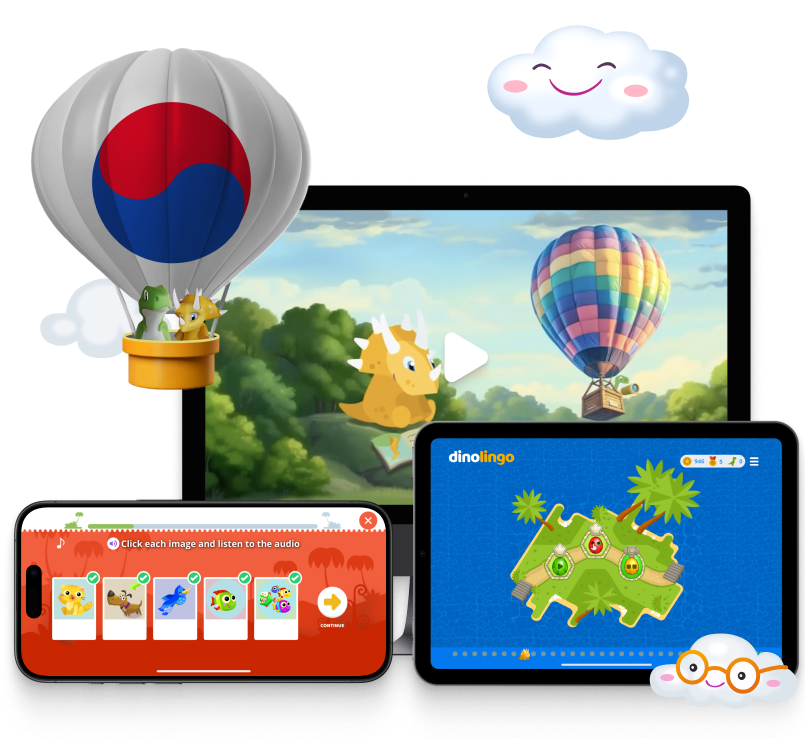
At Dinolingo, children can learn Korean through games, songs, and interactive lessons, making language learning as playful as these classic Korean activities. The Dinolingo Korean program offers a wide collection of interactive songs, cartoons, and games designed specifically for kids. With over 50 languages available, Dinolingo allows children to explore Korean through playful lessons, offline materials, a gamified reward system, and a parent-friendly progress dashboard. Whether your child is a toddler just beginning or an older learner expanding their vocabulary, Dinolingo adapts to every learning stage.