Greek Games That Kids Still Love Today
Children in Greece have been playing imaginative and skillful outdoor games for generations. These traditional games are simple, active, and full of laughter. They also offer a great window into Greek culture and how play connects to balance, rhythm, and patience. And play in Greece is never just about games. The same energy spills over into music, dance, and song, which have shaped Greek childhood for thousands of years. Let us explore three classic game favorites still loved by kids today, then step into the rhythms and melodies that bring Greek culture to life.
Classic Greek Outdoor Games
Greek street games rely on little more than a piece of chalk, a flat stone, or a bottle cap. They reward aim, balance, and timing, and they bring children together outdoors. Here are three favorites that have been passed down through generations.
Crippling
In this game, children draw a large rectangle on the pavement and divide it into four sections using parallel lines. The first three parts are equal in size, and the fourth section, called “king,” is about three times bigger. Each child takes turns throwing a small flat stone called the “team” into the first section, then hops through each part on one foot. When they reach the “king,” they can rest, then return without touching the ground with their other foot. The player must also kick the stone out of each section without stepping on the lines. Finishing all sections without mistakes earns a “rubo.” The child who collects three rubos first wins.
Caps
Caps is a two-player game played on the ground. A small hole is made between the players, and each player uses a bottle cap. Taking turns, they flick their caps toward the hole from about two feet away. The first player to get their cap into the hole wins the round. This game is great for improving aim and timing and is usually played by children six and older.
Hopscotch
Greek children enjoy hopscotch just like kids around the world. They draw eight or more squares on the ground in a straight or alternating pattern. Players throw a small rock into the first square, then hop over it on one leg. The goal is to hop through all the squares and push the rock from one square to the next without losing balance or landing outside the lines. If the rock falls out or the player steps incorrectly, they lose their turn.
Music and Dance: The Other Side of Greek Play
Music and dance have been a central part of Greek culture for thousands of years. In ancient Greece, music was used to accompany poetry, drama, and religious rituals. Even today, the rhythms of many traditional Greek dances can be traced back to the poetic meters used in classical plays. Just as outdoor games teach balance and timing, dance and song give children another playful way to move, listen, and connect with their heritage.
Music and Dance in Daily Life
During Christian times and up to the present day, music, song, and dance have continued to play an important role in Greek celebrations. Events such as baptisms, weddings, saints’ days, Easter, May Day, and harvest festivals are often marked with traditional performances. Whether in large cities or small villages, wherever Greek people gather, music is never far away.
Traditional Greek Dances
There are more than 4,000 traditional Greek dances! Many of these dances are performed in circles or lines during community events. Families and neighbors often dance together, creating a festive and welcoming atmosphere. Learning a few Greek dance steps is a fun way for children to connect with Greek culture, much like learning the rules of a neighborhood game.
Greek Instruments
Greek music includes many unique instruments that give it a special sound:
- Bouzouki: A stringed instrument from the lute family, often used in folk and modern Greek music.
- Gaida: A traditional Greek bagpipe made from goat or sheep hide.
- Toumbi: A large double-headed drum played with sticks, commonly heard in festivals and street celebrations.
Greek Songs for Children
Singing is an important part of how Greek families share their culture with children. Many songs have been passed down through generations, with topics ranging from lullabies to games and dances. Here are some popular Greek children’s songs:
- Αδελφός Ιάκωβος – Brother James
- Καλήν εσπέραν άρχοντες – Christmas Carol
- Παλαμάκια παίξετε – Clap Your Hands
- Έλα ύπνε μου, πάρε το – Come, Good Sleep
- Βρέχει, χιονίζει – It’s Raining, It’s Snowing
- Κουνελάκι – Little Rabbit
- Φεγγαράκι μου λαμπρό – My Little Shining Moon
- Κοιμήσου – Sleep
- Το παιδί θέλει χορό – The Child Wants to Dance
- Να χορέψη θέλ’ η κόρη – The Girl Wants to Dance
These songs are catchy, playful, and easy for children to sing along with. They also help improve vocabulary and pronunciation in a natural and enjoyable way.
Where Language Meets Play
Whether they are hopping through hopscotch squares or learning a circle dance, Greek children grow up surrounded by movement, memory, and cultural tradition. These games, dances, and songs are more than fun. They open a window into a rich and expressive culture, and by listening to songs and learning a few steps, kids build not only their language skills but also their connection to Greek traditions.
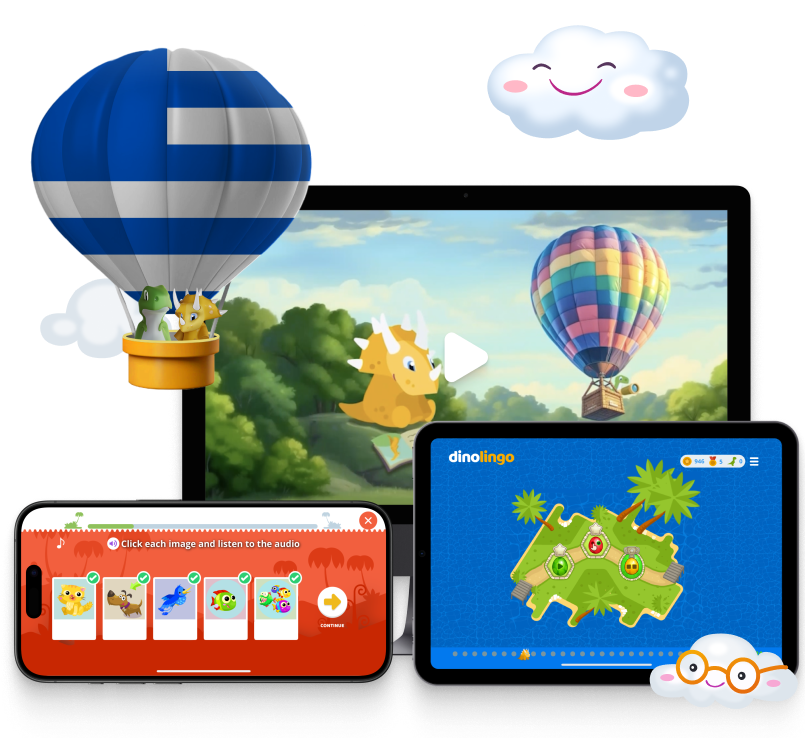
With Dinolingo’s online Greek lessons for kids, children can learn new Greek words, songs, and customs through interactive videos, stories, and games. The program includes engaging songs, animations, and games that make learning feel like play, so children can explore Greek through music and dance while developing vocabulary, rhythm, and cultural awareness, all at their own pace. It is an enjoyable and engaging way to bring the Greek language and culture into everyday life. Let the rhythms of Greece guide your child’s language journey!