Fairy Tales in Russian: Baba Yaga and Magic Words
Russian fairy tales are full of spooky forests, magical creatures, and brave heroes and one of the most famous characters of all is Баба Яга (Baba Yaga). Kids love her not-too-scary tricks and the fun words that pop up in every story. But the magic does not stop with witches and heroes. From animals and colors to nesting dolls, big cities, and even outer space, the Russian language is packed with playful words that kids can learn through stories, songs, and games. This guide brings all of that magic together in one place.
Who Is Baba Yaga?
Baba Yaga is a classic witch from Russian folklore. She lives in a walking house with chicken legs, flies in a mortar and pestle, and says strange but magical phrases. Sometimes she helps the hero, sometimes she plays tricks but she always makes the story unforgettable.
Common words found in tales with Baba Yaga include:
- лес (les – forest)
- дом (dom – house)
- ведьма (ved’ma – witch)
- волшебство (volshebstvo – magic)
- герой (geroy – hero)
Why Fairy Tales Help Kids Learn
Stories make language meaningful. When kids hear Russian words in a magical plot, they remember them better. Fairy tales also introduce culture, values, and emotions in ways that feel playful instead of formal.
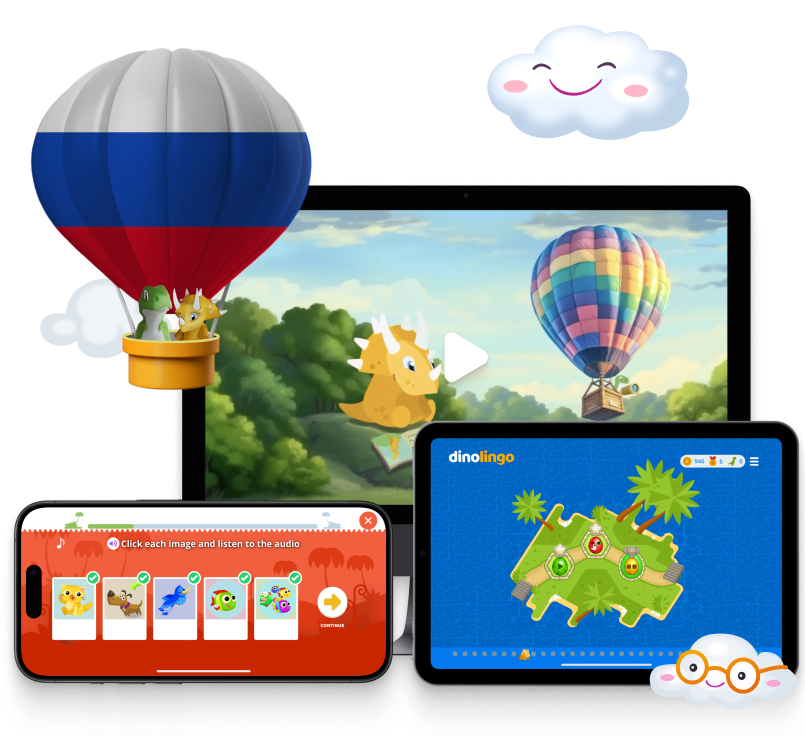
On Dinolingo, kids ages 2–14 explore these kinds of stories through animated videos and read-alongs. Magic words, heroic phrases, and silly witches all come to life!
Songs, Games, and Storytime Magic
For kids, language learning needs to be more than just flashcards and repetition. The real magic happens when Russian becomes part of a playful, joyful experience through songs they can sing, games they can play, and stories that spark their imagination.
Why Music Works Wonders
Catchy songs help kids memorize words without even trying. When children sing along to tunes like “Пусть бегут неуклюже” (Let the clumsy ones run) or the Russian ABC song, they naturally absorb pronunciation, rhythm, and new vocabulary. Repetition in music also helps cement phrases and grammar patterns. Even toddlers can hum along and say words correctly just from listening over and over again.
Play It to Learn It
Games make Russian feel like a challenge to beat, not a lesson to pass. Whether it is a color-matching game or a digital memory card match with Russian words, kids stay focused because they are having fun. Platforms like Dinolingo include thousands of interactive games and videos that help children aged 2–14 learn over 50 languages, Russian included. Each game is designed to match age and skill level, with surprise rewards and progress badges along the way.
Storytime That Teaches
Russian fairy tales and picture books introduce kids to new words in context. Hearing how characters speak helps kids learn how sentences work in a natural flow. Plus, stories build cultural knowledge and empathy. Dinolingo’s animated storytime videos are crafted for different age groups: from pre-readers who follow visual cues to older learners who read along with subtitles. Offline story printables are also available for screen-free bedtime reading.
Into the Forest: Russia’s Nature Wonders
Baba Yaga’s tales almost always begin in the лес (les – forest), and the real Russia is full of natural wonders to match. Russia is the largest country in the world, with deep forests and giant lakes that make it a dream destination for curious kids who love the outdoors. It is also the perfect way to learn new Russian words!
Here are some nature terms you will hear when talking about Russia’s beautiful landscapes:
- лес (les – forest)
- озеро (ozero – lake)
- гора (gora – mountain)
- река (reka – river)
- берёза (beryoza – birch tree)
- медведь (medved’ – bear)
Many of these words connect to real places in Russia, like Lake Baikal or the Ural Mountains. Kids learn best when they are engaged, and what is more engaging than exploring? Linking Russian words to real nature facts helps young learners remember vocabulary and enjoy the world around them. With Dinolingo, kids can explore Russian nature vocabulary through videos, games, and printable resources. From forests to animals, every word comes to life!
Furry Friends: Easy Animal Words
The forest is home to the медведь (medved’ – bear) and many other creatures, and kids love animals. That makes animal words some of the easiest and most exciting vocabulary to learn in Russian! Whether it is a favorite pet or a wild creature from a story, these words help kids feel connected, curious, and confident.
Here are some friendly Russian animal words to start with:
- кот (kot – cat)
- собака (sobaka – dog)
- медведь (medved’ – bear)
- заяц (zayats – hare)
- лошадь (loshad’ – horse)
- корова (korova – cow)
- птица (ptitsa – bird)
These words often appear in children’s books, songs, and games, so kids can hear them in context and remember them naturally. Animal sounds in Russian are different too! For example, a Russian dog says гав-гав (gav-gav) and a Russian cat says мяу (myau). Adding sounds makes language learning more playful and expressive. You can even match Russian animal names like медведь (bear) or волк (wolf) with the sounds they make or where they live. Programs like Dinolingo teach animal words with stories, animations, and sound effects that keep learners entertained and engaged.
Matryoshka Magic and Family Words
Matryoshka dolls, those colorful nesting dolls that open to reveal smaller and smaller versions, are more than just a toy. They are also a fun way to learn Russian words, layer by layer! The word матрёшка (matryoshka) comes from the traditional Russian name Матрона (Matrona), which means “mother.” The largest doll usually represents a mother or grandmother, while the smaller ones inside represent her children or family. These dolls are a beautiful part of Russian culture and they are perfect for playful language learning!
As you open each doll, say a Russian family word:
- семья (sem’ya – family)
- мама (mama – mom)
- папа (papa – dad)
- дочка (dochka – daughter)
- сын (syn – son)
- малыш (malysh – baby)
You can also use colors, numbers, or emotions, so each doll becomes a new learning opportunity. The physical act of opening each doll builds anticipation and reinforces memory. Saying a word while seeing or touching something concrete, like the dolls, is a powerful tool for early language development. On platforms like Dinolingo, kids learn Russian using similar layered learning techniques, pairing visuals, repetition, and interaction to make vocabulary stick.
Little Word, Big Family: Russian Suffix Magic
Just like a matryoshka holds a whole family inside, single Russian words grow into families of their own! How? With suffixes, those small endings that turn one word into many. It is like word magic for kids who love patterns and puzzles! A suffix is a word ending that changes the meaning just a little. For example:
- дом (dom – house) becomes домик (domik – little house)
- кот (kot – cat) becomes котёнок (kotyonok – kitten)
- игра (igra – game) becomes игрушка (igrushka – toy)
Suddenly, one word becomes many, and each version tells you something different! Suffixes help kids guess the meaning of new words, even if they have never heard them before. That is a huge win for building confidence. On Dinolingo, kids explore these word families through stories, songs, and vocabulary games that naturally show suffix patterns. Try writing out word endings like -ик, -чик, and -очка, then match them with base words to see what they create. Suffixes make the Russian language feel alive and ever-growing, and kids can be word wizards once they know how to use them!
Learn the Rainbow in Cyrillic
What better way to add to your child’s vocabulary than with a rainbow? Colors are one of the most fun and useful parts of a child’s vocabulary, and when they are written in Cyrillic, each one feels like a new discovery! Here are the colors of the rainbow in Russian:
- красный (krasniy – red)
- оранжевый (oranzheviy – orange)
- жёлтый (zholtyy – yellow)
- зелёный (zelyonyy – green)
- голубой (goluboy – light blue)
- синий (siniy – dark blue)
- фиолетовый (fioletovyy – purple)
Many of these words sound similar to their English counterparts, making them easier to remember. Plus, they are great for playtime, art projects, and nature walks. The best way for kids to remember colors is to use them in context. Point to colored objects around the house and say their names in Russian. Use crayons or paints to label each color in Cyrillic. On Dinolingo, kids can explore these words through interactive color games, songs, and stories. Each activity reinforces both the sound and the spelling, perfect for early readers and visual learners.
Big Cities on the Map: Moscow to St. Petersburg
Russia is filled with exciting cities, and each one has its own unique flavor, fun facts, and new words to learn. For kids who love maps and discovering places, learning Russian with cities is like going on a trip without leaving home! Let’s take a pretend trip across Russia, starting in the capital, Moscow, and ending in the elegant city of St. Petersburg. Along the way, kids can pick up fun Russian words used in big cities, from street names to famous sights.
Start with these well-known spots:
- Москва (Moskva – Moscow): Russia’s capital, full of museums, parks, and palaces
- Санкт-Петербург (Sankt-Peterburg – St. Petersburg): A city of canals, bridges, and beautiful buildings
- Новосибирск (Novosibirsk – a major city in Siberia!)
- Казань (Kazan – known for its mix of cultures and languages)
Start in Moscow (Москва)
Moscow is full of exciting things to see and do. Here are a few Russian words kids might hear:
- метро (metro – subway)
- площадь (ploshchad’ – square)
- музей (muzyey – museum)
- кремль (kreml’ – Kremlin)
Walking around the city, kids might hear people say Где метро? (Gde metro? – Where is the subway?) or Это Красная площадь (Eto Krasnaya ploshchad’ – This is Red Square).
Arrive in St. Petersburg (Санкт-Петербург)
This city is known for its beauty, bridges, and palaces! Some words to learn:
- река (reka – river)
- мост (most – bridge)
- дворец (dvoryets – palace)
- музыка (muzyka – music)
And some useful phrases: Это Эрмитаж (Eto Ermitazh – This is the Hermitage Museum) and Я вижу реку (Ya vizhu reku – I see the river).
Whichever city you visit on the map, a few words come up again and again: город (gorod – city), карта (karta – map), улица (ulitsa – street), музей (muzey – museum), and река (reka – river). Each city gives you a reason to explore new vocabulary, from foods to landmarks. With Dinolingo, kids can discover city-themed vocabulary and cultural insights through interactive videos, stories, and map activities that make Russian learning a real journey. Learning words from real places makes Russian feel useful, exciting, and full of adventure.
Blast Off: Russian Space Words
From big cities on the ground we can look all the way up to the stars. Space travel is exciting for kids, and in Russian it is full of awesome new words to learn! From planets to rockets, these terms spark curiosity and turn learning into an intergalactic adventure. Here are some stellar words for space fans:
- космос (kosmos – space)
- ракета (raketa – rocket)
- астронавт / космонавт (astronavt / kosmonavt – astronaut / cosmonaut)
- звезда (zvezda – star)
- луна (luna – moon)
- планета (planeta – planet)
Each word opens a door to learning about science and culture, especially since Russia has a rich history in space exploration. Want to sound like a real space traveler? Try these phrases: Я лечу в космос! (Ya lechu v kosmos! – I’m flying to space!) and Смотри, звезда! (Smotri, zvezda! – Look, a star!). With Dinolingo, kids can explore space-themed vocabulary through games, songs, and engaging animations that make every word feel like an adventure.
Tiny Time, Big Words: 5-Minute Russian Magic
Think your child does not have time to learn a language? Think again! Just five minutes a day can lead to surprising progress, especially with Russian. Tiny time blocks are perfect for busy families and curious minds who thrive on short bursts of fun. Short, daily practice is better than long, occasional lessons. It keeps kids interested, avoids overwhelm, and builds strong habits. In just five minutes, kids can learn 2–3 new words, practice pronunciation, sing a song verse, or repeat a short sentence or phrase. The key is consistency and keeping things playful and low-pressure.
What can you do in five minutes?
- Play a single vocabulary game
- Watch one quick animated video
- Use flashcards to review colors, animals, or family words
- Say a tongue twister like Шла Саша по шоссе (Shla Sasha po shossé – Sasha walked along the highway)
Platforms like Dinolingo are built for this type of micro-learning. With bite-sized lessons, quick games, and offline printables, even a few minutes can feel like a full experience. Even a tiny time investment can lead to big confidence, vocabulary growth, and excitement for learning Russian!
Creative Activities to Try
Make a Baba Yaga Mask. Craft your own witchy face and retell a story using Russian words like лес and герой. Add a walking chicken-leg house for fun!
Magic Word Wand. Pick your favorite Russian “magic word” like волшебство or сила (power) and create a paper wand with it written on the handle.
Russian Karaoke Party. Play a Russian kids’ song and let your child sing it with you! Print the lyrics and draw pictures that match the words.
Act Out a Fairy Tale. Choose a simple Russian story and act it out at home. Kids can be the bear, the bird, or the princess, learning verbs and nouns as they go.
Animal Charades. Act out different animals and guess their names in Russian. It is great for memory and movement!
Make a Russian Pet Book. Draw or print pictures of favorite animals, then write the Russian name underneath. Add stickers or fun facts to personalize each page.
Create a Word Matryoshka. If you do not have a physical doll, draw one on paper with five layers. Label each layer with a new Russian word and decorate it together.
Word Family Tree. Start with a base word like дом and draw a tree with branches showing new words using different suffixes.
Rainbow Hunt. Challenge your child to find one object for each color of the Russian rainbow. Say the word out loud as they collect each item.
Color-by-Word Art. Create a coloring page where each space is labeled with a Russian color word in Cyrillic. Your child has to read and match the right color, fun and educational!
Make a Russia Nature Map. Print or draw a map of Russia and label forests, lakes, and mountains with their Russian names. You can also mark cities like Москва or Казань and make up a short story about a child exploring that place in Russian.
City Word Match. Make flashcards with city-themed Russian words and their pictures. Can your child match дворец to a palace? Or метро to a subway?
Design Your Rocket. Draw a spaceship and label its parts in Russian: ракета, окно (window), крыло (wing), and more!
Word of the Day Jar. Fill a jar with folded notes, each with one Russian word. Pick one each morning and see how many times your child can use it during the day.
Fairy tales let kids step into a magical world while sneaking in powerful language lessons along the way. From Baba Yaga’s forest to the rainbow, the family doll, big cities, and outer space, every theme is a new doorway into Russian.
Sources
- Baba Yaga and Russian Folklore – World History Encyclopedia
- Russian Life
- The History of Matryoshka Dolls – Russia Beyond
- Culture Trip
- Russian Colors for Kids – FluentU
- LearnRussian101
- RussianLanguageGuide
- Learn Russian Step by Step
- Geography of Russia for Kids – Ducksters
- Visit Petersburg
- RussianPod101
- Transparent Language
- Fluent in 3 Months
- TED-Ed Blog
- BBC
- Cambridge University Press Blog